[deleted]
A reply to /u/TheMilkyWayMan
Er ....... 90%? That's ..... incredible. I think when we talk about such figures we have to be careful with definitions. Here's a short and sweet article online.
Infant mortality in England, meaning death within the first year, was estimated to be about 14-18% based on church records. In continental Europe that number was a bit higher, 22-28%. It's very difficult to have a better resolution, for example if we ask how many died due to disease, undernourishment, etc.
However, there were plenty of things that could and did kill young boys and girls of that era: various diseases, mishaps, incorrect treatments, etc.
We can further ask, what is the survival rate up to, say, 10 years. Estimates again vary, but roughly in England the survival rate was around 65-75%, with slightly lower in continental Europe.
But infant mortality was not 90%. Your teacher is wrong and should be challenged to provide references.
Lynda Payne, "Health in England (16th–18th c.)," in Children and Youth in History, Item #166, http://chnm.gmu.edu/cyh/primary-sources/166 (accessed February 24, 2016).
M. Lindemann, "Medicine and Society in Early Modern Europe."
W. W. Flinn, "The European Demographic System 1500-1820," Birhgton, 1981.
That is not mathematically feasible. Each family would have to produce about 20 kids on average, for the population to avoid extinction.
I can answer this for Sweden at least.
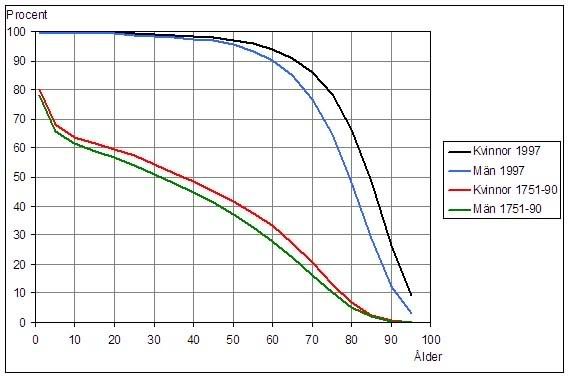
During the 18th century, the Swedish state church also kept the census, and the priest in each parish kept notes on marriages, births, baptisings and deaths. These notes have been digitalised, partially thanks to the Mormon church which has scanned tens of thousands of pages for their own family line research but also the Sweidsh Bureau of Statistics (SCB) which has made a large amount of statistics and data available online in CSV files.
As you can see, about 20% of children die before they reach the age of 1. At the age of 10, about 36% of girls have died and 39% of boys.
While it is a terrible toll, it is certainly not 90%.
No, 90% is too high. But it is worth while to read www.psychohistory.com from Llyod deMause because he is keen on statistics. His ELON (Emotional Life of the Nations) is just up to the point- his main tenet is that there is a slow evolution of empathy in history concerning how parents and children relate...and yes, in the Stone Age (if I remember well) he does mention that 90% of people were involved in homicide (and child killing -called "sacrifice"- was obligatory.
the chance of a child dying before the age of 18 was 90%
Life Expectancy at Birth is the age by which 50% of a given cohort have died (from all sources, including infant and child mortality). If 90% of the cohort is dead by the age of 18, that would imply that life expectancy in 17th and 18th Century Europe was well below 18, possibly 7 or 8 or something like that (since most of that 90% would have died at very young ages).
Your teacher is wildly incorrect here. Life expectancy at birth in Europe during that period was more like 35-40. Perhaps your teacher meant that 90% of children survived to 18, but that would actually be too high a survival rate given a life expectancy at birth of 35-40.
Your teacher might also be referring to isolated incidents where the mortality rate was much higher than the average for the continent as a whole, such as Germany during the Thirty Years' War where they experienced an overall population decline.