What exactly did "Germany" and "Italy" mean before the German and Italian states existed? In other words, suppose I went back in time to 1800 (before either state existed). What would people think if I told them I was taking a trip to Germany or Italy? Or if I told them I was an Italian or a German?
Conversely, would anyone tell me they're taking a trip to Germany or Italy? Would they tell me they're an Italian or German? Or would they refer to some other geographical region?
Did these terms even exist? Did they denote a specific region? Was it more a cultural/ethnic concept?
The word "Italia" dates back to the pre-Roman period.
Many hypotheses have been put forth as to the exact origin of the word, and many point to Greek. The Ancient Greek word Aιθαλία (Aithalìa) could derive from the root Aith- typically tied to words having to do with fire, unsurprising as the vicinity of the volcanoes Etna and Vesuvius were, for the Greeks, major points of contact with Italians (and later, important centers of colonization). The very active volcano at Stromboli, akin to a natural lighthouse bang in the middle of the sea between the greek colonies Νεάπολις (Neapolis) and Μεσσήνη (Messene) and their respective volcanoes, certainly adds to the plausibility of the early Greek mariners calling Italy "The Land of Flame." Other theories tie the roots of the word "Italia" to the Oscan Language of central Italy. Etruscans, Romans and Greeks referred to the Samnite tribes of the Italian interior as "VITELIU", an Oscan word meaning "Young Bull," an animal that the Samnite used to personify themselves. The symbol of the young bull was later adopted by all opponents of Roman hegemony on the peninsula during the Social Wars of the early 1st century B.C.E. (many of whom were speakers of Oscan or one of its dialects). After the Social Wars ended with the extension of Roman Citizenship to the "VITELIU," the the word in its corrupted form "Italia" would slowly come to be a shorthand for the peninsula. However, institutionally "Italy" didn't exist yet, and would be governed as an extended jurisdiction of the city of Rome.
Halfway through the first century Augustus would organize Italy in thirteen regions, but the word "Italia" would not refer to a definite political entity until Diocletian, in the reforms that would bring an end to the crisis of the third century, established the province of Italia subdivided in twelve "Dioceses." As for "Italians", there weren't any as of yet, rather there were Civis Romanus, or Roman Citizens, who would more likely define themselves through the most generic of the three names in the roman naming convention: their Gens and their associated origin story.
After Odoacer usurped Romous Augustulus in 476, the Emperor Zeno in Constantinople machinated to prop up Theodoric as Rex Italiae, or King of Italy in 493. The definition "Italia" here gets complicated, as it has half the trappings of a Roman province, and half the trappings of a Roman Client State. Theodoric has the title of Consul and Patrician in addition to King, but has de facto as well as some debatable de jure ability to establish his own foreign policy. We still don't have any Italians, rather we have "Romans" and "Goths" even if the distinction seems to have been more about class than ethnic background. Theodoric himself would astutely comment, "A poor Roman plays the Goth, a rich Goth the Roman."
After Theodoric's death in 526, his daughter Amalasunta attempted to rule as regent in the place of her five-year-old son Atalaric. The arrangement didn't last, and through machinations her cousin Theodahad came to rule Italy and Amalasunta was murdered in 535. Emperor Justinian didn't hesitate to seize on the flimsy pretext to reassert imperial dominion over Italy, and between 535 and 554 he would wage three campaigns on the peninsula, by the end of which "Italia" would be a Roman province once again.
The reestablished roman province of "Italia" would not last long. The Empire's resources were stretched, and with the majority of troops recalled to fight against the Persians in the east, the last great migration, the Lombard descent into Italy, could occur with supreme ease in 568. This is the first time the word "Italy" starts to fall off the map. In the long struggle between Lombards and Empire, the peninsula was divided into multiple parts: "Longobardia Major," or Northern Italy ruled by the King of Lombardy de jure from Mediolanum but de facto from Pavia; the "Romagna" or coastal area held by Byzantium around the delta of the River Po ruled by the Exarch in Ravenna; the Duchy of Rome, in theory ruled by the Roman Senate but in practice dysfunctional without intervention of the Exarch; and Longobaria Minor, ruled by Lombard Dukes.
Between 568 and 774 (the entire existence of a Lombard polity) there was no cohesive Italian territory: early on the Byzantines were able to hold the southern half of the Po floodplain and Puglia and Calabria. But eventually, the Lombards pushed them very far back. We see increasing political and organizational fragmentation in Italy, as Lombard kings delegate local rule to feudal landholders in a state of near-constant confrontation with the Empire, and naturally each other.
The Lombard King Desiderious (d. 786) got very close to finally kicking the Byzantines out of Italy. A successful offensive saw the encirclement of the Romagna which allowed Desiderious to march south against Rome unopposed. Seeing the Byzantine army pinned down and fearing a loss of independence for the bishop of Rome who had been pretty much guaranteed a free hand to rule the modern Lazio in exchange for Byzantine military access, Pope Adrian cried "Uncle", excommunicated Desiderius, and asked Charlemagne to come to his aid. Charlemagne, even though he was busy conquering what would later become Germany, was immediately flattered and marched for Italy.
The term "Regnum Italiae" emerges after over two hundred years in 781, to denote the conquered Lombard lands given to Charlemagne's third son Pepin. The "Kingdom of Italy" doesn't refer to the entire peninsula though, as southern Italy had never been conquered and is still ruled by Lombard dukes. Italia refers to the northern portion of the peninsula, while the southern part was "Longobardia".
The monuments constructed in Benevento, the Lombard capital in the south, would lead it to be called, "The Second Pavia," while the nearby city of Salerno would become a major Mediterranean entrepôt and come to house a renowned school of Medicine. Encroachments by the Carolingans were successfully repealed, either by force of arms or diplomacy. However, instability would be a hallmark of the principality; until the Muslim Conquests, the Byzantine Empire would always hold the regions of Calabria and Puglia, while dynastic infighting would split the kingdom three ways by the mid 9th century; the Duchy of Benevento, the Duchy of Salerno, and the Republic of Amalfi.
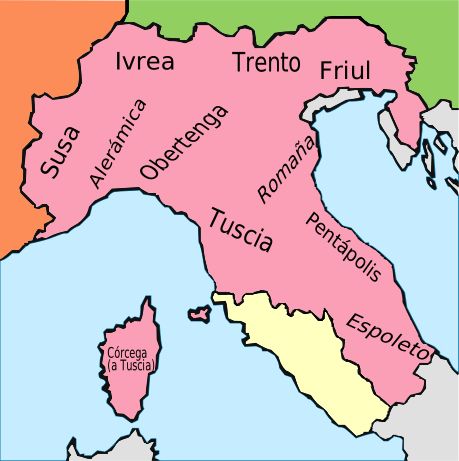
After Pepin's untimely death and the wars of succession following Charlemagne's death, the Kingdom of Italy was given to Lothair (a grandson of Charlemagne) in 795. The uneasy but relatively stable transitions between emperors in the "Crownsharing" deal under the Carolingan dynasty would end in 887, after the deposition of Charles the Fat. Charles was the last Emperor to simultaneously hold the title of King of Italy, France, and Germany, and had been elevated to the Imperial Throne from the position of King of Italy. However, Charles possessed no direct heirs. The fight between innumerable female-line descendants was on, foremost of which were Berengar, Marquis of Friuli, and Guy, Duke of Spoleto. Partly because of the distance separating Friuli and Spoleto (the map is anachronistic) no pretender to the crown was able to assert himself. An incursion by Emperor-elect Arnulf, King of France and Germany (but not Italy) in 894 didn't help the situation either
Who was "Italian" at this point in time? Tough to say. The earliest examples of what can be called written Italian appear in Benevento in the ninth century, but as stated above Benevento and the south of Italy was "Longobardia," while "Italia" was the northern portion, with its crown contested first by a Friulian and a Spoletian.
After the resources of the Italian lords seem spent, the Kings of Burgundy and Provence contested the title until Berengar, Marquis of Ivrea and grandson of the deposed Berengar of Friuli machinates the support of Emperor Otto and is crowned King Berengar II, until Otto decided to take the crown for himself.
The Ottonian Emperors Otto I, Otto II, Otto III, and Henry II would all travel to Italy to be crowned King of Italy by an Italian Bishop (if he was the Bishop of Rome or Milan was of little consequence at this point). Absurdly, the Ottonians came to rely on Italian revenues to contrast the unruly vassals in Flanders, Bavaria and Luxembourg. With the Italian lords having fought themselves into irrelevance in the early tenth century, Italy came to be one of the most centralized parts of the Empire. With the revival of the old Roman cities (and decline of the landed nobility) one of the wealthiest too. Until, alas, Henry II died without issue in 1024. And here it gets interesting, because although Conrad is elected emperor with minimum fuss in Germany, in Italy his ascension is not entirely recognized.
NOTE: When I talk about France and Germany in the context of the Carolingian empire, I mean "Western Francia and "Eastern Francia/Alemannia" respectively.
As a follow-up: did Austrians identify as Germans before the creation of Germany? If so, when did they stop?
The terms Germany and Italy date back to the Romans (Germania and Italia, respectively). Germany was always poorly defined by the Romans; when it crops up in Roman records, Germania seems to just mean "stuff on the other side of the Rhine." Those Roman conventions carried over into the Middle Ages, through the Renaissance and the Reformation, and finally to the advent of the modern nation-states of Italy and Germany.
The exact borders of these regions changed over time. But, for the most part, they roughly correspond to today's borders. Italy was divided in half at one point (between the Kingdom of Italy, part of the Holy Roman Empire, and the Kingdom of Sicily... which would become the Kingdom of Naples and then the Kingdom of Two Sicilies before it was annexed by the Kingdom of Sardinia-Piedmonte). Borders sometimes changed drastically (Sicily, Sardinia, and Corsica weren't considered part of Italy until c. 300 AD and Corsica today is part of France, not Italy), and cultural influences shifted, but for the most part, Italy was still Italy. The situation in Germany roughly parallels that of Italy.
It's important to realize, however, that people living in these places would have considered themselves citizens of their city first, their local state second, and their region last. A trader out of Venice, for instance, would consider himself Venetian before he considered himself Italian. The fact that there was a great deal more variation in regional dialects in the Middle Ages certainly contributed to this.
We can see this in action in Machiavelli's The Prince. At the end of the book, Machiavelli essentially makes a case for Italian unification. He indicates several times in that work that Italy must unify to prevent foreign powers from meddling in the peninsula. But despite that, he dedicated his life to the service of Florence, not Italy. Even after the Medicis exiled him, which would have given him (and his by this time extensive service record) the opportunity to find employment anywhere else on the peninsula, he still maneuvered his way back into Florence. He dedicated the last years of his life to acquiring an appointment in the Florentine court in spite of everything.