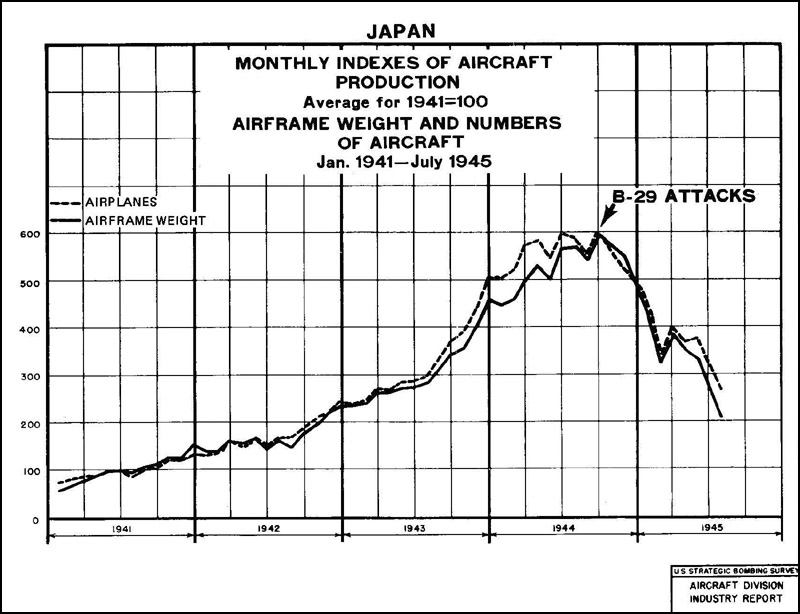
As others have pointed out already, the japanese air/naval power was pretty much destroyed in the latter months of the war. Just like with the european theatre, by the end stages of the war, the US and our allies completely controlled the seas/skies. Before Enola Gay, a significant amount of japanese cities had been firebombed into oblivion for months/years without any significant japanese resistance.
But one thing that hasn't been mentioned so far is that as important as the destruction of japan military capabilities were at the time, japan's loss of overseas territory and resources ( particularly oil ) was even more devastating. Japan is a relatively resource poor nation and once they lost their overseas territories, they lost the energy sources required to fund their military-industrial complex and to fuel their military. Even if they had airplanes, if you don't have fuel for those planes, they are pretty much useless.
Others have covered Japan's decimated military power, but there's a bit more to it. The Americans had been flying weather planes over Hiroshima every morning. The purpose of weather planes was to scout conditions in order to plan for a potential attack later in the day. These planes flew alone and at a higher altitude, as opposed to bombers, which came in groups and flew lower. The Enola Gay itself was misidentified.
A piece written in the New Yorker a year after the bombings confirms this. I highly recommend the read - it compiles the accounts of six survivors, and the description of human suffering is horrific.
A few minutes after they started, the air-raid siren went off—a minute-long blast that warned of approaching planes but indicated to the people of Hiroshima only a slight degree of danger, since it sounded every morning at this time, when an American weather plane came over.
Did any country scramble their planes when they saw a single bomber overhead?
USAAF B-29s started bombing Japan in 1944, from China in July and the Mariana Islands in November. Similar to the strategy employed against Germany, they first targeted the Japanese aircraft industry. Though early raids were not always accurate or successful they did force the dispersal of aircraft production, the later area incendiary attacks continued the process. (The Strategic Air War Against Germany and Japan: A Memoir, Haywood S. Hansell, Jr; he includes [a Strategic Bombing Survey graph of aircraft production] (http://www.ibiblio.org/hyperwar/AAF/Hansell/img/p226.jpg)).
The capture of Iwo Jima in March 1945 allowed long range fighters to escort the B-29s, but by this time attrition had already severely weakened the Japanese air forces: "... by late spring and summer Japanese air strength in the home islands deteriorated so rapidly that bomber formations again went out unescorted" (The Army Air Forces in World War II: Volume V).
Before the atomic bomb missions, then, Japanese air defences were almost non-existent. The first practice missions of the 509th Composite Group were flown in July; "After June 26, Japanese fighters were rarely encountered in numbers (...) The JAAF was virtually powerless to react against the invaders, and it was told to keep its remaining aircraft in reserve for the final battle, expected in the autumn. Japan's industrial power had been weakened, and the means to defend its airspace was lacking." (B-29 Hunters of the JAAF, Takaki & Sakaida).
As mentioned in a few posts, there were flights of small groups of B-29s, so the atomic bomb missions themselves were not seen as particularly unusual, but that wasn't the primary reason that they were not intercepted. To quote my post from [a previous thread] (https://www.reddit.com/r/AskHistorians/comments/35si0z/the_enola_gay_was_able_to_fly_into_japan_without/):
"Several small raids were made in July and August, but to say "the purpose of such flights were to wear down the alertness of Japanese anti-aircraft defense crew" isn't entirely accurate.
The raids were carried out by the unit formed to drop atomic weapons, the 509th Composite Group, using "pumpkin" bombs that simulated the size and weight of the Fat Man atomic bomb. To gather data and gain experience the 509th first flew training flights around outlying islands such as Rota and Marcus Island, then from July 20th there were 18 bombing sorties of two to six Silverplate B-29s against targets in Japan, starting with Koriyama, Fukushima, Nagoka and Toyama.
As others mention in this & the other thread, Japanese air defences were all but destroyed by this point; only the heaviest anti-aircraft guns were effective against B-29s flying at 30,000ft and these were in short supply. The 509th suffered no losses during the "pumpkin" missions, only one B-29 suffered minor damage.
One of the goals/benefits of the missions was that small groups of B-29s on bombing missions (the 3rd Photo Reconnaissance Squadron had been flying over Japan in F-13As, the reconnaissance version of the B-29, from late 1944) were not sufficiently unusual to provoke a response from what was left of the Japanese air defences, had they been capable of such. Japanese radio even commented on a single B-29 bombing Tokyo, a "pumpkin" raider whose primary target was obscured by clouds, and switched to Tokyo without authorisation."
did the pilot dropping the bomb get hit by the mushroom cloud or suffer any ill effects/fall out afterwards?
Not sure how I'd feel having taken part in one of the largest massacres in the world, albeit one that heavily contributed to the end of the war.