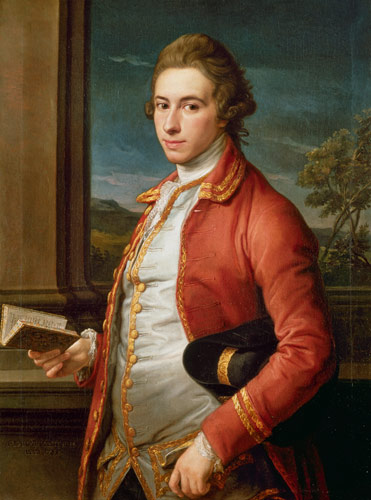
I'm thinking of the Founding Fathers here but any and all information is welcome. Were they like hats that it was just polite to wear in all situations? What's the reason for those hairstyles being proper? If someone could just explain this whole thing to me I'd really appreciate it.
There is rarely ever a "reason" for fashion being the fashion. That is, there is no sensible, logical, eternal reason for doing it or we'd be doing it now, right? So I don't think I can "explain" anything to you, except give you a run-down on how fashion got to that point.
BTW, many of the Founding Fathers didn't wear wigs. Franklin didn't. Jefferson didn't. That's why you can see his hair is red in his portraits. Washington didn't: that's his own hair. That's just the big names off the top of my head. Now John Adams did wear a wig, and as late as James Monroe we have a president in a powdered wig.
Back in the early 1600s, men wore their own hair, more or less long. Depending on the place and the year, it might be mostly above the collar with a single long lovelock tied with a ribbon (there was a whole language of ribbon colours), or it might be long all around, with or without lovelock tied off. This was a transition from the earlier short hair worn with big ruffs. Obviously long hair doesn't work when you're a head on a platter. So part of losing the ruff (actually, it collapsed downward, then became a deep collar with lace edging) was being able to grow hair longer. You usually see this in Three Musketeer movies (here's Frank Finlay in costume).
But that's the reign of Louis XIII, and the lead-up to the English Civil War. (Here's Charles I and his adherents) But it's hair today and gone tomorrow for most of us as time passes. Refusing to accept this, in 1624, the prematurely balding Louis took to wearing a wig, and this style is usually called a peruke. So all his courtiers did, too. Then everyone else with any pretense to fashion had to.
When Louis XIV, the Sun King, came to the throne, everything just had to be more so. He wore his curly hair very long, and what the Sun King did, every French nobleman did. Here he is in 1685
This also took on across the Channel. There's a charming section of Samuel Pepys's diary in 1665 when he first wears a peruke or periwig (to church, of course) and is so self-conscious of it, only it turns out that no one seems to notice, dammit. About this time King Charles also finally dumped doublets for "the Persian fashion" of a vest, coat, and breeches, creating the modern suit in its earliest incarnation.
So that's where the wigs being something everyone just had to wear began.
For some reason buried in the depths of time, in the mid 1700s fashionable people began powdering their hair or wigs (women usually wore their own hair, later with extensions). Possibly it was done to compliment aging monarchs. (Here we see it on George II of England) You can also see it's still mostly perukes, all those curls hanging down.
In 1761, at the coronation of George III, Hogarth lampooned the many styles. While some are showing side rolls, may are just more or less long, but there's also a short bushy style. It's a bit after this that the naturally white wig, made of horsehair, began to be used, which saved on all the powdering mess for men who had something to do, whether, lawyers, judges, or military officers. For some of these, the wig, like the medieval robe, fossilized into part of their formal costume in Britain.
By the 1770s, wigs were actually starting out of fashion. Young men, the ones without bald spots, were taking to having their actual hair done up and powdered, just like their sisters. In 1795, the British began taxing hair powder, to raise money, and that shot it right out of fashion.
On the other hand, men wearing wigs because they're losing their hair continues right to one of the regulars on my commuter bus. George IV notably went to one, but in chestnut brown and the short Titus cut.
LSS: It was a fashion. Fashion just is.
Keep in mind that it was a society rule to always have your hair "dressed" at this time (and really up until the 1960s). This doesn't mean you have to have an elaborate style all the time, wearing a cap also constitutes finished hair, but for a man their working caps were not fashionable or formal. This meant they had the choice, if they were the sort of person who dealt with formal situations regularly, to grow their own hair out to a fashionable length, add hair pieces, or wear a wig. Part of this choice might come down to things like hair loss. And, if you think about it, wouldn't it be nice to have your hair fashionably styled every day and you could just pop it off at night, sleep however you want, and it'll still be perfect in the morning?
/u/Zither13 did a good overview of hairstyles throughout the popular history of the wig, but I'm going to focus in on the 1770s and 1780s since that was the Revolutionary period. Every time period has aesthetics that it likes. At this point in time symmetry was still very popular (not so much in the 1790s) and proportions tended to be in a 1:2 or 1:4 ratio. If you look at where the curls sit on either side of the head they sit near the top of the ears at the level of the eyes. If you've ever taken a drawing class on the human figure, the head is shaped and a cross put on the face quartering it. This horizontal line gives you eye level as well. Putting this fullness on either side of the head at the line gives a very even proportion to the face. This portrait shows how some hair height on top can also work to create balance if the face is not. In a practical sense it also allows for a hat to be work without disturbing the hair. As for the queue in back, hair left down and untamed would have left it tangled and dirty (smoke, grease, dust, and more get into our loose hair every day). Wrapping the queue, clubbing it, or placing it in a small bag did even more to keep it clean. As we move into the 1780s there is a stronger and stronger Classical influence, eventually leading to the short cut being popular in the 1790s. Mens hair is a little looser around the head and one can start to see imitation of those Classical hair shapes.
And as a quick note, because in any conversation about wigs it comes up, they were not worn for cleanliness reasons. Both wigs and hair were kept clean and healthy through use of pomade and powder. Lice and other such pests prefer clean hair (hence their love of children). Think of this regiment as a conditioner and dry shampoo. It was combed through very often to prevent build up of natural oils and reapplied every week or two to cleanse the hair. Extra powder is applied to the finished style for appearance or to keep areas from being too oily (like dry shampoo). I can personally attest to it's function.