Edit: It seems I misread OP's question a bit. My point remains the same though: It is very much possible to correct misconceptions on the Holocaust without coming across a denier depending on how you do it and what arguments you employ.
If I am understanding the question the right way, the answer is no. With the wealth of resources on the Holocaust that are out there, there is just no reason or subject where an encounter with denialist/revisionist literature would be unavoidable unless someone would be seeking for their misconceptions to be validated.
Holocaust deniers and revisionist tend to built upon public misconceptions about the Holocaust though. It is their core method to cherrypick their sources and facts and built a narrative from that, which to someone seeking to validate his own opinion or someone having little to no information at hand seem plausible.
One such example is the issue of the Hitler order:
Deniers and revisionist will argue that because there is no singed order for the Holocaust by Hitler that either the Holocaust did not happen or that Hitler did not know about it. They will ignore the wealth of evidence that exists for the Holocaust such as the Wannsee Protocols or the Korherr Report among others and latch onto the fact of the missing order to distort the whole narrative. However, there is a wealth of literature explaining, why there is no written, signed order for the Holocaust by Hitler including books by people that are very easy to find and have almost become household names to anybody interested in the topic such as Richard Evans, Christopher Browning, and Ian Kershaw.
Another example is the gas chambers:
Building on the prominence of Auschwitz and the method of gassing people, deniers/revisionist will argue that the gas chambers neither didn't have the capacity to kill 6 million people. Well, here again, every book giving a general overview of the Holocaust found in a bookstore will give you the info that a huge number of victims of the Holocaust were not gassed and not killed in Auschwitz. Many people died either through the Einsatzgruppen or in the Aktion Reinhard Camps etc.
The point I am trying to make is that every misconception that there is about the Holocaust can be addressed by historical literature that addresses the subject in a historical, i.e. not revisionist/denialist, manner. There simply is no topic where contact with revisionist/denialist literature would be unavoidable if someone is genuinely interested in the topic. Especially since denialist/revisionist literature in book form is not that easy to come by (i.e. you can't walk into the next Barnes&Noble and pick up a copy of David Irving or Ernst Zündel).
The danger of the situation rather lies with denialists/revisionist specifically spreading misinformation in order to promote their underlying anti-Semitic agenda (several places on reddit and other popular internet venues like NationStates are perfect examples of this). These people spread misconceptions and built upon them rather than addressing them.
Sources:
Evans, Richard J. Lying About Hitler: History, Holocaust, and the David Irving Trial. New York: Basic Books, 2001.
Gottfried, Ted. Deniers of the Holocaust: Who They Are, What They Do, Why They Do It. Brookfield, CT: Twenty-First Century Books, 2001.
Lipstadt, Deborah. Denying the Holocaust: The Growing Assault on Truth and Memory. New York: Free Press, 1993.
Shermer, Michael, and Alex Grobman. Denying History: Who Says the Holocaust Never Happened and Why Do They Say It? Berkeley: University of California Press, 2000.
Zimmerman, John C. Holocaust Denial: Demographics, Testimonies, and Ideologies. Lanham, MD: University Press of America, 2000.
One very specific misconception is the use of the gas chambers in Dachau and the different roles of the KZ vs the VZ camps.
Dachau was one of the few western concentration camps and notably was a KZ (konzentrationslager, concentration camp) and not a VZ (extermination camp). The role of Dachau was to provide slave labour to the surrounding industries in Bavaria. Most inmates in Dachau were not actually in the main camp most of the time, but rather in smaller industry-centric subcamps. For an understanding of how extensive the subcamp system was, see this image of the subcamps of Buchenwald (another western KZ).
There were many executions at Dachau, most notably of Soviet prisoners of war and of 'difficult' prisoners. However generally, prisoners who were deemed unfit to work were sent to the eastern camps for extermination. The closest of these was Mauthazen in Austria.
The typhus outbreak in late 1944 and early 1945 caused a large number of the approximately 30,000 deaths recorded at the camp. It is stated in multiple sources that this was viewed primarily as a labour-supply concern by the administration. The gas chambers were constructed to sterilise garments and linen to attempt to limit the spread. They were repurposed to also allow for exections, however from my understanding, they were never actually employed for this purpose.
In brief, to answer your question directly:
The public often believe that the concentration camps were purely extermination centers. In reality, many camps had a near total focus on slave labour, and relatively few died in such camps (e.g. 30,000 primarily from disease in Dachau from 1938-1945 vs. 1.1 million executed in Auschwitz-Birkenau or 900,000 in the tiny Treblinka extermination camp in just one year). The gas chambers in Dachau were not, to my knowledge, used to kill people.
I'm not sure that mentioning it would make one come across as a denier/revisionist, but a lot of people don't seem to realize that antisemitism was not restricted to just Hitler and the German population. Antisemitism was extremely widespread through the 1930's, which made it easier for the Nazi party to round up "political prisoners" from the territories that they occupied.
In the 1936 Berlin olympics, the US pulled its Jewish track and field athletes from the games to appease potential political tensions that could arise if our athletes competed. We also rejected a refugee ship of approximately 900 Jewish people attempting to flee Germany. This isn't to say that the US was okay with Hitler's beliefs toward genocide, but it's to illustrate that other nations weren't doing much to prevent his actions.
this map shows the murder rates of Jews in various European countries, not all of them under Nazi control.
I'm not sure if this is what the question is asking, but I heard a researcher from the USHMM give a great talk a number of years back in Boston.
Afterwards, he and I were talking shop, and I asked him what the most common misconception he commonly faced in his public presentations.
What he answered really stuck with me, namely:
Most Americans (and especially American Jews) imagine the Holocaust primarily as the story of Anne Frank... in other words, as integrated Jewish families in Western European cities, increasingly isolated, being legally discriminated against, hiding and ultimately being arrested. Of course, this happened a great deal... particularly in Western European countries, from which many Jews ultimately managed escape... including to the US. So it makes sense that this is a common "memory" of the Holocaust in the US.
But that was a very small part of the Holocaust. The bulk of the Holocaust consisted of armies marching into villages, rounding people up, and shooting them en masse, or throwing them onto trains to death camps. In other words, it was a much more militarized, much more transparently-violent. It was a massive assault on millions of helpless civilians. And very, very few survived this. So it is not in the "memory" of the Holocaust.
Hi there! I wrote my honors thesis on online Holocaust Denial and have just started on my doctorate on online Antisemitism. Your question is an interesting one, because depending on what regional perspective you are looking from, there are numerous "misconceptions" that have been exploited by Holocaust Deniers.
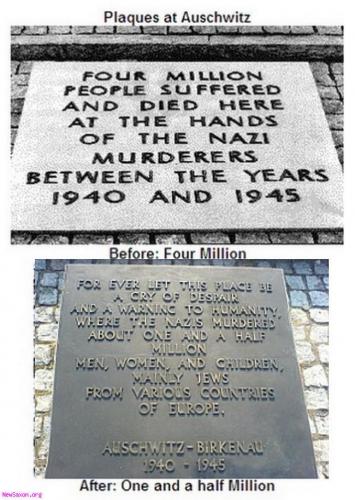
For example, Holocaust deniers often make the argument of the "shrinking Holocaust" or "shrinking Auschwitz" based on a disparity between sources on the death toll at Auschwitz. Basically, while the Soviets controlled Poland, they erected a plaque at Auschwitz that commemorated the "4 million killed" at Auschwitz. Then in the 90s, when the iron curtain lifted, the plaque was replaced with one commemorating the "1.5 million killed" at Auschwitz - and yet the overall death toll of "6 million" stayed the same, which Holocaust deniers tried to exploit as evidence that the numbers behind the Holocaust death toll were fabricated.
This of course was nonsense. The Soviet estimate of those killed at Auschwitz was grossly inflated, and never agreed upon by Western Academics. In fact, the first major historical work on the Holocaust, The Final Solution by Gerald Reitlinger (1953), claimed only 0.7-0.8 million died at Auschwitz based on available data. Of course once the iron curtain lifted and western academic thought reclaimed the historical sites in the east, the plaque was corrected.
However this discrepancy, while ultimately benign, can easily be made into a meme (like this) comparing the two plaques which clearly cannot be easily explained by any ordinary member of the public. This type of misinformation has been used to considerable success with the rise of the internet.
I would have gone into more detail, but others seem to have beaten me to this thread. I will advise that the post by /u/commiespaceinvader is terrific and has the best sources for dealing with this information at the bottom of his/her post.
Another question: I read that Auschwitz had a brothel that the guards used, and that sometimes the guards would let certain prisoners use the brothels in their place. Is there any validity to this? In school when I said that I had come across this, my teacher told me I was making things up. I believe the book was "Auschwitz: A New History" by Laurence Rees.
I believe that I read this in Lipstadt's Denying the Holocaust, but it has been 15 years since I've read it, so it might be somewhere else.
The idea of the crematoriums being able to burn up so many people that were largely emaciated would have required much more fuel than the camps actually used. In a regular crematorium, there is enough fat on the body to keep the fire going once things are rolling. Many of the people that were burned in the extermination camps were emaciated, so they didn't have any fat that would keep the fires going without constantly fed by additional fuel.
Lipstadt (I think) explained this by claiming that once the fires got rolling, even though the bodies were emaciated, it just required a bit more time than it would with a normal body to become a self sustaining fire and cremate the bodies.