I'm watching a documentary about Stalin and I've noticed that he has his left hand at his heart inside his jacket, like Napoleon had.
I think Napoleon had a disease that causes him to do it, but why did Stalin do it?
Stalin was 160cm so maybe he identified with him in some way...
Edit: It might be as simple as to keep it warm... His other hand is in his pocket. Not sure if there is only one pocket in his jacket for a hand
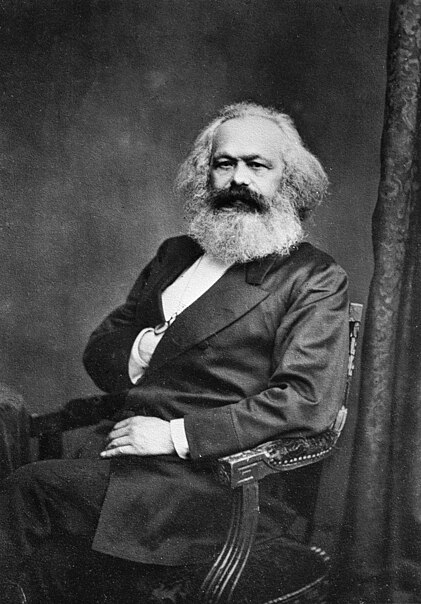
The symbol of a hand within the jacket is known as "Hand-In-Waistcoat", and is a symbol used in official portraits and photos to symbolize calm yet firm leadership. The pose has traces in the Classical era, where Aeschines suggested that for a speaker to speak with their arm outside of their toga could be seen as bad manners.
Other examples of this pose being used in history besides Napoleon and Stalin are Emperor Pedro II of Brazil, taken in 1851, Karl Marx, taken in 1875, and George McClellan in 1861.
The hand-in-waistcoat position in portraits is heavily drawn from the style of the Ancients. The styles of antiquity (or perhaps more accurately, what people thought the styles of antiquity were) had considerable influence over portraiture. Portraits were a way to express a person's character and artists looked to the guidelines classical writers had laid down for great orators.
The hand-in-waistcoat pose appears first as French social etiquette, with the earliest depictions appearing around 1680. The pose came to denote good breeding, and eventually became codified when Francis Nivelon wrote in "A Book of Genteel Behaviour" (1738) that it showed "manly boldness tempered with modesty". Its popularity in portraits grew until it reached levels of cliche in England. Thomas Hudson (1701-1799) painted so many portraits in this pose that his ability to paint hands was actually called into question.
The pose's strong association with Napoleon (due to David's famous 1812 portrait) ultimately led to its decline. When Napoleon fell, the pose came to denote pride rather than good breeding and fell out of favour.
It's possible that Stalin used this pose to draw a comparison to Napoleon. Napoleon proclaimed himself the end of the revolution, and it's perhaps Stalin used this pose to suggest the same. The Head of the Provisional Government Alexander Kerensky saw himself as a Napoleon and it has been suggested that his arm being in a sling during his visit to the Front in 1917 was perhaps aimed at evoking this association.
Sources: Meyer, A. (1995). Re-dressing Classical Statuary: The Eighteenth-Century "Hand-in-Waistcoat" Portrait. http://www.jstor.org/stable/pdf/3046079.pdf?acceptTC=true (paywall)
Figes, O. "A People's Tragedy: The Russian Revolution 1891-1924", page 411.