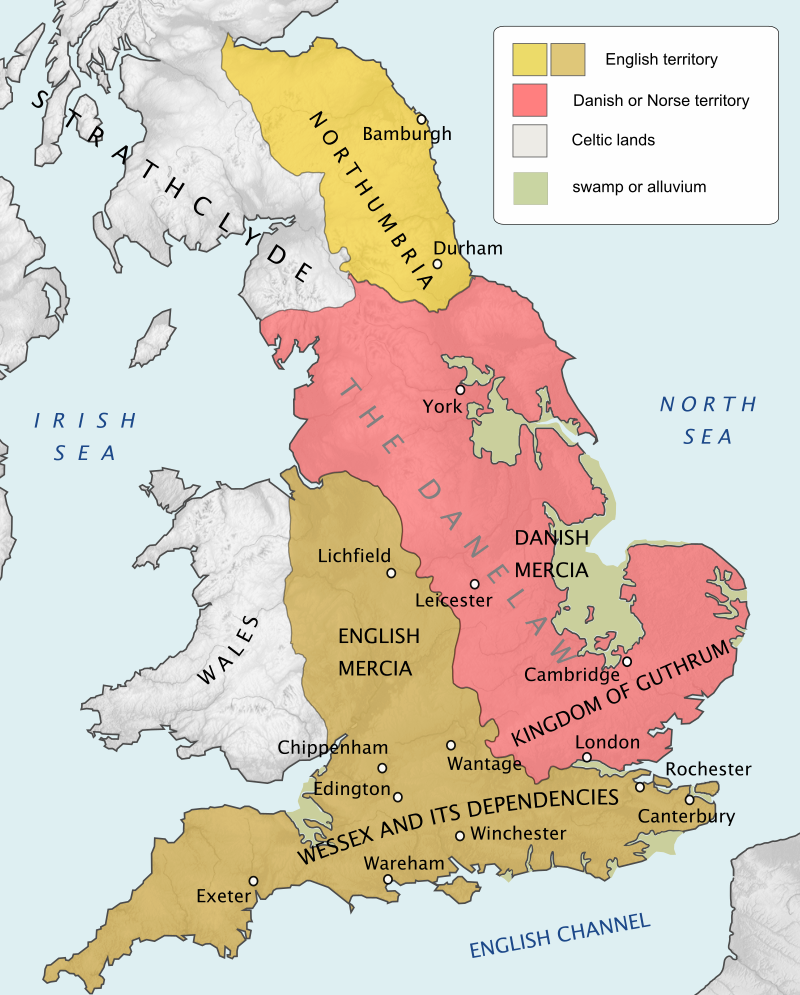
In English schools, children are always taught about the Celtic, Roman, Anglo-Saxon, and Norman periods of English history. The occurance of Viking raids is also usually mentioned, but they're almost always portrayed as foreigners who came to rape and pillage.
Consequently, very few people are aware of the Danelaw, the Norse colonisation of a huge area of England. Is there any particular reason that this period is so often omitted?
As a side question, is this history well known in Scandinavian countries?
The question is generally not down to curriculum, for the first 3 years there is not really (with a couple of exceptions) specifically mandated topics which have to be covered for state schools (and certainly private schools). In fact in its most recent incarnation the National Curriculum demands state schools have to teach at least some pre-1066 stuff. Thus in theory therefore schools can perfectly teach Danelaw.
The reasons behind the relative dearth are twofold, firstly the legacy of 1066 and the perhaps slightly irrational belief in it as a 'bookend' of British History has meant that for many a curriculum it is an ideal starting point. Thus in the first 3 years even if there is some inclusion of pre-1066 it is likely to be a token amount. Additionally since the majority of schools tend to stick to a chronological history over the three years (and others reduce non-examined parts to two years) this period is usually one of the first topics 11 year olds study coming into school. As such as a general rule it is mostly glided over with out any real depth of study for fear of the relative lack of ability (primary school history is generally appalling) and the need to get to the perceived 'more managable' story of William the Conqueror. Essentially this relegates the world of the Anglo-Saxons and Danelaw to a 'warm-up', fetishising certain cultural tropes but not really getting to grips with anything as complex as Danelaw or Anglo-Saxon society/politics. By the time they have developed the intellectual acumen and confidence in History to get to grips with topics such as Danelaw in any real appreciative way students have usually be whisked along the narrative timeline to the Medieval era.
It is worth noting that pretty much all GCSE and A-Level options (which then de facto sets the History experience for all those older than 14) have historically started after 1066, even the earliest options. There has again been some change recently with one or two courses essentially still being focused on 1066 but with a nod towards Britain before it. The exception is OCR (one of the many exam boards) which offers at A-Level (among around 60 other options) two discreet units pre-1066 one on Alfred the great and one on 'Viking Britain'.
So is it time to rejoice for an impending resurgence of dear old pre-1066 historiography? Sadly not. These options are relatively unlikely to be selected by schools. Aside from certain (generally top end) schools selecting them for a perceived prestige value there is not the skill-set among the History teaching profession for this period. Most departments will perhaps have one person who is informed around this period, and the inertia once the course materials have been written, lessons planned, tricks learnt and textbooks bought wards against change to the curriculum once it has been set, often years before. This serves to 'pickle' the subjects selected to a relatively narrow post-1900 topics or Tudors/Stuarts despite the efforts and desires of incoming staff.
This lack of awareness among teachers (not necessarily understanding as this can be learnt) causing a rejection of its selection is an issue which is key. The Anglo-Saxon and Norse program at Oxford is suffering even worse than Classics in terms of uptake. They have taken to offering free whole-day courses for any teacher to make them aware of the subject and hopefully push their subject into the classroom. I went on it and it was really good (one part looking at Welsh in the period to decode difference in world view on regional levels) however fear that with the best will in the world the opportunity to really spread it has been missed with the new curriculum rollout which has done little to make the period more attractive to schools. Most schools should have made their decision now and from what I have seen the pre-1066 world has not be taken up. This is due to the period suffering lack of expertise around that period, a lack of experience of the topic among students (as they only covered it briefly aged 11) and sense of the pre-1066 'other' adding a mystifying edge to the topic. This in turns gives the impression that this option is 'too hard' for students to understand and in a world of standardised testing and performance related pay too much of a risk. This in turn means that aside from a few lessons at the start of Secondary school pre-1066 Britain will never be covered by most students.
There are, of course, exceptions. Particularly in the private sector, and particularly the middle-to-upper schools trading on a reputation beyond simply exam results these pre-1066 topics make an appearance in the 'knowledge curriculum'. Anglo-Saxon and Norse history has an association with the 'proper', 'traditional' and 'elite education'. Part of me fears that this educational 'iconography' of 'culturally significant prestige 'higher' topics' that Anglo-Saxon/Danelaw Britain falls into is actually counter-productive. Part of the big problem Classics and Ancient History has had is that it is seen in the same light thus shunned by the vast majority of state schools as 'not for them' horrifically limiting its uptake and thus higher education programs. This is because due to it being seen as a prestige subject it is the staple of many private schools and top end state schools making a point. However as such it is viewed with suspicion by management and some teachers in the state sector as almost being the same as other private school ritualisms such as rugby teams, boarders, divisionals, meaningful house systems ect. and thus dismissed as not something that happens in state schools. Again even here there are exceptions, particularly among top end state schools or departments with medievalists or Anglo-Saxon/Norse specialists in charge (medievalist teachers often have a similar chip on their shoulder for the same reasons) who thus can direct the options selected.
Overall there is no reason why it should not be taken but the weird nature of British education means that it currently is not, and despite some progress is unlikely to much more for a while.