This is a very politically-charged question, so I'm looking for a more unbiased historical opinion of how Reagan contributed to the end of the Cold War.
How did Reagan contribute to the end of the Cold War? It was almost certainly some combination of:
What was the precise combination of these things? It seems like #1 is what you see most conservatives pointing to as the biggest contribution, whereas liberals are more likely to point to #3 (or #2 if they're being generous). It seems to me that there's merit to each of these arguments. It's difficult to argue that Reagan's foreign policy played no role. Yet it's doubtful that had Reagan been president say during the Truman administration, he would have been able to end the Cold War.
Some more specific questions:
I've copied this comment from a previous question that asked "In what ways did Reagan deal with the Cold War?" I believe it answers most of your questions.
Generally speaking, we can divide the Reagan administration into two distinct periods. The first, from Reagan's inauguration to late 1983-early 1984 was defined by bellicose rhetoric and aggressive action against the Soviet Union. It was in this period that Reagan spoke of the Soviet Union of an "evil empire" and stated that Marxism-Leninism would end up on " the ashheap of history." Reagan backed up this confrontational rhetoric with action. In 1981, he instituted the largest peacetime military budget in U.S. history—roughly thirty percent of the entire federal budget. He additionally proposed the creation of a Strategic Defense Initiative (SDI) that would create a “nuclear umbrella” of spaced-based missile defense technology that could protect against any incoming Soviet missiles. It's difficult to overstate how much Gorbachev initially feared SDI, as he believed that the United States would actually use the technology, nominally for defense purposes, as an offensive weapon. As many critics said of SDI, Reagan was attempting to militarize outer space.
Reagan supplemented the anti-Soviet hostility inherent in SDI’s proposal with even more overt acts of American militarism. In 1983, he approved the commencement of Able Archer, a military exercise meant to test the United States’ nuclear capabilities in the case of war against the Soviet Union. As a part of the exercise, the U.S. Pacific Fleet conducted its largest naval exercise in history right next to Soviet waters. Tensions between the two superpowers neared a boiling point on September 1, 1983, when a Soviet fighter jet shot down Korean Air Lines flight 007, which had inadvertently crossed into Russian airspace. Two hundred and sixty-nine people died, including sixty-one U.S. citizens. By 1983, Reagan’s bellicose rhetoric and policies, in addition to the Korean Air Lines tragedy, heightened Cold War superpower tensions to their highest level since the Cuban Missile Crisis in 1962.
Reagan additionally heightened Cold War tensions through his support for various Third World insurgent groups that were fighting communist-supported governments, most notably in Afghanistan and Nicaragua. Reagan wanted Afghanistan in particular to be the Soviet Union's equivalent to the U.S.'s Vietnam War.
By 1984, a more focused foreign policy agenda within the administration, international pressure from American allies, and Reagan’s desire to dampen hostility between the two superpowers led Reagan to adopt a more cooperative approach toward the Soviet Union. Equally important to this transition in superpower relations was the rise of Mikhail Gorbachev. The U.S. saw Gorbachev as a reformer, someone who the U.S. could work with to lessen or even end the Cold War. The Reagan administration took a less aggressive stance in part to ease Gorbachev's domestic critics that were arguing for a more hardline stance against the U.S. The last thing Reagan wanted was for aggressive U.S. actions to lead to Gorbachev's ouster as Soviet premier and the arrival of a much less cooperative Soviet leader. In many ways, this policy of cooperation continued under George H.W. Bush, who made sure to dampen any triumphalist rhetoric as Eastern European countries began to break away from the Soviet Union. This did much to ensure that Gorbachev was able to stay in power throughout the turbulent period from 1989-1991
Reagan's role in the end of the Cold War was only secondary to Gorbachev's reforms and changes in the structure of the international order. Most prominently, Gorbachev offered a completely different interpretation of American global ambitions than his Cold War predecessors. Gorbachev didn't believe that capitalism was inherently expansionist and that the U.S. was attempting to surround the Soviet Union. As Melvyn Leffler has argued, with this change in Soviet threat perception, Gorbachev was then able to attempt to promote domestic economic and social reform that led to the end of the Cold War. Leffler gives Gorbachev the credit of being the “indispensable agent of change” that brought about the end of the Cold War, with Reagan adroitly maneuvering to accept Gorbachev’s attempts to de-escalate the Cold War while also ensuring that the Cold War ended “on America’s terms.”
While historians debate whether it was Gorbachev or the changing structure of the international order that brought about the end of the Cold War, most scholars agree that Reagan's foreign policy was only a secondary factor. This is not to discount Reagan's role in the end of the Cold War. There were many chances in which Reagan's actions might have actually prolonged the Cold War, particularly if he had continued to act aggressively and forced the Soviet government to go in and militarily repress the revolutions in Eastern Europe. No historian really says that Reagan did a bad job with his Cold War policy. He is generally seen as having skillfully recognzed the changing nature of the international system and the sincerity of Gorbachev's attempts at domestic reform. For this, Reagan deserves a lot of credit at ensuring that the external processes that would eventually end the Cold War took place smoothly.
Some historians argue that Reagan knew what he was doing all along, that historians can't really divide the administration up into two distinct eras--one of conflict, one of cooperation. John Lewis Gaddis is perhaps the most prominent of among this interpretation. More so than just Reagan's presidency, Gaddis argues that the Cold War was primarily an ideological conflict and that the U.S. won due to its greater technological capabilities and the ideological superiority of capitalism and democracy over communism. Hal Brands has recently offered a more moderated view of the triumphalist narrative of Gaddis that still gives a great deal of credit to Reagan. Brands argues that the change in tone toward the Soviet Union was a part of Reagan's plan all along. Reagan's policy was so effective because "the administration underscored Gorbachev's incentives...for moderation and reform, and thereby promoted the transformation of U.S.-Soviet affairs...In the end, Reagan thus succeeded in combining vision with flexibility, strength with diplomacy, and in bringing his grand strategic agenda to fruition."
I don't, however, want to give too much emphasis to the triumphalist interpretation. Most scholars disagree with it, and in large part its popularity derives from Gaddis's popularity as one of the best diplomatic historians of the 20th century (plus, it's a pretty satisfying narrative for Americans). Besides Gaddis, most Cold War triumphalists are former Reagan officials like Jack Matlock, Robert Gates, Richard Pipes, and others. I gave the example by Brands to show a much more measured version of the argument that, while I might still disagree with some of its main claims, I can still respect as a well-structured argument not founded on ideas of American moral superiority.
In contrast to the triumphalists, other historians, like Beth Fischer, argue that Reagan simply bungled his foreign policy in his first term, and was only able to get his act together by late 1984 to enact a successful policy toward the Soviet Union.
Whether triumphalist or not, almost all historians accept that from 1984 onward Reagan handled foreign policy with the Soviet Union incredibly well. Most, however, believe that Reagan's ultimate role was one more as expediter rather than a direct cause of the end of the Cold War.
Sources
Melvyn Leffler, For the Soul of Mankind: The United States, the Soviet Union, and the Cold War
Hal Brands, What Good is Grand Strategy?: Power and Purpose in American Statecraft from Harry S. Truman to George W. Bush
Campbell Craig and Fredrik Logevall *America's Cold War: The Politics of Insecurity * Beth Fischer, The Reagan Reversal: Foreign Policy and the End of the Cold War
John Lewis Gaddis, The Cold War: A New History
John Lewis Gaddis, Strategies of Containment: A Critical Appraisal of American National Security Policy during the Cold War
Coral Bell, The Reagan Paradox: US Foreign Policy in the 1980s
First of all, let's look at US defense spending as a proportion of GDP from 1960 to 2008:
https://econographics.files.wordpress.com/2012/10/u-s-defense-spending.jpg
What's immediately apparent when you look at the spending trend is that Reagan was in fact not the biggest defense spender. Defense spending was actually highest in the 60s and dropped significantly until the end of the 70s.
Now, right-leaning think tanks like the Cato institute - who are largely responsible for creating the idea of Reagan "winning" the Cold War - acknowledge this and point out that the Vietnam War was ongoing during the 60s and that Reagan funded all-new weapons technologies like Star Wars. That said, I find this argument entirely unconvincing - because the US was also developing many new weapons in the 60s and they actually worked. Ballistic missile submarines (which could wipe out the Soviet Union and remain undetected against a first strike) was just the most prominent addition to the US arsenal in the 60s, whereas Star Wars by contrast to this day is largely an empty threat.
Hence, the idea that Reagan out-spent the Soviet Union to death falls apart at the correlation level, much less the causation level. The US spent much more money in the 60s and deployed more weapons that actually worked and threatened the Soviet Union. The Soviet Union didn't collapse at this point.
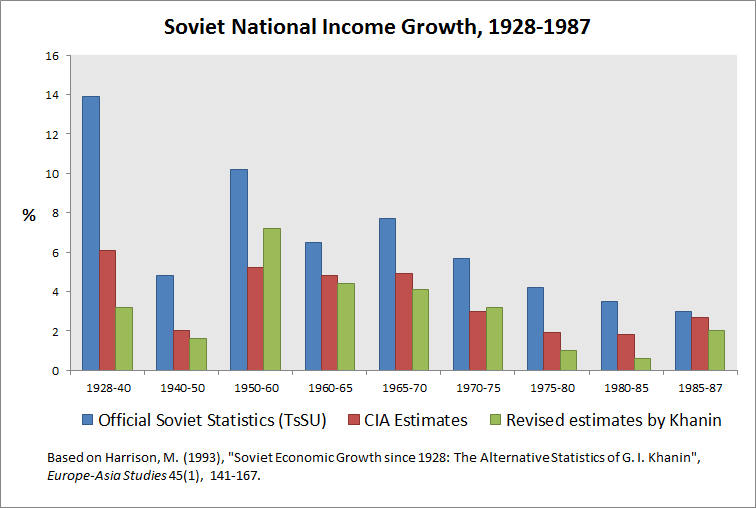
Second, let's look at the economy of the Soviet Union, more specifically its growth:
https://upload.wikimedia.org/wikipedia/en/7/78/Graph_of_Soviet_National_Income_Growth.png
Note how the Soviet economic growth - based on all available sources - had been on a downward trend since the 1970. Indeed, the only time the Soviet economy "recovered" and had higher growth was 1985-87 (at least based on CIA estimates), or exactly when Reagan was in office! Indeed, before Reagan the Soviet economy only experienced decline in its income growth rate.
The answer, much as it's a bitter pill for Americans to accept, is that the Soviet Union in fact most likely collapsed not because of anything America did.
The key is the declining Soviet economy from 1970 onwards, which in turn led to the rise of Gorbachev who initiated a series of economic reforms (which is why we see an increase in growth in the Reagan period). Unfortunately, Gorbachev was not able to complete the reforms before the Soviet Union collapsed.
So the question is, what happened in 1970? American defense spending in fact declined during this period, so that's not the answer. The American economy also took a hit in the 1970s leading to a full Recession by the start of the 80s (which was later turned around), so America wasn't out-competing the Soviet economy. What economy actually grew dramatically in the 1965-1970 time period?
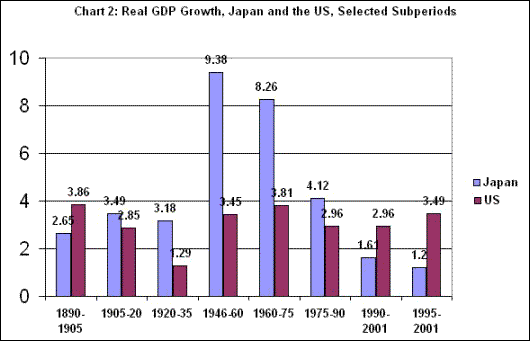
Well, let's take a look at the growth of the Japanese economy vs the US economy:
http://www.networkideas.org/images/chart/Japan_Decline/chart2.gif
Japan, in fact, was the dynamic and growing economy of the 1970s, far outstripping US and Soviet growth. And they were in fact accompanied in sustained growth by some Asian nations (especially Taiwan) and also West Germany.
While I can't point (yet) to a direct chain of causation between the fall of the Soviet economy and the rise of Japan (albeit do note that Japan was one of the USSR's most important non-communist trading partners), I can say that the correlation between the Soviet Union's collapse and Reagan is in fact very weak. The US economy and defense spending were NOT growing just as the Soviet downturn began. Instead, it was Japan's economy that was growing when the Soviets began their downturn, and indeed there was a similar downturn in the US economy that accompanied the rise of Japan.
The question, therefore, may be less about the Reagan "beating" the Soviet Union, but how the Soviet Union collapsed after the economic downturn of the 70s whereas the United States remained intact. And in that regard more study needs to be done, particularly with regards to American finance as a big reason why Reagan managed to eke by was his enormous increase of US debt.
Caveat: Note that some of the figures and time periods I've linked are not exactly comparable. The intent is to show the economic and defense spending trends of the USSR, US, and Japan. Direct comparisons are almost impossible anyway due to the different statistical methods used.