Why did the Ottomans throw thousands of soldiers trying to besiege the walls of Constantinople in 1422 and 1453 when they could instead try to blockade them with their superior navy and army?
The Ottomans did attempt just that beginning in the spring of 1394 CE under Sultan Bayezid I "Yildirim" (d. 1402). The Byzantine Emperor Manuel II Palaeologus traveled to Venice, Paris, and London in 1399-1400 in order raise troops and funds to save the city. This idea was suggested to him by the French Marshal Jean Boucicaut, who had forced his way through the Ottoman blockade in 1399 and brought the Emperor with him to Europe. He returned in 1403 and found that the situation has completely changed.^1
It was Tamerlane who saved Constantinople from an eight year blockade, however. He defeated the Ottoman army at the Battle of Ankara (1402), which lead directly to the Ottoman Interregnum in which several princes fought for the throne.
Because Constantinople was not a city you could simply starve out, especially at it's depleted population.
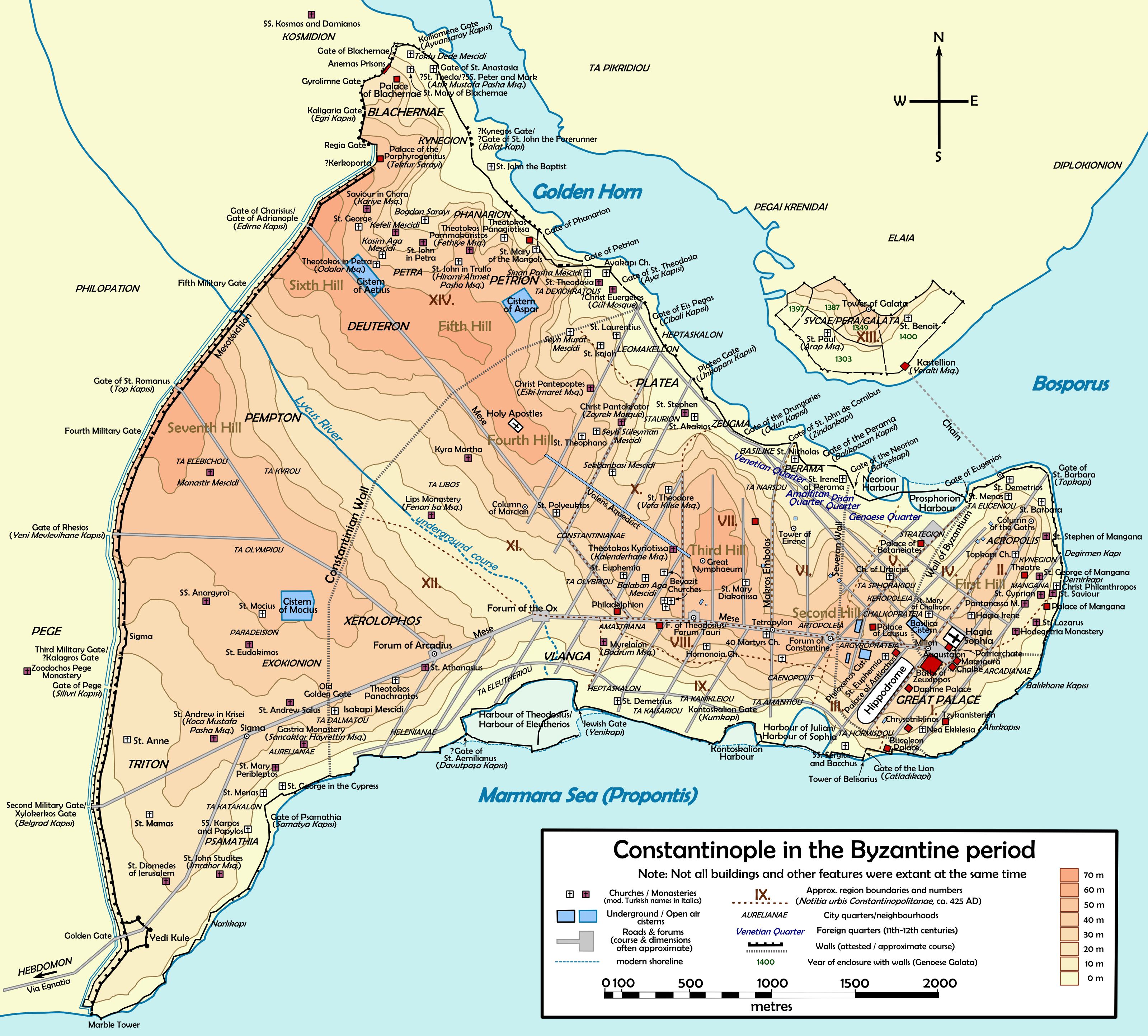
To begin with, look at this map. https://upload.wikimedia.org/wikipedia/commons/b/bb/Byzantine_Constantinople-en.png
See those blue squares? The city had an incredibly thorough system of cistern, above ground and below. They could hold hundreds of thousands of gallons of water from the rain and from groundwater, and there were probably more than are shown on this map. This water could effectively keep the population with enough water in times of siege for extended periods of time. The great sieges of Constantinople (The Avar and Arab Sieges) saw the city blocked off from outside water for extended periods of time, but the city had enough water. In those centuries, the population was 125K+, while at the Ottoman siege it was much much less.
Alongside that, most of the population lived closer to the inside of the city, near the old walls. Much of the land out near the walls was farming and vineyards and other agricultural land. This left the city with a steady but small supply of domestic agriculture even if the walls were blocked off.
Alongside that, the Golden Horn, which was usually still under Byzantine Control, could be fished with decent yield. Even if the golden horn was occupied, the harbors would still provide small amounts of food.
Constantinople was the greatest fortress made in the Middle Ages. There wasn't a city that was more siege-proof. The Theodosian Walls are just ridiculously large and impossible to assault, it had ample access to resources, it was basically impossible to take.