This might be a somewhat cliche focus for all you learned guys and gals reading this. But I've always been interested in the peoples who came over to the Americas. Something about the hardship they endured and rugged nature of the people who first moved across intrigues me. An example of the sort of thing that kinda sets off my wondering is the movie Pathfinder. I know it's fiction and such, but it always gets me thinking about what these people must have been like. Even looking at the Yukon and Alaska and the Northwest Territory now, northern North America is not an incredibly hospitable place that many people think about in any terms beyond adventure.
So what I'm asking for is an idea of what the earliest people who came over were like. Perhaps who they descended from (I'm vaguely aware they're of Asian descent), cultures that spurred from them, perhaps the history of specific people or important events. I've never heard of any big North American empires, but I'm not a historian either. Basically the more informative and in-depth (so, long) your answer the better (though, don't not post an answer if you think it's shorter than I'd like).
Perhaps who they descended from (I'm vaguely aware they're of Asian descent)
"Vaguely Eurasian" is the best we can say. The ancestors of the Paleoindians (as the earliest Americans are called by archaeologists) don't correspond to any particular populations today. Genetically, there are hints of peoples from all over Eurasia that mingled together to become their own unique population around 25,000 years ago (Tamm et al 2007). Some parts of this gene pool are closely related to peoples who now live in Siberia, other parts are tied to the ancestors of those who settled East Asia, other parts to those who settled Europe, other parts to the people who settled Australia. Of course, the reason for the particular closeness with Siberia isn't just due to the location of the likely Paleoindian ancestors, but also because of more recent back-and-forth contact across the Bering Strait.
So by 25,000 the Paleoindians were a distinct population, but were they in the Americas at the time? That's uncertain. The linked paper thinks they were hanging out on the relatively mild tundra of the Beringia during the Ice Age, blocked from expanding into the Americas proper by the continental ice sheets that covered almost all of Canada at the time, and were pretty much stuck there for about 10,000 years. That's looking increasingly unlikely. By 16,000 years ago, and possibly as early as 19,000 years ago (though this early date is still controversial), people were living at the Meadowcroft Rockshelter, west of Pittsburgh, Pennsylvania. There are several other sites in the United States with similar dates (reliably dated to around 16,000 years, controversially dated to 19-20,000). By 14,500 years ago, and possibly as early as 18,500 years ago according to this recent paper, people were living in southern Chile. So the initial settlement of the Americas probably began not long after the Paleoindians became genetically isolated from peoples in Eurasia (more or less; there's always some level of cross-hemisphere interaction), or the expansion happened very fast around 20,000 years ago.
What likely happened is that the initial wave of Paleoindian settlement bypassed the ice sheets by expanding down the Pacific coast. From these early settlements on the coast, people expanded eastward at various points where they could find passes through the mountains. From there, its a complex tangle of internal migrations over the next 20 millennia or more.
cultures that spurred from them
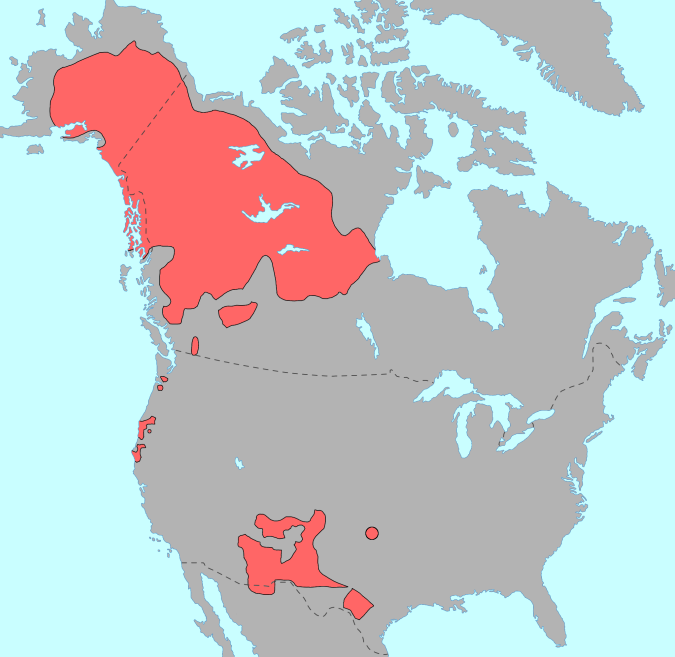
All Pre-columbian cultures of the Americas, with a few notable exceptions, are descended primarily from these first Paleoindian societies. The Inuit, Inupiat, Yupik, Aleut populations of the coastal Arctic are more recent arrivals, coming across the Bering Strait around 4500 years ago. The Na-Dene peoples (which includes the Navajo and the Apache in the Southwest, and most cultures of the interior Northwest (map for Na-Dene languages) are also post-Paleoindian arrivals, but likely weren't too far behind. Everyone else is primarily descended from the initial wave of settlement as far as we can currently tell. Some researches are attempting to parse out that 20,000+ years of migration more finely, but it's early days still on that front.
Even looking at the Yukon and Alaska and the Northwest Territory now, northern North America is not an incredibly hospitable place that many people think about in any terms beyond adventure.
I can't say much about the Pacific Northwest at the time, other than to say that along the coasts of there were unglaciated valleys that would have facilitated the hypothetical coastal migration to bypass the worst of the Ice Age had to offer.
Instead, I'll jump back to Meadowcroft Rockshelter. Here is a map that shows the location. As you can see the southern edge of the Ice Sheet isn't terribly far away. Based on the stone that the people there made their tools from, we also know they either traveled 150 miles into Ohio to get it, or had trade connections that could transport it. The glacier was closer than that, and they almost certainly would have known about it, and memory of it may have survived the Iroquoian mythos. This is close to the Iroquoian homeland, where they say they took refuge when Tawiskaron (whose kind of the Iroquoian Loki, in that he's chaotic and dangerous, but not really evil) sets a bunch of monstrous beasts and white marching mountains loose on the world.
Based on pollen from Meadowcroft, we know that the Allegheny Plateau wasn't terribly different from its current climate at the time, despite it's proximity to the glacial front. The early people of Meadowcroft were hunted small and mid-sized game. White-tailed deer were the largest animals that they went after. Big-game hunting of things like Mastodons kicks in a little later, around 13,500 years ago with the spread of Clovis technologies. There's no Clovis component at Meadowcroft because part of the cave's ceiling collapsed just before this time period and made the place unlivable for a while.
For a long time, Clovis "people" were thought to be the first people in North America. Armed with a tool kit that seemed specially designed to hunt Ice Age megafauna they were theorized to have swept rapidly through the continents, fueled by unsustainable hunting of various giant animals. Now that we know more and more about pre-Clovis peoples from sites like Meadowcroft and Monte Verde in southern Chile, we know that there's really no such thing as Clovis people. The rapid spread of Clovis technologies doesn't represent a migration of people, but the exchange of tools and ideas from one group of people to another. They spread of a big-game hunting tool kit probably didn't kill of the Ice Age megafauna either - though it didn't do them any favors either and added one more problem to already stressed animal populations as the more recent ice age came to a close.
perhaps the history of specific people or important events.
If we're talking about the earliest people in North America, then we're looking back so far that we're in a mythic era of oral tradition to discuss specific events and people, like the story about Tawiskaron and his monsters or the Lenape story about the war against the mastodons - even that is referencing a time period that would hypothetically be occurring many thousands of years after the first people reached the Americas. You'd be hard pressed to find any information about specific people and events going back 20,000 years in Eurasia too.
I've never heard of any big North American empires
You probably have, but likely don't think of them as North American. Remember that North America extends all the way down to Panana, which means that the empire of the Aztec Triple Alliance was North American, as was its major contemporary rival, the Kingdom of Tzintzuntzan in western Mexico, as well as their predecessors like the Toltecs and the Teotihuacanos. But, again, these don't show up any many thousands of years after the earliest peoples in the Americas.
If we're going to open this question up to virtually the entire history of the Americas, it's going to get out-of-hand quickly. To give you a brief idea of the sort of rabbit hole that opens up, here is a series of posts that I wrote a while ago as a crash course on the more than 16,000+ years of Ohio Valley archaeology and history, starting with Meadowcroft and ending with the Indian Removal Act of 1830. If you want to go down that path, it'd probably be best to ask more specific questions rather than a huge, open-ended one.
Don't wish to stifle any discussion but you Might be interested in Clovis Culture and the First People in America by /u/RioAbajo in our FAQs.
I'd just like to point you to /r/AskAnthropology. There are some archaeologists here like Reedstilt (who gave an excellent answer), but this topic is really the purview of archaeologists, who fall within the anthropology discipline. There's a lot of used crossover between that sub and here, but your question may get more attention there.
The first peoples of the Americas arrived over 10,000 years ago. Thus not much is let but their stone tools to get any idea of what they were like. Sites are generally rock shelters that promote the kind of preservation needed for something to survive over 10,000 years.
The exact first people to arrive in North America is unclear. The first widespread people are called "Clovis" and are often referred as the First People of America. They are famous for their beautiful lanceolate points made from a variety of stone types such as obsidian and chert and hunting the extinct large mammals inhabiting North America. Unfortunately there is no clear link between the Clovis and people in Siberia, thus it is possible some other people arrived before the Clovis and the Clovis are a descendant of this group. This comment to an article outlines some of the difficulties we archaeologists have with determining anything of value when all we can find of the people of this time period is a few points and badly eroded bones.
We know that the first people to arrive in North America arrived in several waves of migration across the Bering Land Bridge and through the ice free corridor into America. These people travelled vast distances possibly following the migrations of the large mammals they subsisted on. We know they travelled vast differences due to the lithic sources of their tool kits. These sources of obsidian, chert, chalcedony, etc. could be several hundred kilometres from where we eventually find them in the archaeological record.
To summarize there is not much we can say about the earliest people of North America because there is not a lot we find that you can say much about. These were highly mobile people that made beautiful points from a variety of material while much of Canada and the U.S. were still covered under kilometres of ice.
Further reading:
To get started on further reading this Wikipedia article on the Settlement of North America is well sourced and is a good launching point.
Caribou Hunting in the Upper Great Lakes: Archaeological, Ethnographic, and Paleoenvironmental Perspectives, edited by Lisa Sonnenburg, Ashley Lemke and John O’Shea. Memoirs of the Museum of Anthropological Archaeology, University of Michigan No. 57, Ann Arbor, Michigan. Is a good series that details the earliest people in the Great Lakes region, which is my area of expertise.
This books summarizes the recent research on Clovis and the early people in the Americas. I have read select essays but not the whole thing.