So after extensive and mind numbing research I can't answer my questions without bringing in the big guns.
How accurate is leather armour? Was it ever used in western Europe around the 15th century? And finally how accurate are the brigandines with 4inch by 4inch plating?
EDIT: thankyou all for the awesome replies! Nothing at all what I wanted to hear but that still bought me to a conclusion, you've definitely got another fan in me.
They originated around the 13th century, at least from mentions in inheritances, inventories and that sort of thing. The St Maurice statue in Germany has something of a hauberk with plates on it, and is dated to around 1250. Other early examples include a similar coat of plates from a similar time in the form of a statue, the "Holy Sepulchre guard", found in the weinhausen monastery, also in Germany.
The coat of plates, and thus the brigandine, was mostly backed on canvas or hemp, rather than leather, and coated with felt or velvet. Leather facing was somewhat less common, and those were still often backed by fabric.
Most in that time period (Visby etc) used overlapping plates, not 4x4 plates. Some had one large panel horizontal around the midsection, and then smaller (2x6) plates vertically aligned.
By the 15th century you're looking at much more complete armour pieces, rather than brigandine armour. At this point in history, cloth covering were done for maintenance and aesthetics on what was otherwise a mostly solid, modern, and shapely "wasp waisted" affairs, essentially they were breastplates but with stylings of the coat of plates that preceded them.
There were, however, some exceptions during this time period. Some of the 15th century extant finds have split fronts, to allow fastening at the front for comfort and convenience. Also available were split backs (see the statue of saint George, in Prague). These are more like a coat of plates, but only superficially.
After this (later half 15thC) the plates were made of many small overlapping plates, and thus they had MANY rivets. Hundreds per piece. These are often referred to as brigandines, but I doubt they are what you meant (given you said 4x4 plates, separated)
Pure leather armor needs to be several millimeters thick, almost a centimeter, even proper veg tan, fully gain boiled leather, to stop a thrust from most period weapons. This is much heavier, and even perhaps more annoying to make, than iron plates.
Since you asked about the 15th century, I will answer two questions about the armour of that time period. 1) How was leather used for armour in that time period? 2) what were 15th century brigandines like?
Was leather armour used in the 15th century? Not in battle. However, leather armour was used for a variety of tournaments that were fought with clubs or whalebone 'swords'. Since it only needed to deflect the blows of blunted clubs, not deflect sharp points or blades (which can bite into leather pierce it), the armour for these tournaments could be made of hardened leather. Earlier, in the 13th and earliest 14th century, hardened leather armour seems to have been used to supplement mail (though a number of these armours are associated in inventories with tournament equipment). In roleplaying games and other media, leather armour is often potrayed as a 'poor man's armour', but in fact this role was generally filled by fabric armours - gambesons, pourpoints, and jacks, which were quite effective for their cost - Alan William's tests indicate that 30 layers of linen can easily resist a sword. Leather armour was mostly used as a supplemental or 'sport' defense by knights and similarly equiped soldiers ('men at arms'), in Medieval Western Europe at least.
What were 15th century Brigandines actually like?
First of all, Brigandines were one of the most common forms of protection in the mid-15th century for soldiers below the level of men at arms (archers, halberdiers, etc), especially in England (though men at arms might wear them as well). In the inventory of John De Vere, Earl of Oxford (second half of the 15th century), there are 101 brigandines and only 16 breastplates. They only become less common with the introduction of cheap infantry breastplates in the later 15th century, which largely displace brigandines among infantryman by the early 16th century.
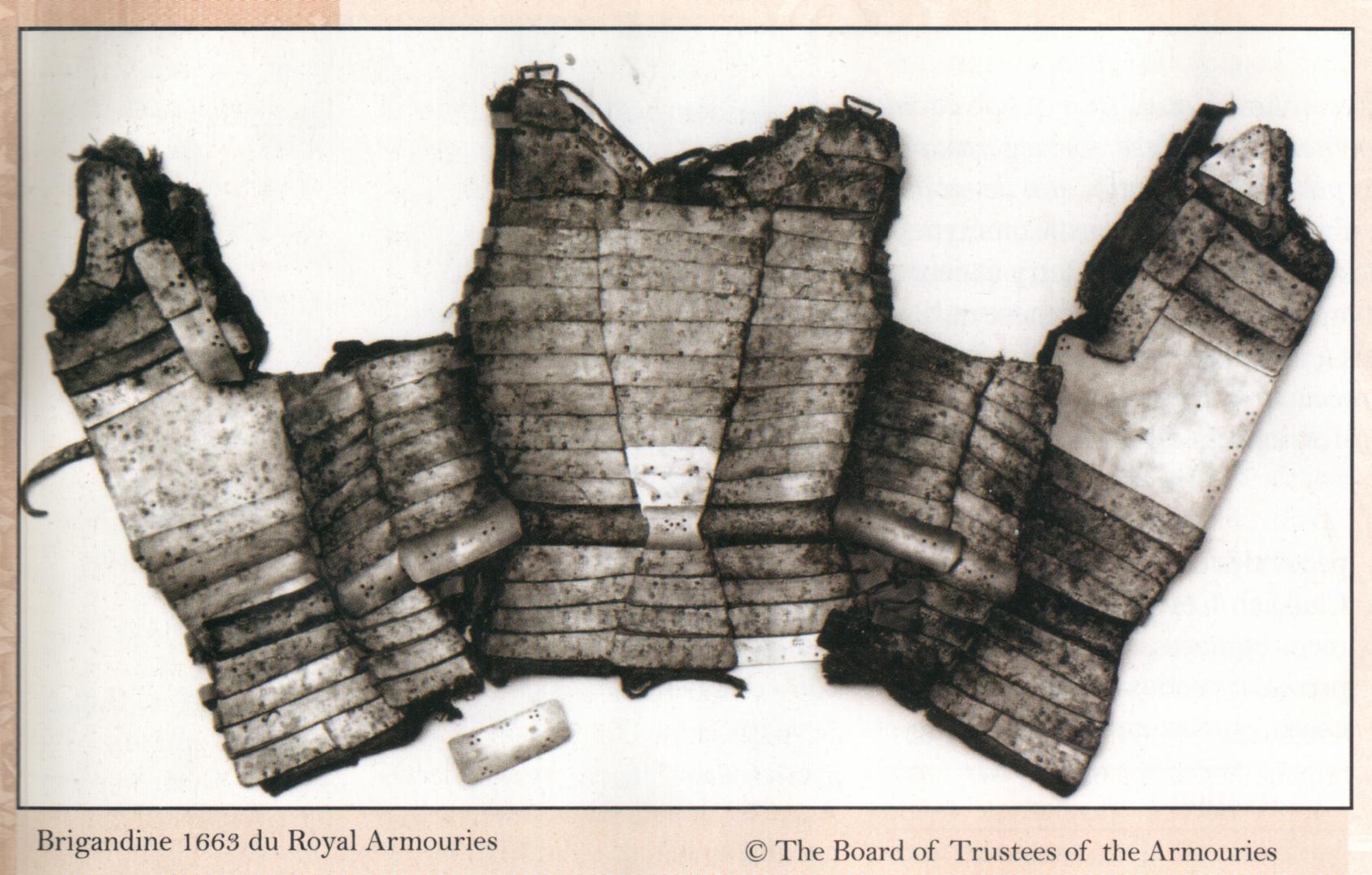
The mid 15th century brigandine is made up of a large number of roughly oblong plates, oriented horizontally. The plates are not all identical, they are shaped so that they fit the body when put together - the ones at the back or the sides may be narrower. The chest is generally protected by two large plates. The plates overlap with each other. Often they were coated in tin to prevent corrosion. This Image from the Royal Armouries shows how plates were arranged in a mid-15th century brigandine.
They open in the front and are closed with straps. The plates back a sturdy piece of cloth (like a canvas), which is in turn covered by some kind of decorative covering material - leather, fustian, or even a rich fabric like velvet. The plates are riveted to the backing, and the rivet heads show over the covering fabric. Often 15th century brigandines arrange most of their rivets in a triangular set of 3, but not always. The rivets were often decorated, and on the brigandines of wealthy men might even be silvered or gilt. When everything is put together, a 15th century brigandine has a pronounced 'nipped' waist and a noticeable skirt, much like contemporary men's doublets. You can see what the exterior of a brigandine looked like in this painting by Memling - the man with the pollaxe is wearing a brigandine.
As time goes on the plates become somewhat smaller, and the chest plates are not always included.
Brigandines were tailored protective garments made up of non-identical plates. As such, 4x4 plates are not an accurate representation of brigandine construction in the 15th century, or at any other time.