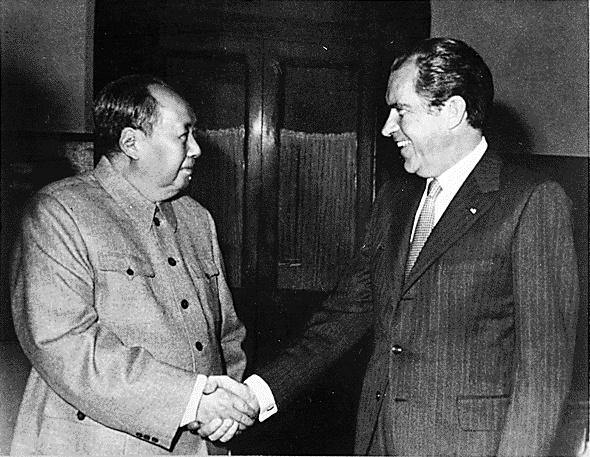
As someone else mentioned, it depends on what you consider "positive." Nixon's focus was almost entirely on foreign policy, and in that regard he presided over the end to the Vietnam War, opened up trade and diplomatic relations with Mao and the PRC, and reduced tensions with the Soviets. His policy wasn't necessarily isolationist, but it was more focused on avoiding direct military involvement, and enhancing our trade and diplomatic position in the world.
As far as domestic policy, he followed what's been coined "New Federalism." He very much saw domestic policy as something for individual states to handle, and wasn't much interested in it himself. He delegated most domestic matters to his cabinet and secretaries. Though, he was a conservationist and did support the establishment of the EPA. He was also a supporter of the CRA, and presided over forced desegregation of public schools. He also supported the ERA, even though it wasn't ratified.
Hello all. Just as a quick reminder, /u/AskHistorians answers are expected to be both informative and comprehensive, provided by people who could go deeper into the topic, if asked to do so.
This isn't the right place to share one-sentence (or not-quite-one-sentence) answers.
You don't need to have done you doctoral dissertation on Nixon's presidency, but you do need to keep our basic commenting standards in mind. We welcome anyone to answer who can do so in more than just a few words.
Thank you for your help in maintaining the quality of the sub.
That of course depends on what you mean by "positive". Perhaps the most notable and lasting legacy of his presidency is the American (and UN) recognition of the People's Republic of China in place of the Republic of China (Taiwan), culminating in a state visit to China and the famous Mao-Nixon handshake. This is seen as a positive by many people in China, since it brought international recognition and legitimacy that was (arguably) previously lacking, and also many in the United States as it allowed for an easing of tensions with a former staunch adversary-- though things were not exactly to be all happy times and noodle salad between the PRC and USA from that point on. However, the consequences of that action continue to cause problems for the island of Taiwan and its people, which remains cut off from "official" diplomatic recognition.
People seem to forget that Nixon helped finalize deagregation in the South. While Brown v Board set the precedent for desegregation it never immediately went into effect. You still had localized segrgeation in both the North and the South and while Nixon refused to touch bussing, the Northern, large city based, issue with desegregation, with a 20ft pole he did understand that segregation in the South will still be a hot issue especially in the future Presidential elections so he felt a need to tackle it early so he did so that he can garner more unified support from Southern politicians. He sent Spiro Agnew to the south to work with Southern Politicians. Granted, Agnew, wasn't entirely into the whole idea, they were still able to get a lot done. They managed to set up local committees, which included both blacks and whites, which helped mediate the desegregation process and also set up incentives to desegregate such as funding and meetings with the President. By the early half of the 1970s less than 10 percent of African American children in the south still went to segregated schools and Southern Politicians enjoyed the smoothness of the transition and the little face value involvement they had to put into it.
Nixon is famous for China/USSR, mostly, but one of the more underrated aspects of his Presidency, in my opinion, is his foreign policy with Western Europe in 1969. Euro-American relations had strongly deteriorated throughout the 60s, and there was a real risk that NATO could have fallen apart at a time where the Soviet Union had recently squashed the Prague Spring and looked invulnerable. Nixon, to his credit, helped prevent that. He was pretty much the only POTUS we had that managed to have a functional relationship with De Gaulle, right before he died.
There is also no denying his decision to go off the gold standard in August of 1971 was extremely significant in modern history. Nixon's economic decisions were largely poor and uniformed as a whole, but this one was an exception: he goes on about what the world was going to look like in 20 years on the tapes and how it was necessary for the US to start preparing. That basically lay the blueprint for the modern global economy in a world where Europe and Japan had recovered from WWII and untapped markets like China and Indonesia were just beginning to make contact with the outside world, considering a turn away from Soviet inspired socialism to trading with other nations and developing economically. Reeves has mentioned this a lot, yet for some reason, most biographers don't talk about it much.