It's a somewhat common sentiment that we knew how big the world was before the voyage of Columbus and no one had tried simply because no one expected anyone to make it all the way to Asia before starvation set in. Hand in hand with that idea is the notion that Columbus was a fool for expecting to make it.
Why then was he financed by the Spanish crown? Why waste the ships?
And more so (in my education at least) the story went that he was refused by other nations and the Spanish were the only nation willing to finance his mad dash around the globe. If he had failed, what would have happened? Would the Spanish have financed another explorer? Was he the first? Would the English have gotten into the game?
It's important to know that Columbus or his voyage didn't just come from nothing, and it's not him that pioneered this idea of exploration and discovery. He is a product of his time and circumstances, maybe even more then usual.
Portuguese
You see the Portuguese were the ones running the show of exploration and discovery since at least 1415 (year usually taken as start, denoting taking of city of Ceuta in Africa).
Since then, the Portuguese were systemically exploring and trading further and further along African coast. Here is a map of some exploration voyages. It is very important to stress that this map only shows the actual first discovery date. All of those discoveries were followed by constant, numerous trading expeditions.
This commercial activity was quite extensive and profitable. And Columbus, and his brother, were quite involved in it. Working for the Portuguese in the 1470s, he engaged in trading and sailing from Guinea to Madeira to Portugal. And it is undoubtedly here, from the Portuguese, he gained the necessary experience in sailing the oceans. And it is during this time with the Portuguese that he formed his idea of going West to go East, which he first pitched it to his patron Portuguese King Joao II.
But this plan was dismissed by the Portuguese as a panel of experts determined that Columbus theory is based on faulty evidence. And because they already had in mind an alternative viable route to get to India: by going around Africa. As they disagreed, Columbus left for Spanish court to offer his services there, whether to pitch his ideas again, or just get more money I am not sure.
Spanish
Now where do the Spanish come in play? Well since the beginning of the Portuguese explorations, Spanish (or more correctly, some Spanish) were also interested to get involved. But they rarely pursued the kind of concentrated, royally backed, effort the Portuguese did. This allowed Portuguese to set themselves up in the region, in practice as well as legally. Since 1440s and 1450s Portuguese were lobbying, successfully, the Pope to grant them legal rights over the new areas.
At that time Spanish hardly protested such measures, since it seemed both fair that the Portuguese get what they laboured for, and since it was not yet obvious it will be so profitable.
But by the 1470s both Portuguese and Spanish saw clearly how rich this trade can be (and this just trade with Africa)
So during the War of Castillian Succession (1475-1479), Spanish queen Isabelle sent a fleet to Guinea to take over the trade and oust the Portuguese. The Portuguese themselves counter attacked, intercepted and surprised the Spanish on the return journey, scoring a major victory and capturing the fleet and it's wealth.
And while the rest of the war ended up as victory for Isabelle and Ferdinand giving them the Castillian throne, they did have to make concessions to the Portuguese in the sea. Signing the peace Treaty of Alcáçovas in 1479, they agreed Portugal rights to all land and trade south of Canary Islands (those themselves remained and were confirmed Spanish)
What this ended up with was that the Spanish were left without any legal right to conduct any trade or exploration in the southern direction ( which at the time was basically considered the only direction) without paying the taxes to the Portuguese
So here we come to the point of why Isabelle funded Columbus' expedition. Why Isabelle would in the end decide to risk it would be purely speculation.
But we can state as a fact that for the Portuguese the proposal of Western route was just a very high risk expedition which had more probable alternatives. But for the Spanish going West had no alternatives. It was the only way they could go to avoid the restriction of not being allowed south of Canary islands. Basically losing few ships would be expensive, but the the prize would be worth more to them who didn't have any trade in their control, while their neighbour was taunting them with theirs. Any hesitation was probably further lifted when Portuguese finally discovered the Cape of Good Hope, and proved India could be reached from the Atlantic. This event was probably a final push to give Columbus a go ahead.
What if
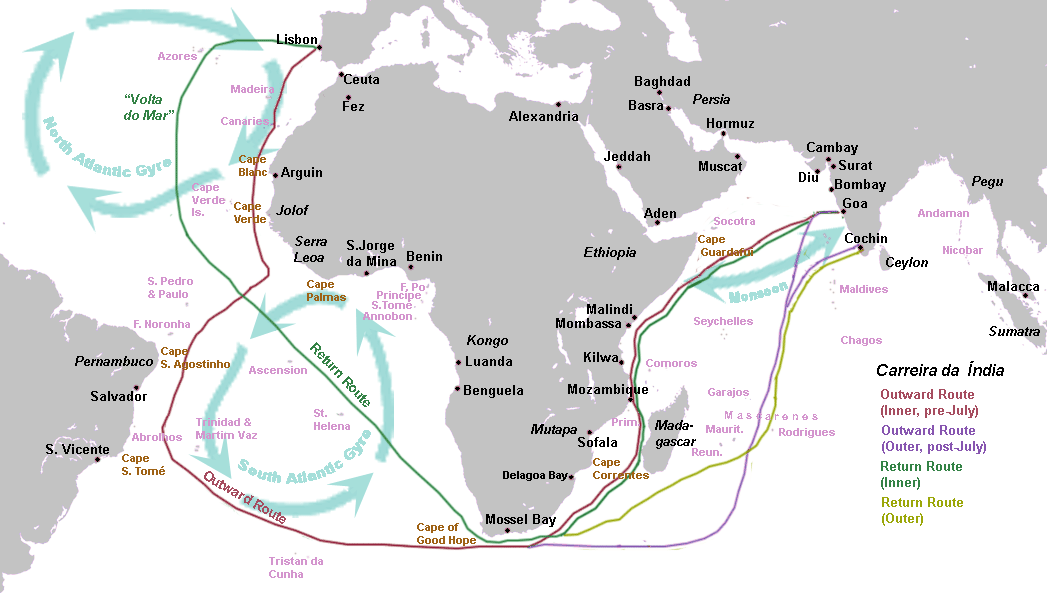
Now to the last question of what would happen if Columbus failed. While this is a what-if question, which means not suited for this sub, I can tell you that Brazil was discovered independently by the Portuguese in 1500. They stumbled upon it by following the best wind sail routes to go around the Cape of Good Hope. And the wind patterns and currents in that part of the oceans, make someone reaching Brazil almost a unavoidable occurrence if sailed regularly.
So even if Columbus' trip was a fluke of good luck, even if it had failed or he never returned, the Portuguese would have without doubt stumble upon Brazil on their way to India, as it actually happened in 1500 by Cabral's fleet.