For the Philippines, it's hard to say for certain, but in Linda Newson's book on Old World diseases and the archipelago, Conquest and Pestilence, she points to Spanish contact rather than the pre-colonial trade with the Chinese as the conduit for introducing (and making endemic) smallpox and other pestilences.
For one, the Chinese were not the only foreigners trading with Filipino communities before the Spanish came. Arabs as well as other Southeast Asian contacts were known well before Magellan first arrived in 1521.
Despite this trade contact with China (as well as medieval Filipino pirate raids on the Chinese coast) the Filipino words for these diseases are not lexical borrowings from Chinese, nor are their treatments.
For another, the populations of individual Filipino communities were typically small - usually only about 30 to 100 families per polity - aggregating to ~1.5 million people dispersed over the thousands of islands of the archipelago.
From the circumstantial evidence taking these into account, and Spanish records of smallpox and measles ravaging subject Filipino communities during the early colonial period, Newson concludes that while acute infections may indeed have been introduced from China (as from the other trade contacts of the archipelago), the low population densities in the Philippines did not enable these diseases to become endemic. And the tremendous suffering from these diseases experienced upon the advent of the Spaniards - who tended to require the Filipinos to live in concentrated population centers - indicates that the diseases' introduction in such circumstances was not something with a precedent in this scale before the colonial period.
Out of curiosity is it the Years of Rice and Salt you read?
There are a few references of early Chinese naval expeditions to the eastern sea finding islands, and some of those reports included there being aboriginal populations, which were occasionally mysteriously "gone" upon further inspection, or were outright reported to have been wiped out through illness upon contact with the Chinese sailors.
Quite a few of these expeditions to the great Eastern Sea were in attempts to find "immortality drugs" or elixirs on the reigning emperor's behalf, as well as holy legendary mountains. The most famous of these legendary places - on which early emperors were convinced immortals dwelled - were called Penglai, Fangchang, and Yingzhou.
One expedition was supposedly carried out in the 1100's BCE during the reign of the 26th King of Shang, Wu Yi... but probably the most famous of these expeditions was carried out on behalf of the First Emperor himself, Qin Shihuang, by his admiral Xu Fu, in 219 BCE. He purportedly carried some thousand men and women in an attempt to discover Penglai, but never returned... legendarily both stories goes that its own particular group settled the Japanese islands as the Wa/Wo/Yamato People, but that's almost categorically been shown to be just legend in both instances. From the Cambridge History of China, vol 1:
During the Ch'in period, and perhaps the first century of Han, attention was focused on a Paradise of the East. The way lay through certain islands lying east of China which were thought to possess magical and spiritual properties; these were known as the home of certain creatures noted for their purity. By passage through these islands, and particularly the one named P'eng-lai, it would be possi- ble to procure the elixir; once this had been obtained, it would be possible to ascend to a higher realm.
There were a few other instances of the "discovery" or quite possibly "re-discovery" any number of the many islands in the East China Sea, due to a 400 year civil war effectively wiping much of the slate clean for later dynasties, in terms of external geographical knowledge. During the 3 Kingdoms Era, a naval expedition of the Wu Kingdom reported finding a place they called Yizhou in the 3rd century. They reported that the native fought them fiercely, but soon had died of a plague. Essentially they shrugged it off, said there wasn't much worth conquering anyway, and headed home.
Following reunification, the 2nd and last Emperor of Sui, Yang, mounted another expedition which this time found a place they called Liuqiu in the 7th century... which is kind of difficult to pin down because that would later come to mean the Ryukyu islands, but Chinese understanding of where exactly everything was at this point was hazy enough that there are quite a few who think it may have actually been Taiwan. Regardless, it piqued his interest enough that he would send a further two expeditions there. From the Book of Sui, vol. 81 in its chapter on 東夷, "Eastern Barbarians":
The country of Liúqiú is situated amidst islands in the sea, in a location that should be east of Jiàn'ān County, to which one may arrive with five days' travel by water. The land has many caves. Its king's clan name is Huansi, and his given name is Keladou; it is not known how many generations have passed since he and his have come to possess the country. The people of that land call him Kelaoyang, and for his wife, [they] say Duobatu. His place of residence they call Boluotan Grotto, with threefold moats and fences; the perimeter has flowing water, trees and briars as barriers. As for the domicile of the king, it is sixteen rooms large, and engraved with carvings of birds and beasts. There are many Doulou trees, which resemble the orange but with foliage that is dense. The country has four or five chiefs, who unite several villages under their rule; the villages have [their own] little kings.
The people have deep eyes and long noses, seeming to be rather akin to the Hu, and also having petty cleverness. There is no observance of hierarchy of ruler and minister nor the rite of prostrating oneself with one's palms pressed together. Fathers and children sleep together in the same bed. The men pluck out their whiskers and beards, and any place on their bodies where they happen to have hair, they will also remove it. The adult women use ink to tattoo their hands in the design of insects and serpents. As for marriage, they use wine, delicacies, pearls and shells to arrange a betrothal; if a man and a woman have found pleasure in each other, then they get married.
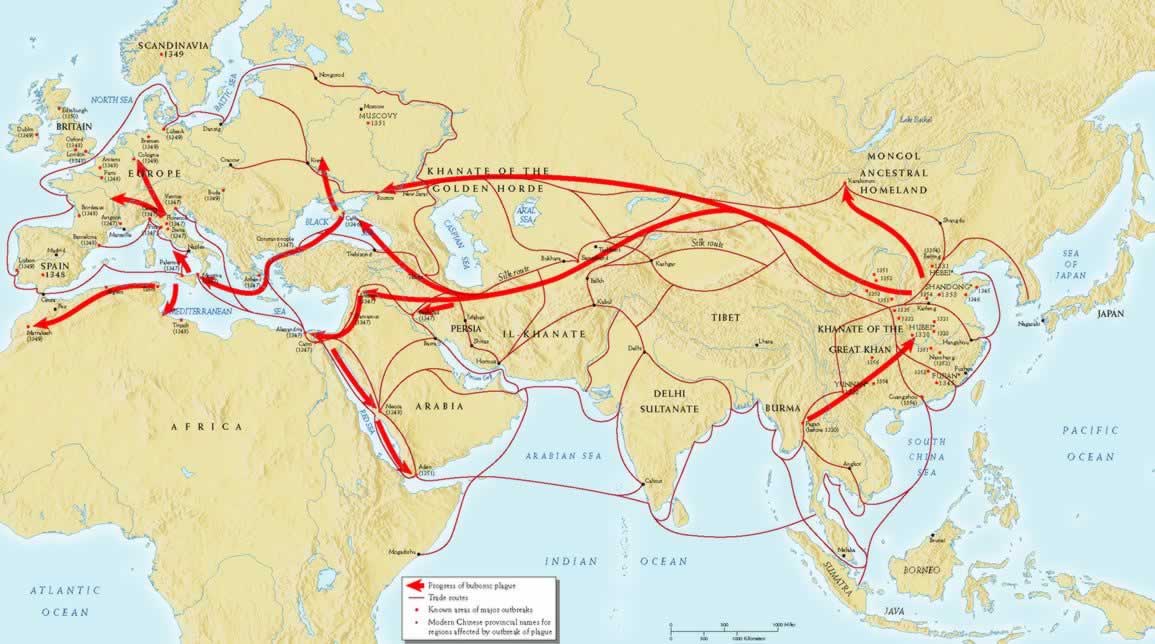
It would be remarkably unsurprising to think that the Chinese would have cause outbreaks - potentially devastating ones - among many of those with whom they interacted. As stated before, they even bothered to note occasionally when such instances occurred... but more frequently, it really just wasn't noteworthy to them when/if "barbarian tribes" died out or why. But many of the diseases that would ravage Asia, Europe, and the world stemmed from the highly urbanized disease factories that were medieval Chinese cities. Bubonic plague, for instance, we can thank Chinese rats and the Silk Road for.
Nevertheless, at least in Taiwan's case, the aboriginals were able to fight off the occasional attempt at Han Chinese colonization while apparently avoiding at least truly slate-wiping diseases those from the mainland might have carried up through the 13th century, when they were at last brought into the Ming's hegemony with the colonization of the Penghu Islands (the Pescadores). This was, to be sure, much less a result of the resistance the natives may have put up, than general Chinese disinterest in the islands of the East - they held almost nothing of value, only perhaps to the occasional fisherman and mom-and-pop traders seeking to barter...and when those facts were established, they were generally left alone because Chang'an generally had much bigger fish to fry.