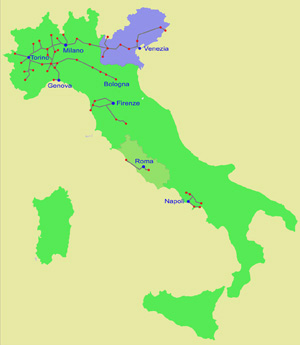
Recently many historians are claiming that the Risorgimento period was not a just unification which gave birth to a new age for Italy (as portrayed in the past), but a violent conquest of the allegedly rich south. The greedy exploitation of these riches would be one of the reasons (if not the main reason) why today southern Italy is poorer than northern Italy. I tried searching for sources in Italian, but I am not sure of their objectivity.
Is this true? Was Garibaldi more a criminal than a hero? Was the Kingdom of the Two Sicilies really that rich?
It's a rather contentious topic in Italy which has recently been manipulated for political purposes. As can be expected and as you have correctly observed, a number of people unwilling or unqualified to give complete balanced analyses have invaded the Italweb.
In light of this, I'd like to tackle the question analyzing this article by two organizers of the "For The South" political party (a counter-weight to the larger pro-north "Lega Nord" party, which in 2014 was absorbed into Forza Italia after their dispute with the Lega Nord). The article cites a study authored by two professors at the Tor Vergata University of Rome and published by the Bank of Italy. The study had not been subjected to any sort of peer review that I have thus far been able to find.^1
The study examines economic growth in various parts of Italy in the years 1871, 1881, 1901 e 1911.
In 1871, the degree of industrialization in Campania (the Kingdom of the Two Sicilies' most important region) was **0.98%**^2 , while the degree of industrialization in Piedmont (the equivalent region in the Kingdom of Sardinia-Piedmont) was equal to 1.13%. The authors of the article go on to account for this difference by saying that in the decade following unification the Italian Government reduced the size of the state-run Pietrarasa railyards, however the small size of the Two Sicilies' Railway Network leads me to doubt that a single railyard could account for 0.15% of industrialization.
Here is, in no particular order, the level of industrialization of the regions formerly in the Kingdom of the Two Sicilies in the year 1871 (using the modern Italian name of each region except for Abruzzo, which was agglomerated with Molise):
Abruzzi: 0.57% Puglia: 0.89% Basilicata: 0.70% Calabria: 0.72% Sicilia: 1.08%
These, on the other hand are the industrialization of the regions that today form Italy's Industrial heartland (the Torino-Genova-Milano triangle):
Piemonte: 1.13% Liguria: 1.09% Lombardia: 1.36%
Clearly, the north has some intrinsic qualities give it a head start in industrialization. Agricultural surplus in the fertile Padanian Plain^3 ? Denser urbanization leading to more rapid specialization? The proximity of industrial centers? A combination of all three most likely.
Now we can certainly argue that the South was mismanaged, plus because the north of Italy was smaller and had been conquered first, Piemontese laws and infrastructure had been installed seamlessly with a two-year head start. But there certainly wasn't a systematic plan to disfavor the south as some commentators would have you believe; in fact industrialization in Campania rose to 1.05% in 1881, while the "Southern Question" was hot topic in post-unification Italian politics. Although there certainly was a patronizing attitude among the ruling class of the early Italian state (mostly of Piemontese extraction) the utter incompetence of 19th century Italian governments stunted growth more than anything in both north and south: between 1871 and 1911, industrialization in Veneto would fall by -0.10%, while the regions of Emilia and Tuscany would increase by only 0.05% and 0.01% respectively.
Especially under the prime minister Giovanni Giolitti, a concentrated effort was made to improve the lot of southern farmers. However, initiatives were horribly misguided; his 1908 cabinet reduced taxation on landowners, but the benefits were felt exclusively by owners of large estates as the majority of southern farmers were sharecroppers. Indeed there are accusations that Giolitti and previous Italian prime ministers systematically favored southern landowners and power-brokers to better govern the south, leading Socialist MP Gaetano Salvemini to publish an essay accusing Giolitti to be Il ministro della mala vita, literally "The Minister of the Bad Life", Mala Vita being a phrase which today is used to refer to corrupt (often nongovernmental) points of authority in Italy (which includes but is not limited to organized crime).
Mired investment in the north by the Italian Government would cause an unquestionable fall in industrialization in the south. However, it is wholeheartedly incorrect to characterize the Kingdom of Two Sicilies a wealthy utopia prior to Piemontese conquest; had it been as prosperous as some would purport it certainly wouldn't have disintegrated as easily as it did before Garibaldi's army.
The article states it was published in English by the Bank of Italy, but I have only been able to find a version in Italian.
Misreported in the article as 1.01%
Primary sources dated to the 1830's show how Bourbon administrators were concerned about the level of agricultural production in the south, as were neutral observers like the French consul in Palermo.