In US History, we learned about Manifest Destiny. Why wouldn't the United States go on to conquer other nations/negotiate cessions after Hawaii and Alaska and the U.S. territories? Especially once we became a superpower in the world, what stopped us from taking other countries? Why was Manifest Destiny limited to continental North America, but not the entire world?
Oh, we did take other countries, and Manifest Destiny was definitely used to justify overseas expansion as well, but only into the early 1900s. A famous quote from Teddy Roosevelt extending it past the coastline, "it is manifest destiny for a nation to own the islands which border its shores."
Alaska was purchased in 1867, and Hawaii was annexed in 1898— but it was not the only territory we took. After defeating the Spanish in the Spanish American War, the US also annexed Guam and Puerto Rico and bought the Philippines for 20 million dollars, in the Treaty of Paris. Immediately afterwards, the Philippine-American war was fought to keep them from gaining independence, which the US didn't recognize until 1946, after WWII. American propaganda depicted filipinos as either uneducated children, in need of wholesome American guidance, or as savages to be killed. Here's a nice article overview of the Philippine-American war, it was truly awful. Cuba was also temporarily occupied by the US, but was granted limited independence in 1902.
Here is a relevant (racist) political cartoon from 1899, showing Uncle Sam as a teacher of self-governance. You can see that the states added in the mid-1800s are reading quietly, while the new class of Philippines, Hawaii, Puerto Rico and Cuba sit unhappily in the front row. And a Native American kid is off in the corner not knowing that his book of ABCs is upside down, a Chinese kid is waiting to be let in, and a black kid looks on while washing windows (here a very similar cartoon shows China leaning in the window to shoot spitballs at Uncle Sam, as he tries to teach Guam, the Philippines, Puerto Rico and Hawaii).
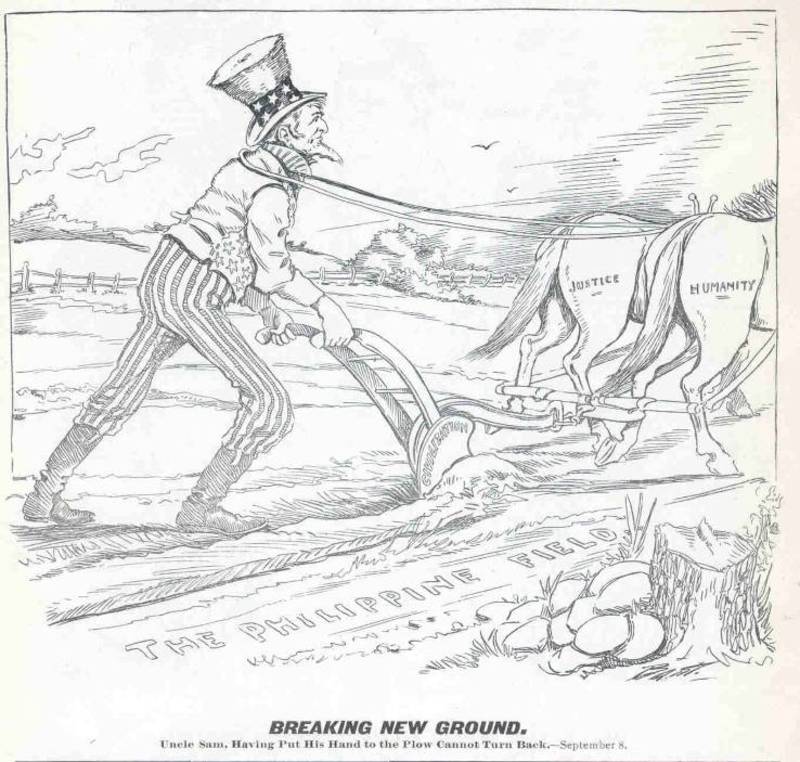
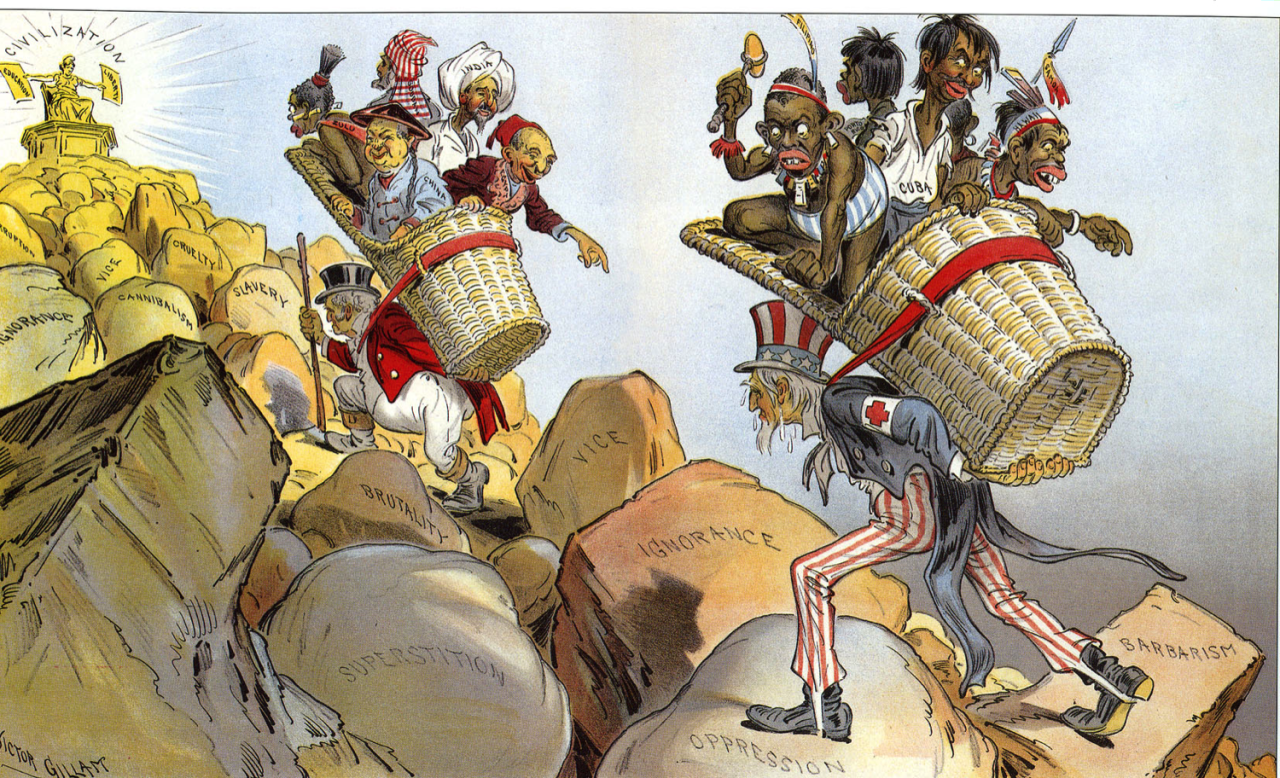
A major stated motivation for the expansion into these territories was the 'civilizing' of the native populations. Here is a political cartoon showing Uncle Sam is forced to give the Philippines the plow of civilization by the horses of Justice and Humanity. Here is another extremely racist cartoon showing Britain and the US carrying their respective territories on their backs from barbarism and superstition towards education and liberty, and the US's are the Philippines, Puerto Rico, Cuba, Samoa (annexed 1899), and Hawaii. If you've ever heard of Kipling's "the white man's burden," this was it. It was seen by some as a moral obligation, though others saw it as an unwanted burden. At this time, Hawaii wasn't seen as any different from these other territories, no more likely to become a state.
(Read /u/The_Alaskan's post below for more background, it wasn't all driven by race.)
Another US territory story: When the government of Colombia refused to let the US build a canal through it in 1903, the US created/backed a revolution that lead to the creation of the country of Panama, and the Panama Canal Zone was officially US territory from 1903-1979.
The US also intermittently annexed various islands throughout the 20th century. But the 20th century also saw independence or revolutionary movements in basically every colonized country globally, including those territories taken at the end of the 19th century. Some movements failed (there were revolts in Puerto Rico in the '50s, but of course it remains US territory today), but as all major European powers decolonized, the US changed its approach to foreign policy. After WWI, the US became strongly isolationist, no longer interested in overseas wars. Of course in WWII Japan would occupy the US' many Pacific Territories, and the US fought to reclaim them, but by the beginnings of the Cold War, the rhetoric of Manifest Destiny was long gone. Intervention in foreign affairs with the goal of propping up anti-communist governments was the plan, no longer adding territory or civilizing people.
As /u/xiaorobear stated in another post, the United States' 1898 claims on Hawaii were not its last territorial adventure. To add to the Philippine-American War and the Spanish-American War that he mentioned, I'd add the purchase of the Danish Virgin Islands (now the American Virgin Islands) in 1917 and plans for the purchase of Greenland in 1946.
I'm going to take a somewhat contrarian approach to /u/xiaorobear's post, however. About 10 years ago, Eric Love published a book called Race over Empire that argues that American imperialism was conducted despite racism, not because of it, and that racist attitudes worked against American expansionism. The idea of "white supremacy" and "white man's burden" is the traditional view, but if you look at the arguments and rhetoric of the time, you get a different picture. As Love states in his preface:
"... racism had nearly the opposite effect: that the relationship between the imperialists of the late nineteenth century and the racist structures and convictions of their time was antagonistic, not harmonious (and no class understood this more acutely than the foreign policy establishment itself); that imperialists, contained by the expectations and demands of the racial social order, neither spoke nor acted in the manner usually presented in the historical literature; that they did not overwhelm the racist invective of the anti-imperialists with more potent racial rhetoric (fighting fire with fire); that, instead, they reacted with silences, disingenuous evasions, and denials that race had anything to do with their expansionist projects.
In short, imperialists knew what most historians in recent years have overlooked: that in an era marked by as much racial fear, hatred, reaction, and violence as the last decades of the nineteenth century-by the collapse of Reconstruction; the reversal of civil rights and equal protections, condoned by the U.S. Supreme Court; by the final suppression of Native Americans; by the defeat of the Federal Elections Bill of 1890 (called the "Force Bill" by its enemies); by segregation, disfranchisement, and the lynching of thousands of African Americans; by immigration restriction and other reactions against the so-called new immigrant groups, such as the founding of the American Protective Association and the Immigration Restriction League; by Chinese exclusion and gentlemen's agreements-no pragmatic politician or party would fix nonwhites at the center of its imperial policies.
I'm sorry for the lengthy blockquote, but that's literally three sentences.
In any event, I find Love's argument persuasive: That some of the biggest opponents of 19th century American imperialism were racists. Look back at the Mexican-American war, for example. Sen. John C. Calhoun, a virulent racist if there ever was one, loved the idea of annexing Texas (which had a significant white population) and the northern two-fifths of Mexico, but he objected to plans to annex portions of Mexico farther south because its population would be "subversive to our free and popular institutions," he said in a speech.
Calhoun was fine with incorporating white-owned (or dominated) territory into the United States, and he was fine with incorporating territory containing American Indians, because their populations were thin on the ground and ─ perhaps most importantly ─ they were not citizens. Annexing significant portions of Mexico would bring Mexican citizens into the United States, and the U.S. could not simply abrogate Mexican citizenship without severe international consequences. (It was done on a small scale, anyway.)
In the Spanish-American War, you see the United States seizing Spanish possessions but never considering incorporating them as states ─ again because of that anxiety about nonwhite citizens. If you believe the "white man's burden argument," it would have made perfect sense to annex Cuba and incorporate it as a state. The United States did not, because of that dread of nonwhite citizens. President Grant, after the American Civil War, made secret plans to annex the Dominican Republic (Santo Domingo at the time), but was defeated by legislative resistance. In his Personal Memoirs, Grant wrote that he sought annexation to save the United States from a race war by giving black Americans a place to emigrate to.
American territorial expansion was not driven by racism. Rather, it was retarded by racism. Far better, contemporary Americans argued, for these failed states (as they were seen) to be allowed to fail on their own than to have the United States dragged down with them.
In addition to u/xiaorobear's comment:
Overseas expansion played a minor role in the lead-up to the Civil War. For the first half of the 19th century, tensions over slavery were kept at bay by a careful balancing of numbers of "slave states" versus numbers of "free states." Westward expansion was in full swing, so states were being added to the union fairly frequently, and each time a territory applied to become a state, an argument would arise as to whether slavery would be legal in the state. Following the Missouri Compromise in 1820, where Missouri was allowed to become a slave state with the provision that Maine be admitted to the union as a free state, states started being admitted in pairs like this to preserve the balance.
But obviously abolitionists and people in free states were interested in tipping the balance in favor of free states in order to eventually abolish slavery across the nation, and people in slave states were interested in tipping the balance in their own favor to make it harder to abolish slavery across the nation. As the century goes on, tensions heighten and civil war is narrowly avoided multiple times as slavery advocates start to play dirty and the balance is tipped first in favor of slave states in 1845 and then in favor of free states by 1858.
To get back to the topic at hand, some slavery advocates made plans to conquer land overseas in order to create US territories where slavery was legal that could then be admitted to the union as slave states. A group called The Knights of the Golden Circle had plans to annex territories in South America, Mexico, Central America, and the Caribbean, including Cuba, although they never made any progress towards their goal. A man named William Walker briefly captured La Paz, Baja California, Mexico, in 1853 and declared it the capital of a nation called the Republic of Baja California, which he intended to combine with the Mexican state of Sonora to create a Republic of Sonora which would then become a US state. Walker was ousted in 1854 and put on trial in the US for violating the peace treaty between Mexico and the US that had ended the Mexican-American War. He was acquitted, and the next year sailed to Nicaragua and conquered the city of Granada, effectively taking control of the country. President Pierce recognized Walker's rule as legitimate in 1856, and Walker declared himself president of Nicaragua later that year and began attempts at Americanizing the nation, including reinstating slavery. Walker was again overtaken by the people he had attempted to conquer, and returned to the US in 1857. In 1860, Walker traveled to Honduras with the intention of trying the same scheme again, but was captured and executed before he could begin plans.
After the end of the Civil War, some citizens of the former Confederate States left North America and established colonies in Brazil, Mexico, and other Latin American countries, including Americana in Sao Paulo, Brazil.