Since this week's theme is agriculture and farming I figured I should take the opportunity to ask something very basic of which I am sadly ignorant: How did farming, and agriculture in general, actually work historically? I have to admit that I know next to nothing about agriculture, neither modern nor historic.
My mental image of historic agriculture is basically a guy digging in the earth a bit, planting seeds and such. I exaggerate but only slightly, the point is that I would very much like a description of historical agriculture that is more detailed and in depth than just the basic "peasants would work the land." I want to know what that actually entails, how it's done, how much time it takes, what tools are used; anything you can give me.
I am of course aware that agriculture has changed over time and varied across regions, but as long as you can describe the agricultural practices in some detail I don't mind if it's only for a specific time or area.
Thank you in advance, this ignorant city kid would be much obliged.
There are a lot of ways to answer your question, and it’s a long and complicated thing, because there are several techniques ancient people used to maximize the potential of their fields. But we’ll just go through some of the basics and take a look at some tools. Much of this will be based on Egyptian techniques, as they illustrate a lot of methods for us in their tomb paintings, but the basic principles and technologies apply to most early agriculture.
Farming requires a couple of things. First, it requires water for the crops. Second, it requires decently fertile soil. For this reason, the earliest farming/agricultural systems happened near river valleys, such as the Nile (flooded every year depositing fertile soil and hydrating the ground), and the Tigris and Euphrates in Mesopotamia. The earliest agricultural efforts in China also happened in river valleys/flood plains, but they are very difficult to excavate because the alluvial buildup is so quick that the cultural material is buried extremely deep and hasn’t been thoroughly investigated until very recently. Agriculture near rivers is the easiest way of obtaining water for crops, and some groups (such as the Egyptians) would make canals to bring water from the river over to the crops.
Ok, so the ancient people in question have found a good location with fertile soil and a reliable accessible water source. What is the next step? How do they go about growing the crops?
The first step is to turn over the soil, to mix it up (and sometimes to mix in a fertilizer such as sheep/goat dung), to break up the lumps, remove the rocks, and prepare the soil for lots of plants and roots. To do this, they used tools. They could use tools similar to shovels, hoes, and rakes to “till” the soil to prepare it. A very ancient depiction of such a hoe can be seen in the Scorpion Macehead, where the Predynastic King Scorpion of Upper Egypt holds a hoe as he prepares to dig a foundation for construction around 3100 BC. These hoes would have looked similar to this reconstruction. The blades might be made of a hard wood, or they might be made of another material, such as flint or bone (especially the shoulder or scapula of an animal).
Of course, tilling by hand is very hard work. So people sought to find a way to harness the power of animals to do much of the work for them. This brought the invention of the ploughing ard, a really big hoe that was dragged behind a harnessed animal such as an ox. Sometimes, in the absence of such an animal, the ploughing ard was dragged by people. Both can be seen in the paintings in the tomb of Paheri in Egypt (18th dynasty, ~1500-1200 BC).
The seeds would be sown into the tilled ground, most likely by scattering them by hand into the field. Then the seeds would be trampled into the soil to protect them from birds and other pests. Additionally, you could do the process in reverse, sow the seeds and then till them into the ground. Both methods have been observed in Egyptian tomb painting.
Once the seeds are planted, the job is far from over. Unfortunately, it’s not as simple as “wait until it’s all grown”. Birds and other pests had to be kept away from the growing crops. Any watering of the plants that was necessary had to be done manually in the beginning, until the development of irrigation (and still manual labor was involved). If the crops are to be used as animal feed, they may have been cut while green, prior to when one would harvest for grains. Unwanted plants had to be weeded out from the fields.
Once the harvest was ready, it would be harvested manually by workers using sickles. These tools might take several forms. Early sickles would be a shaft of wood or bone (perhaps a jawbone of a donkey or cattle) that was studded with sharpened flint to make a cutting edge, [like this one](https://upload.wikimedia.org/wikipedia/commons/4/49/Dagon_Museum,Neolithic_Sickle(2).JPG) or like this one. Later they would look more streamlined, but with the same idea, like this one from Egypt. Eventually, when metal was affordable, sometimes they would be made of metal, but the flint blades in a bone or wood handle were very effective, relatively cheap, and used for thousands of years (I’ve recovered flint sickle blades from the Iron Age, some 2000 years after the Egyptian examples and some 8000 years after the second bone sickle version pictured above).
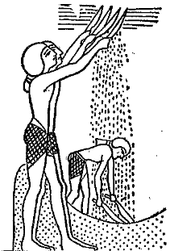
To harvest, one would slowly walk through the field, grasp a bunch of grain and use the sickle to cut the grain by hand, working through the field methodically. Once the grain is harvested, it would be threshed, to remove the husk (the chaff). This might be done by beating the grain by hand on a hard surface, or by trampling it with beasts of burden, or by dragging a threshing sled around on top of it, either by hand or behind a draft animal. These sleds might have a bunch of flint embedded in the bottom of them, and someone might sit or stand on the sled to provide pressure as it was dragged around on top of the harvested grain, like in this picture. The next step was to separate the grains from the husks and stalks (chaff and straw). So workers would toss the threshings into the air with baskets or winnowing forks, so the grains fall to the bottom and the chaff blows away, and the straw (the stalks) can be piled up in the center and used for roofing, brickmaking, or feeding livestock.
Them’s the basics on ancient agriculture. Of course, there are many different subtleties involved, such as raised beds, irrigation, rainfall agriculture, etc. But this should give you a good idea of the basic processes involved. If you have any questions, ask away and I’ll try to answer.
A good book to get an idea of Egyptian agricultural tools and methods is
Also
Bowman, Alan K. and Rogan, Eugene, es. Agriculture in Egypt: From Pharaonic to Modern Times (1999)
Edit: fixed a couple links