[deleted]
When we talk about the Irish experience in America, it's important to distinguish between Catholic Irish immigrants and the Protestant (so called 'Scots-Irish') colonists. The vast majority of early Irish setters were actually Protestant - descendants of the Scottish and English planters who had settled Ulster during the 17th century. These Irish largely settled in the interior instead of the cities, served in great numbers during the revolutionary war (though not necessarily due to any lingering Irish nationalism ), produced a President in Andrew Jackson, and were generally well integrated into contemporary American life.
Anti-Irish discrimination and racism was largely a result of mass Catholic Irish immigration in the mid-nineteenth century. Huge numbers of Irish arrived in America from the 1830s onward, causing no small amount of consternation among the established classes. For example, 37,000 Irish arrived in Boston (a city of 115,000 people) in 1847 alone. Quite a shock to the Mayflower descended elites, no doubt.
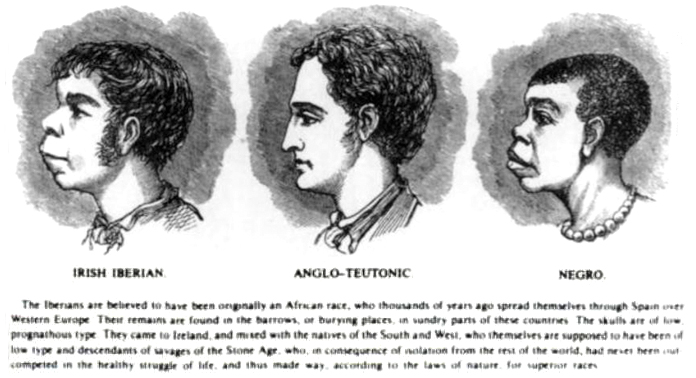
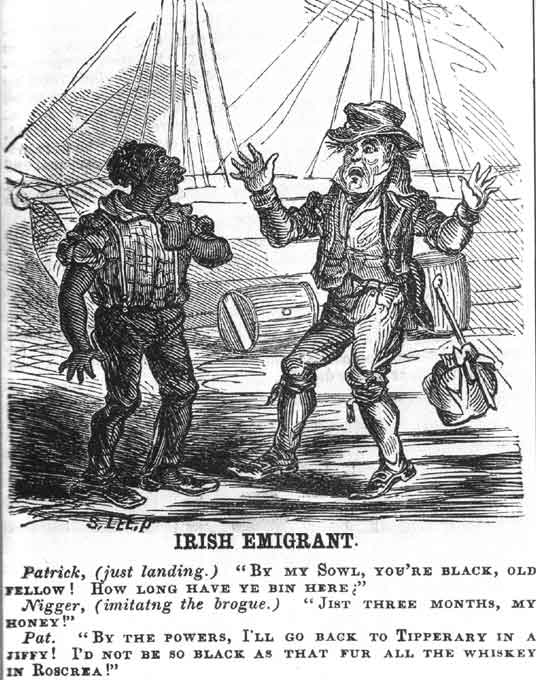
Racism toward the Irish generally took on two forms: the caricaturing of the Irish as drunken, servile, lazy and violent, or through the more insidious application of scientific racism.
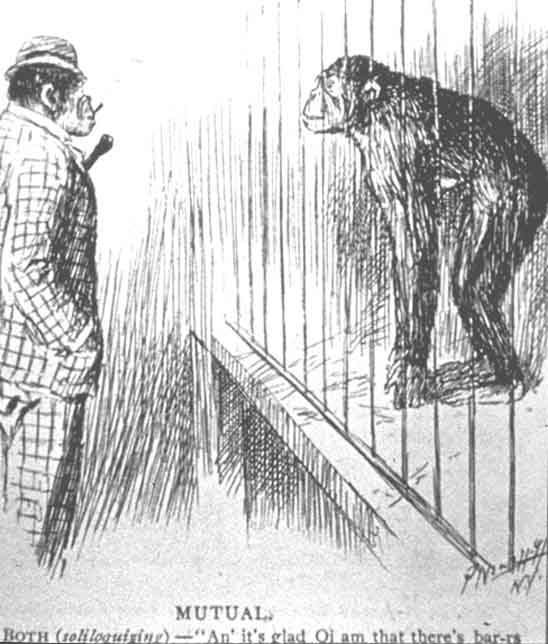
The Catholic Irish were often lumped in with the 'blacks' and 'chinaman', as part of an ostensibly subhuman grouping. This cartoon from Harpers Weekly, for example, shows an 'Iberian' Irishman - supposedly descended from Africans - and clearly simian in appearance. Irish woman were portrayed in a similar manner. In this cartoon, both Irishman and ape give thanks that the bars separate them and here the possibility of the Irish and Africans intermixing is caricatured.
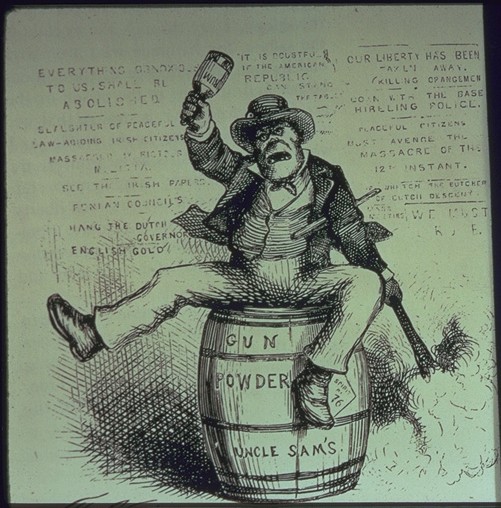
The famed and feared cartoonist Thomas Nast more or less perfected the simian caricature of the Irish: top-hatted, gap-toothed and altogether bestial in appearance (surprisingly, Nast supported the abolition of slavery, native American rights and Lincoln's election campaign in 1864. He also created the version of Santa Claus we know and love today).
The second strand of discrimination was - of course - the 'drunken, shiftless Irishman' stereotype. Richard Outcaults 'Hogan's Alley' series portrayed Irish communities as chaotic, thuggish and drunken places. This image from 1867 shows a typical St. Patricks Day for the Irish.
Oh, how things have changed...
There was also an idea that the Irish were simply too unruly to assimilate into American society. This 1882 cartoon from Puck magazine shows Russians, Negroes and Germans sleeping peacefully, while Uncle Sam exclaims to the Irishman: 'Look here, you, everybody else is quiet and peaceable, and you're all the time a-kicking up a row!'". Another from Puck shows an Irishman (appropriately simian) refusing to mix into the mortar of American life.
The great Irish migration to the New World produced an great deal of resentment and fear, particularly when it came to employment, which in turn supposedly justified a great deal of racism toward the Irish. That's not to say that every American shared these views, but they were widespread enough that mainstream publications felt comfortable publishing this kind of material. The Irish were only one of several ethnic groups treated this way, and racism toward the Irish - despicable as it could be - was certainly not the worst suffered by minorities at the time.