Today:
You know the drill: this is the thread for all your history-related outpourings that are not necessarily questions. Minor questions that you feel don't need or merit their own threads are welcome too. Discovered a great new book, documentary, article or blog? Has your Ph.D. application been successful? Have you made an archaeological discovery in your back yard? Did you find an anecdote about the Doge of Venice telling a joke to Michel Foucault? Tell us all about it.
As usual, moderation in this thread will be relatively non-existent -- jokes, anecdotes and light-hearted banter are welcome.
Weird week. I gave a private talk on Wednesday to General Michael Hayden, former director of both the CIA and the NSA (a potent combination). The President of my university was there, along with a handful of much bigger wigs than me. I felt a little out of place, I have to admit — I am a pretty small fry here (a second-year assistant professor in the humanities, at an engineering school), so to be one of the basically four professors whose work they highlighted was both an honor and, well, kind of ridiculous. But hey, they wanted me there, so I was there. I know which side my bread is buttered on. I hope they felt good about their decision! :-)
I talked about the importance of taking a historical perspective when thinking about American secrecy, in particular if one wants to imagine ways of reforming or improving it in the future. (This is one of my jams when I talk to people in the policy world — history, it ain't just for fun.) It was, I felt, very well received, helped perhaps by the fact that the General himself had a B.A. and M.A. in history (so the next time someone asks, "what can you do with a history degree?", I can answer, "well, you could run the CIA and the NSA, perhaps!").
Anyway, I wrote up an account of my talk (with some pretty amusing photographs, I think) for my blog post this week: My conversation on secrecy with a Super Spook. I also Storified my Live-Tweeting of his talk later that afternoon.
TIL that Ph.D. students dismissed for plagiarism can get this desperate. (PDF)
A 91 years old lady got her PhD in my university ! I think this is so cool that she kept doing her research for so long. Her research was about immigrant workers in the city, making her thesis useful in both geography and history.
The Guardian even made an article about her !
Why does the American nobility allows the peasant rabble to "vote" for their emperor instead of allowing a righteous man with the Mandate of Heaven to rule over the unified Americas?
By the way yes, I am continuing my binge on manga set on the ancient China period. Why do you ask?
The research phase of a big project I've been working on is almost over. I'm definitely feeling confident about my knowledge of the subject and the solidness of the bibliography I'm using.
I'm also really grateful to the sub. My writing isn't the best, so being able to practice my writing and getting positive feedback is really welcome. Thanks, everyone.
Can someone explain why Furet's work devastated the historiography of the French Revolutionon? I've seen him mentioned multiple times and I still don't understand. :/
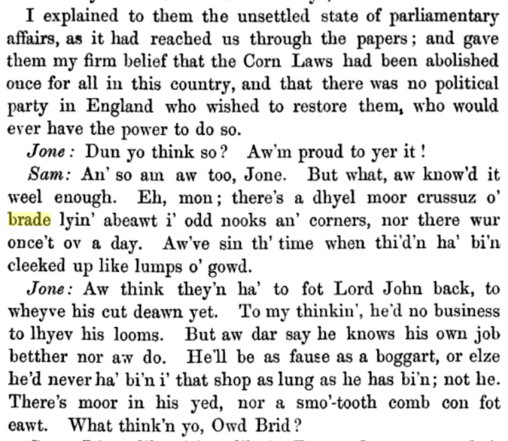
Anyone want to take a stab at translating 19th-century Lancashire country-talk? Some of this I can make sense of, some of it is... challenging.
It's from Edwin Waugh's Sketches of Lancashire Life and Locality, 1855
Alas, the Kon Tiki II expedition has ended prematurely.
They made it from South America to Easter Island, but "atypical winds" (possibly from El Nino) kept them from completing the return trip - supplies were running low. They requested assistance from the Chilean navy after 114 days and 4,500 nautical miles, and wound up being taken aboard the freighter Hokuetsu Ushaka bound for Chile.
Forgive a bit of indulgence, but I did promise this last week so I figured I should deliver. While my latest blog entry starts off with some goofy stuff (what anime I've been watching and what videogames I've been playing), I do provide a little bit more background on the actual writing process of my dissertation you guys might find interesting :D
That'll probably be the last post I make about my dissertation for a while...until my profs get back to me and I have to get started on my second draft ;D
I was wondering what some professional historians think of media that's based in history.
I recently found out about this YouTube channel called History Buffs that goes through history based films and analyzes some of their inaccuracies. I'm a history undergrad, but I was wondering if I could get the opinions of other people. Do you think there is some value to movies that take certain liberties with history? Do films or any media have a duty to inform people of "true" events? Is the fact that films based on historical events get people who aren't extremely interested in history more important than the fact that it can give them false information about the past?
How were people and animals possessing different colored eyes perceived throughout history?
A lot of times there are dogs that have (and very commonly) one brown eye and one very bright blue eye. This also happens in humans too, though very quite rare.
A lot of times in movies, they are shown to be very important characters.
In different eras, civilizations, and empires, how were different-colored (or...bicolored?) eyed animals (like dogs) and humans treated by people?
Anyone know where I can find a collection of university level history essays (on any and all topics)? I'm doing it in school now and want to improve my own essays and they are interesting, but whenever I search I just get websites asking for money to write one for me.
Currently embroiled in an argument at CMV about US Civil War infantry combat. I don't think there's much evidence engagement ranges commonly passed 200 yards or so, mainly due to the lack of marksmanship training or general visibility on the battlefield. Would appreciate if anyone has sources on doctrine or data re: engagement ranges.
I have a theory that Frederick the Great's leniency towards the death penalty had to do with Katte. I'm sure that many people have thought this, but I've never seen it brought up the way that theories of his abolition of torture were brought up. Is there any evidence to suggest that I'm wrong?