Today:
You know the drill: this is the thread for all your history-related outpourings that are not necessarily questions. Minor questions that you feel don't need or merit their own threads are welcome too. Discovered a great new book, documentary, article or blog? Has your Ph.D. application been successful? Have you made an archaeological discovery in your back yard? Did you find an anecdote about the Doge of Venice telling a joke to Michel Foucault? Tell us all about it.
As usual, moderation in this thread will be relatively non-existent -- jokes, anecdotes and light-hearted banter are welcome.
I'm nearing the end of my more recreational period in South Africa, and getting ready to put my nose down to the wheel in the archives. The National Archives has actually restricted consultation of records; realizing that they could not keep up with requests, they've limited researchers to 25 items per day. This is a measure I understand because the reshelving table used to get really, really, really backed up, sometimes for weeks. I will ask the command structure about limited exceptions to that rule, because I tend to go through more than 25 on some days, and I am there open to close (830 to 1600). Fortunately, restrictions on photography have not worsened, so it's just the text documents.
I need to make the most of the first weeks in April because with any luck I shall at long last get into Zimbabwe next month. Supposedly the Research Council will make a decision on my application next week (maybe) and then, two weeks later, I should be able to fly in. But so far the process has taken over a year and a half, so anything is possible. Those of you who do research in more permissive lands (myself included, most of the time), thank your lucky stars. Eish.
In case you had not heard, the remains of a huge Bronze Age battle was discovered in northern Germany. Flint and bronze weapons, horses, wooden clubs, and evidence that some of the fallen warriors were struck down from behind as if they were fleeing was found at the site. What deepens the mystery is that many of these people showed dietary isotopic signatures that point towards an origin in southern Europe. Some preliminary DNA testing was also done which point to relatio s with modern Scandinavian, Polish, and southern European populations
I learned the other day that some hardline Polish nationalists (specifically during the 1800s, in which Poland no longer existed) held the belief that the nation of Poland was the geopolitical manifestation of Christ, and that Poland had literally died for the sins of the nations which opposed it (mostly Austria, Germany, and Russia, but to a lesser extent Sweden, the Ottoman Empire, and others). Today this belief is known as 'romantic messianism' or more specifically 'Polish messianism'.
I'm on holiday in Edinburgh, and have just discovered that my interests historical are now so refined and precise that I couldn't find a single book in the entire history section of Waterstones that I wanted to buy. This is a terrible state of affairs.
Mini-Review. Half way through the Jonathan Sperber's biography of Marx. It's really fascinating to get such a detailed study of Marx's action and thought as it evolved from his student days up to his revolutionary politician and exiled intellectual days. Especially one so well written.
It seems like the book has been given the academic seal of approval but I can't help but notice how Sperber really seems to focus on negative aspects of Marx. I'm not a Marxist (though I was trained in orthodox Marxist historical method), but I feel like something is missing when I'm halfway through the book and, based on the author's caricature of Marx, I don't understand the loyalty of his friends or his influence among German intellectuals. Sperber talks about how well the Manifesto was received and how brilliant it was, but Marx already had an important following before that. The author has as one of his main objectives removing Marx from his pedestal, but it seems that in attempting to do so he overcompensates and paints a picture overly concerned with negative aspects of Marx's personality and actions without explaining why he inspired such love, admiration, loyalty, and support. It's probably a book that makes a lot more sense if read in the context of excessively positive books which are more politics than history, but as a stand alone it feels off to someone not overly familiar with that historiographical context.
How to survive Time travel, the definitive edition:
A barroom conversation started about how stupid it is to think anyone could travel back to the "middle ages" and survive; linguistic differences, no knowledge would be practical to apply, etc. etc. However, we went further and the question became:
If you had a year to prepare using all modern knowledge you have access too, and then you would be transported back in time to a random "city" (any dense human habitation) anywhere in the world, randomly between the year 500 AD and 1500 AD, what would be the most useful skills to learn?
So I ask you, historians of reddit: If you had exactly one year to prepare to be sent back in time to a random city between 500-1500 AD, what would you try to learn in that time?
Clarifications:
I'm reading Bennett's Ale, Beer, and Brewsters in England, and have noticed a word being used in an unfamiliar way: slippage. She uses it to describe her potential error in counting married versus not women in brewing assizes, whereas I'm used to seeing it only in finance. I couldn't help but wonder if it was just a quixotic word choice on her part, if it has a specialized meaning in history, or if she was just purposefully avoiding using a technical term when she's not really doing that kind of analysis.
I've got a question for you guys: where and how do you find a place to stay while you're doing archival research? And how do you not get homesick? Up until now I've always done research in London or England, which is easy enough to navigate and never for more than a month or two. But my developing dissertation project might send me to Barbados or Jamaica for six months. Which would be super cool, but I don't know the first thing about it. It's a long way off, but the thought of just dropping into a country and not knowing anyone is sending me into a very slight panic.
Im reading through Josef Matuz's "The Ottoman Empire" and its fairly good in giving the reader a perspective of the Ottoman Empire, be it its rise or downfall (aka "the sick old man at the Bosporus") and even some insight into its society and religion.
What struck me was something that reminded me of the Austro-Hungarian Empire and its south-eastern territories. When the Ottoman Empire advanced into Europe and came to the territory of nowaday's Bosnia, in a fair part of nowaday's Croatia (here I dont quite remember perfectly, but I thought also Slowenia or parts of it) Austro-Hungary deployed a tactic of miltarizing this region. People, who would settle down in this region were given land to farm and were free from paying taxes but had to serve military (here im paraphrasing, im lazy now, this is even from another source). This established the "Military Border" in which settled down mostly people, who fled from the Ottomans. As a side note the Serbs, who settled down there, stayed until the recent Balkan Wars. (Aka "Krajina"-Territory) But to come to the point, the Ottoman Empire had something similiar, but something already well established - the Timar-System. Where military service was also bound to receiving "land", but in this case never really owning it, more like taking its outcome as your payment, while having no authorities over the people farming that land and having the possibility of being taken away from you at any time. The land belonged still to the Sultan. This system fascinated me. But I may be vague about it because the book doesnt quite dig deeper in this field. I assume, it wasnt for any military rank and later it showed that this system was doing well only as long as there were conquests to satisfy the promised land for these soldiers, and thus was causing dissatisfaction in peaceful times (amongst many other factors of course). But its not my field of expertise, but overall Eastern Europe (without Turkey) is, so thats why it got me interested.
I really recommend it!
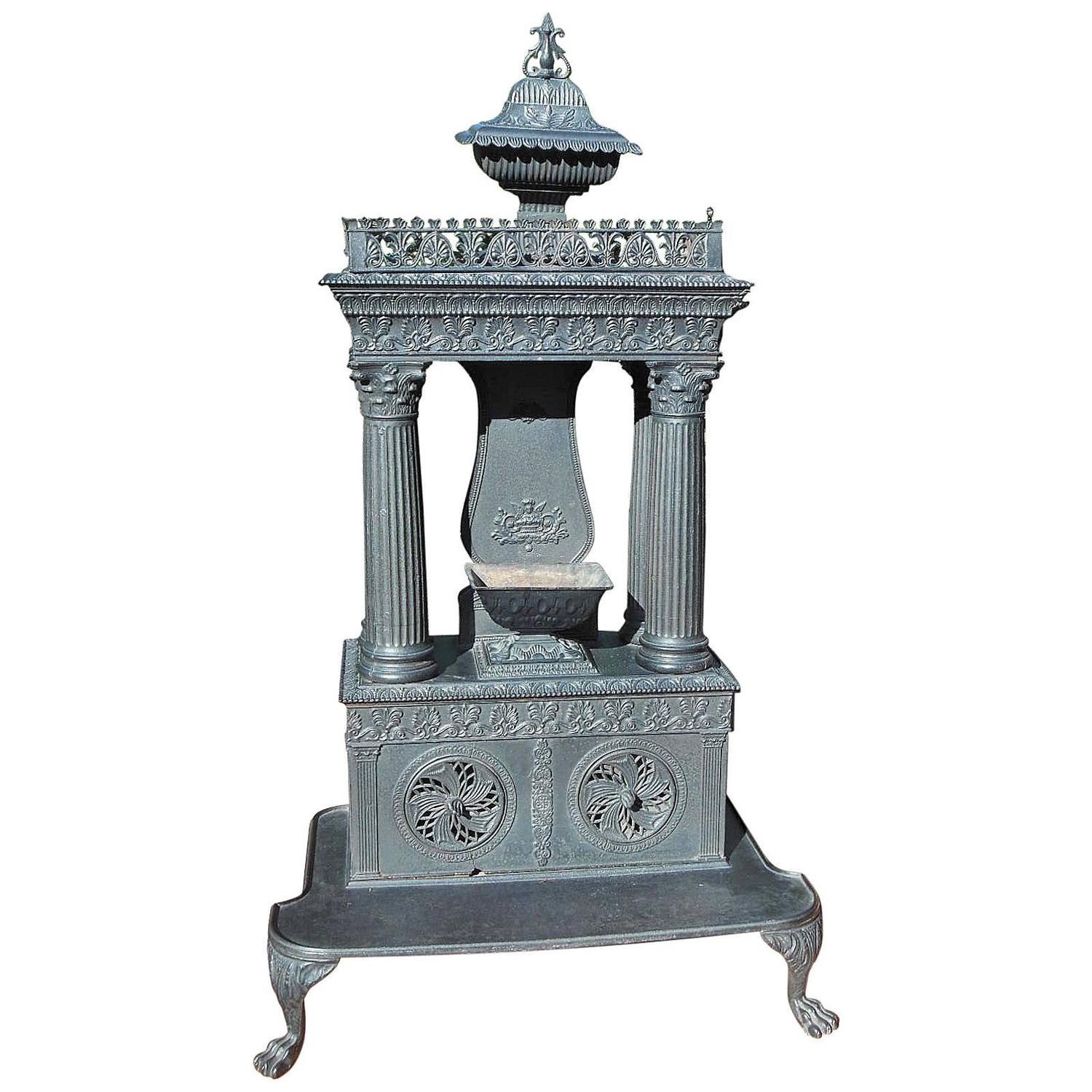
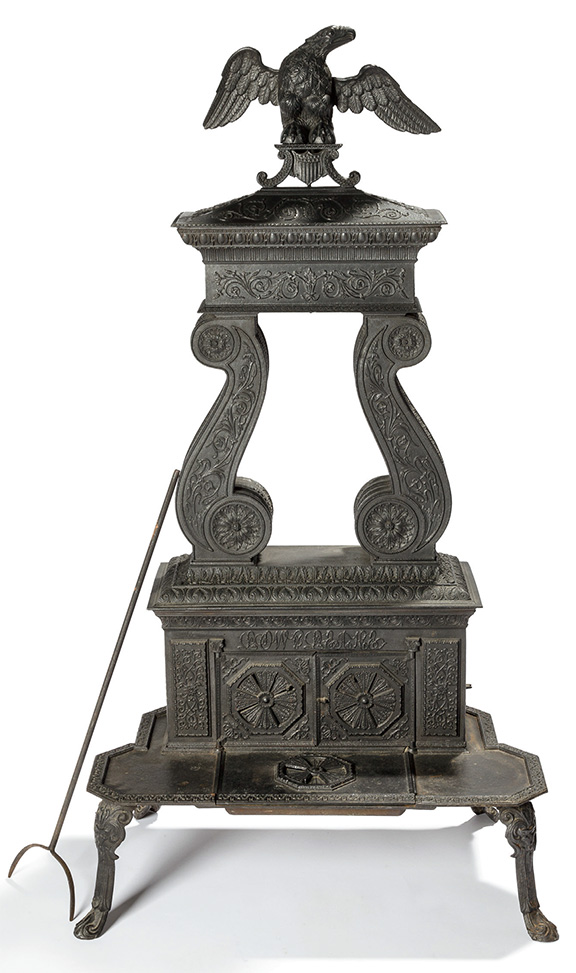
I just got back from a trip to upstate New York. Many of the local history/art museums had these curious-looking cast-iron "pillar" stoves. This picture is representative of the style. Here's another one from online. Apparently these classically-styled cast-iron stoves were popular in the early-to-mid 19th century, and the area around Albany and Troy was a center of their manufacture.
I'd never seen anything quite like it before, and found it the level of detail to be quite intriguing. Did the "pillar" design serve any purpose, or was it just to look pretty?
I've been thinking of expanding my loose knowledge of alcohol history and bar history recently, and the recent "Hey we want (37 new) Flair!" reminded me of that. However, as of now a lot of my knowledge is ... while not apocryphal or anecdotal... perhaps not well sourced.
So, I was chatting with a friend about this, and he went "Huh, well, where would you even learn about that kind of history?" Turns out, I don't know either. Thus, this question:
What's a good process for expanding your area of expertise when you're kind of quasi-comfortable in it, and it "feels" niche enough that modern pop-history (or the pop-history included with many cocktail books these days) doesn't seem to cover it adequately? More specifically, does anyone know of any good places to start in Bar/Alchohol/Cocktail history?
I somewhat worry that I'm just over-thinking this and it's much easier than I've lead myself to believe...
I read a book about Crusades once and cannot recall the name, the book described a siege battle in northern France where tunnels were dug under the walls and then packed with pigs which were then set on fire. The idea was that pigs fat could get very hot and damage the stone wall. Since then Ive never heard any mention of this type of siege tactic, was it ever actually used?
Watching a PBS film, "The 1916 Irish Rebellion" and it is fascinating.
Does anyone know any good books related to the subject?