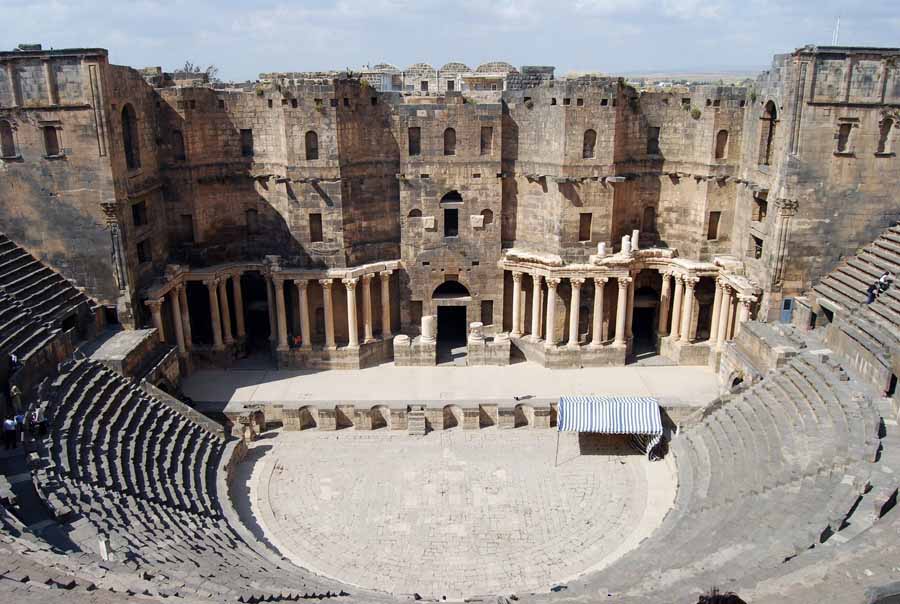
I know 18th century opera stagings used forced perspective staging, and that the singers would have to hang out in the front of the stage or else recreate the tiny Stonehedge scene from Spinal Tap. But to be honest I don't know much else of anything about it! What's the history of this staging technique, and why did it fall out of fashion?
Forced perspective has actually been around for a quite some time in the theatrical world, though it was wasn't referred to in that way. The Romans actually developed a forced perspective pretty nicely with their scaenae frons (the whole back wall in this image).
Forced perspective in the way you're thinking of it, I believe, came about during the Renaissance with Sebastiano Serlio, who designed stages with a single perspective, layering various set pieces in order to make the space appear larger than it was before.
As to why it fell out of fashion, I can only speculate. Melodrama came about in the 19th century, where a need for spectacle came, like setting building on fire on stage, as in The Poor of New York (here's a tiny image of that). And at the turn of the century, Strindberg made realism extremely popular with Miss Julie (picture of the original set). We seem to still be in the realism phase of set design, though the incorporation of more digital and electronic elements is on the rise as well.
I hope this was adequate.
Sources: The Renaissance stage: documents of Serlio, Sabbattini and Furtenbach by Allardyce Nicoll
edit: grammar and spelling