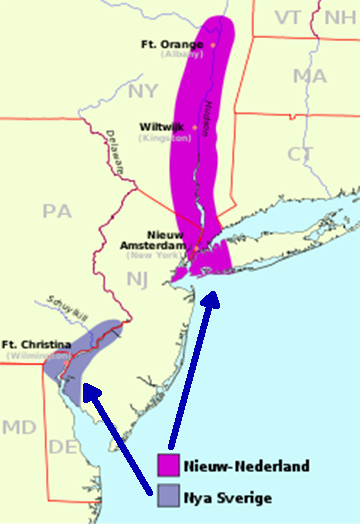
Those curious to see where these two colonies were in an overlay of a current day map of the US, see this graphic.
New Netherland (singular), like most other colonies in North America, had vague and ambitious claims to much of the surrounding area. Three main rivers defined its limits: the Zuydt Rivier (the South River, now the Delaware), the Noordt Rivier (the North River, now the Hudson), and what is now called the Connecticut River. The Dutch say they were the first Christians to claim the Delaware Bay, in 1609, and considered it to be their territory. (1) One of the first governors of New Netherland, Peter Minuit (appointed 1626), was fired from his post by the Dutch West India Company in 1632 for reasons that are unclear. In 1638 he joined a Swedish expedition, and using his knowledge of the area, led them to the Delaware river. They erected Fort Christiania near present-day Wilmington, thus founding the colony of New Sweden.(2) The Dutch governor of New Netherland at the time, Willem Kieft, was busy pursuing a disastrous policy of war against the Native Americans along the Hudson, and made no attempt to stop the Swedes. Over the following years, numerous forts and small settlements would be built by colonists from Sweden and Finland, some remnants of which still exist today. New Sweden is an interesting colony about which little has been written, but it is most notable because, unlike other colonies on the Atlantic Coast which based their economy on trading resources between native tribes and Europe, New Sweden seems to have engaged in intercolonial trading among the American colonies more than it traded with (Old) Sweden.
Kieft's policies of war were soon met with disdain by the residents of New Netherland and he was replaced by Governor Peter Stuyvesant in 1647. Apparently on his own initiative, Stuyvesant rallied a fleet of 11 ships and more than 100 soldiers from across New Netherland and assaulted New Sweden in 1650, attempting to reincorporate the territory into New Netherland.(2) Some forts were taken, and new ones erected, but a lingering Swedish presence remained. Two years later, the First Anglo-Dutch War broke out, and Stuyvesant withdrew many of his troops to New Amsterdam to defend against English attacks on Long Island and from Connecticut. In the meantime, new Swedish forces managed to sneak into New Sweden and strengthen it. After the war was over, Stuyvesant invaded New Sweden again, and this time managed to permanently establish control (although control is maybe an overstatement, it was to remain a sort of 'Wild West' within the colony with little oversight). To prevent further insolence, he enriched some of the ramshackle forts with colonists and transformed them into permanent settlements. Though the area remained largely autonomous, it served as useful buffer against English incursions from Virginia, and holding it (however loosely) allowed New Netherland to ignore this threat and instead concentrate its efforts on defending itself from New England.
The Dutch influence on New Sweden can still be seen in the names of some bodies of water in the area. Like many rivers and creeks in New York, some bodies in Delaware and New Jersey contain the word 'Kill,' such as the Schuylkill River, the Murderkill River, the Broadkill River, and the Whorekill River. 'Kill' is an old Dutch word for a river or creek.
The influence of New Sweden on New Netherland is less obvious, but still of note. Though the Dutch settlers were primarily of the Dutch Reformed Religion, the Swedes (and Finns) were primarily Lutherans, and many of them moved to New Amsterdam, the capital of the Dutch colony. Together with the Quakers, and an influx of Jews from Dutch Brazil, Stuyvesant was faced with a religiously diverse colony that he couldn't handle, and tried to enact strict laws regarding the practice of religion in New Netherland. These oppressive laws were deemed unbearable by those it oppressed, and lead to the "Flushing Remonstrance." This was an appeal to the Dutch government in Europe to grant them the religious freedom that they would have had in the Dutch Republic, and it was successful.(3) This marks one of the earliest arguments for religious freedom in America. Also, the Swedes and Finns in New Netherland contributed to the early ethnic and linguistic diversity of the colony, and helped make it the melting pot of cultures that it has been ever since.