I'm interested in the conflict between Israel and its neighboring states particularly with the six days war... additionally, anybody have any good documentaries you recommend watching?
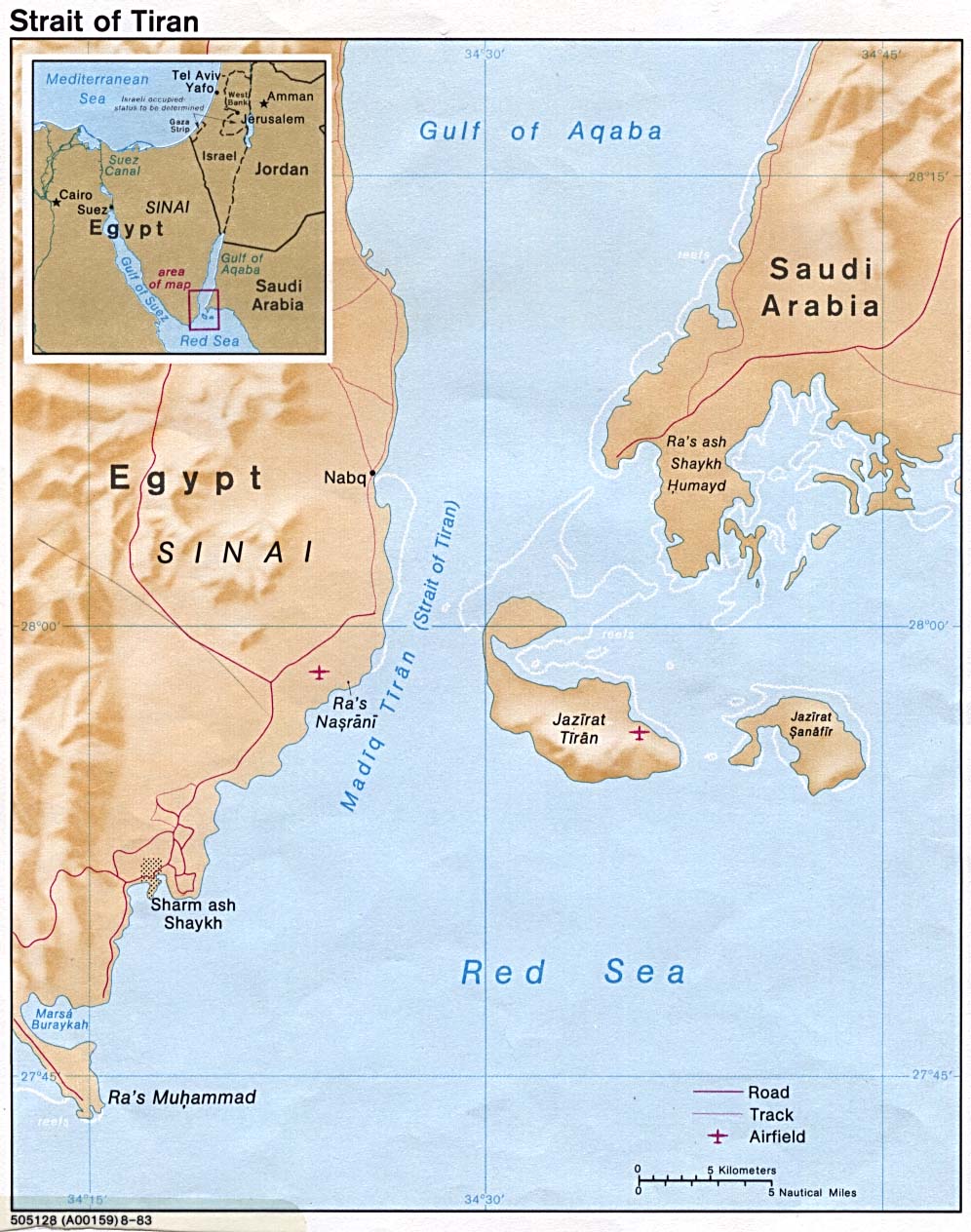
The most immediate cause of the Six Days War was a conflict between Israel and Egypt over the Strait of Tiran. This Strait was vital for the export of Israeli oil and goods to the outside world. It is connected, northward, to Israel's key port of Eliat, and around the horn of the Sinai to the Suez, India, and the rest of the world. For years before the Crisis, Egypt had begrudgingly kept the Strait open to Israeli traffic, largely thanks to pressure from the United States. However, as a result of changing events and political realities, the Egyptians came to see Tiran as a bludgeon with which to attack the legs of their enemy Israel. By closing the Strait, they could attack Israel, provoke it, test America's resolve and commitment to Israel, and rally Arab support behind Nasser's government. If everything went poorly, then the Israelis would have to launch an attack to open the strait back up across the inhospitable Sinai Peninsula against a well equipped, well motivated, experienced army. By closing the Strait of Tiran on May 22nd, Egypt hoped (and succeeded) in provoking a political crisis which would place it at the center of an Arab coalition against Israel, while simultaneously dividing Israel from its chief allies in the west.
However, placing the conflict in that limited context gives Egyptian diplomats and politicians far too much credit for actions. Egypt and Israel were working within the context of a much larger situation in which many countries and leaders interacted pushing for and against conflict.
As with most of the Arab-Israeli conflict, the Six Day War has its roots in the '48 War. Unable to defeat Israel in 1948, the Arabs were again humiliated when the Israelis seized the Sinai in 1956, and were only prevented from securing further gains by the intervention of the Western Powers. Following Israel's success in the Suez Crisis, Egypt and Syria formed a military and political union called the United Arab Republic. However by 1961, this Republic had already collapsed in everything but name.
All this left Egypt in a dominant position within the Middle East as a major powerbroker, but also physically and politically isolated from her former allies and friends. Egypt needed something which would galvanize the Middle East, bring it together, and tie countries (especially Syria) back to Egypt.
In steps Israel, who nobody liked, and who spent most of the 1960s pissing off her neighbors. Specifically, in 1966 Israel shattered the tense peace between her and her Arab neighbors by authorizing an incursion into Jordan later called the Samu incident. This raid, aimed at destroying a violent PLO stronghold, backfired politically. It shattered the fragile relationship between Israel and Jordan, and it allowed regimes like Egypt and Syria to portray Israel as an aggressive power intent on violating its neighbors borders and conquering territory. When combined with a number of other disputes, major and minor, Egypt was able to convince Syria, Jordan, and much of the rest of the Middle East that Israel was a threat to them.
In steps Egypt again. While Egypt and Israel wrangled political for most of the 1960s, militarily, Egypt became heavily involved in the Yemeni Civil War. In trying to be a regional power, Egypt intervened in the War, and by 1965 had deployed 70,000 troops to the country and had taken tens of thousands of casualties. This war taxed Egypt's manpower, its finances, and sapped its military of strength. While the Army looked outwardly powerful, equipped with the latest Soviet weapons and thousands of experienced soldiers, inwardly the Army was weak, suffered from low morale, and had frittered away much of its strength.
All this is to say that by 1967, Egypt was looking for a small political that would redirect attention away from Yemen and towards Egypt. Nasser wanted Egypt to be the center of the Arab world, and he felt that by provoking Israel, a country his compatriots all disliked, he would build Egypt up as a regional power. And if Israel challenged his move, then the powerful Egyptian Army would check their movement in the Sinai. For Egypt, the move seemed like a safe move, filled with more reward than risk.
And for Israel, Egypt's moved were taken in the harshest possible way. Egypt's actions in Tiran were viewed as a direct challenge to Israel, while the mobilization and deployment of the Egyptian Army to bases in the Sinai were the prelude to an imminent invasion. By rebuilding the coalition of '48 and threaten Israel in that manner, Egypt seemed to be poised to attack. Israel politicians and planners believed that it was only a matter of time before the Egyptians again escalated the situation. By allowing the closure to exist, Egypt created a new and unacceptable status quo, and allowing the buildup of forces in the Sinai, Egypt threatened Israel's heartland, its economic ties to the world, and its mysterious research facility in the Negev Desert. They resolved to launch a preemptive strike which would cripple the Egyptian Army and put Israel in the position of negotiating a new status quo, rather than letting the Egyptians negotiate for them. The stage was set for one of the greatest military feats of the post-war period.
Sources:
Six Days of War: June 1967 and the Making of the Modern Middle East, Michael Oren
Key to the Sinai, the Battles for Abu Ageila in the 1956 and 1967 Arab-Israeli Wars (Note: more of a tactical study than a strategic overview, it still provides interesting context into why the Sinai was important, and what led both the Israelis and Egyptians to consider the region vital in both conflicts.)