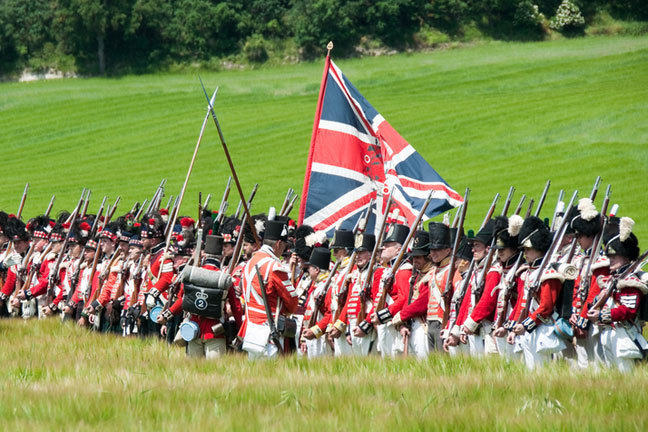
Sure, a musket is more lethal but troops wearing woolen clothing would scatter under a hail of arrows.
Yes, it could take years to perfect the bow and arrow but it seems like it would wreak havoc against a formation like this:
https://ugc.futurelearn.com/uploads/images/9a/54/hero_9a54dcda-2c22-477d-9446-f4f2a637f57e.jpg
Similar questions to this have been asked before and there are some pretty good answers on the wiki
https://www.reddit.com/r/AskHistorians/wiki/faq/militaryhistory#wiki_early_firearms
There was the occasional thinker from time to time who suggested returning to bows (notably Ben Franklin once recommended that the entire colonial army should be armed with longbows), but it doesn't seem to have ever been seriously considered.
Armies with muskets did continue to fight archers from time to time during the 18th - 19th century. During the Napoleonic Wars the french faced large numbers of Bashkir and Tartar horse archers fighting for the Russians. These bow armed-troops were quickly nicknamed "cupids" and the french found them very non-threatening.
From the Memiors of General Baron de Marbot:
With much shouting, these barbarians rapidly surrounded our squadrons, against which they launched thousands of arrows which did very little damage because the Baskirs, being entirely irregulars, do not know how to form up in ranks and they go about in a mob like a flock of sheep, with the result that the riders cannot shoot horizontally without wounding or killing their comrades who are in front of them, but shoot their arrows into the air to describe an arc which will allow them to descend on the enemy. This system does not permit any accurate aim, and nine tenths of the arrows miss their target. Those that do arrive have used up in their ascent the impulse given to them by the bow, and fall only under their own weight, which is very small, so that they do not as a rule inflict any serious injuries. In fact the Baskirs, having no other arms, are undoubtedly the world’s least dangerous troops.
However, since they attacked us in swarms, and the more one killed of these wasps, the more seemed to arrive, the huge number of arrows which they discharged into the air of necessity caused a few dangerous wounds. Thus, one of my finest N.C.O.s. by the name of Meslin had his body pierced by an arrow which entered his chest and emerged at his back. The brave fellow, taking two hands, broke the arrow and pulled out the remaining part, but this did not save him, for he died a few moments later. This is the only example which I can remember of death being caused by a Baskir arrow, but I had several men and horses hit, and was myself wounded by this ridiculous weapon.
I had my sabre in my hand, and I was giving orders to an officer, when, on raising my arm to indicate the point to which he was to go, I felt my sabre encounter a strange resistance and was aware of a slight pain in my right thigh, in which was embedded for about an inch, a four-foot arrow which in the heat of battle I had not felt. I had it extracted by Dr. Parot and put in one of the boxes in the regimental ambulance, intending to keep it as a memento; but unfortunately it got lost.
You will understand that for such a minor injury I was not going to leave the regiment, particularly at such a critical time…
During the American Revolution, Benjamin Franklin suggested this idea to the Continental Army. It all comes down to training. You can train someone to just aim and shoot a musket, bows are more complicated. Muskets can double as a pike when a bayonet is plugged or attached. Muskets produce devastating firepower and surprisingly easier to produce ammunition. A longbow can take years to master while a musket is just point and shoot. Let's say a fire-by-rank tactic is being used against an equal number of bowmen the line infantry would win. A musket ball going pretty fast will beat both armor and wool.
There are several reasons I can think of, one you have already mentioned in that it takes far longer to train an archer than it does a musketeer.
A reason that is related to that is that, in terms of exertion, it's much more demanding on the body to pull back a bow with a lethal draw weight (let's say in the case of longbows at LEAST 80 pounds, often over 100) sixty times than it is to load and fire a musket sixty times. If a disease or plague or other illness goes around the army - which was quite common during these time periods - then lots of your archers won't be able to fire out of how weak they are. By contrast, since it's much easier and much less strenuous to load and fire a musket, you can keep men in worse health in service for longer. Robert E. Lee's Confederate army was starving and near bone-thin in some cases during the siege of Petersburg and the Appamattox campaign but they were still delivering ferocious volleys and pushing forward with the bayonet whenever possible.
Archers also need much more material to keep them supplied with ammunition than musketeers. A supply train for a musket-equipped infantry regiment would only need lead and powder and occasionally spare parts for muskets. An archer regiment's supply train by contrast would need spare arrowheads, shafts (which requires a lot of wood), fletchings (which means a lot of dead geese), and spare bowstrings, firing gloves, and in the case of recurve bows, stringers.
Not to mention, the simultaneously largest advantage and drawback of the bow is its firing speed. With a bow, you can expend your ammunition in fifteen minutes if you're just shooting casually, assuming sixty shots, which was common load for musketeers of the same timeframe. Sure, you might try to pick up your expended arrows again when possible, but in the heat of battle, a disorganized mob of men scouring the field for arrows is one hell of a tempting target for an artillery barrage or a cavalry charge. So in effect, your archers fire for fifteen minutes and have to just stay put and hope they don't have to do any more fighting, unless circumstances present themselves in such a way that they can recover some of their arrows.
And speaking of which, archers are quite vulnerable to cavalry, as unlike musketeers, archers don't have bayonets.