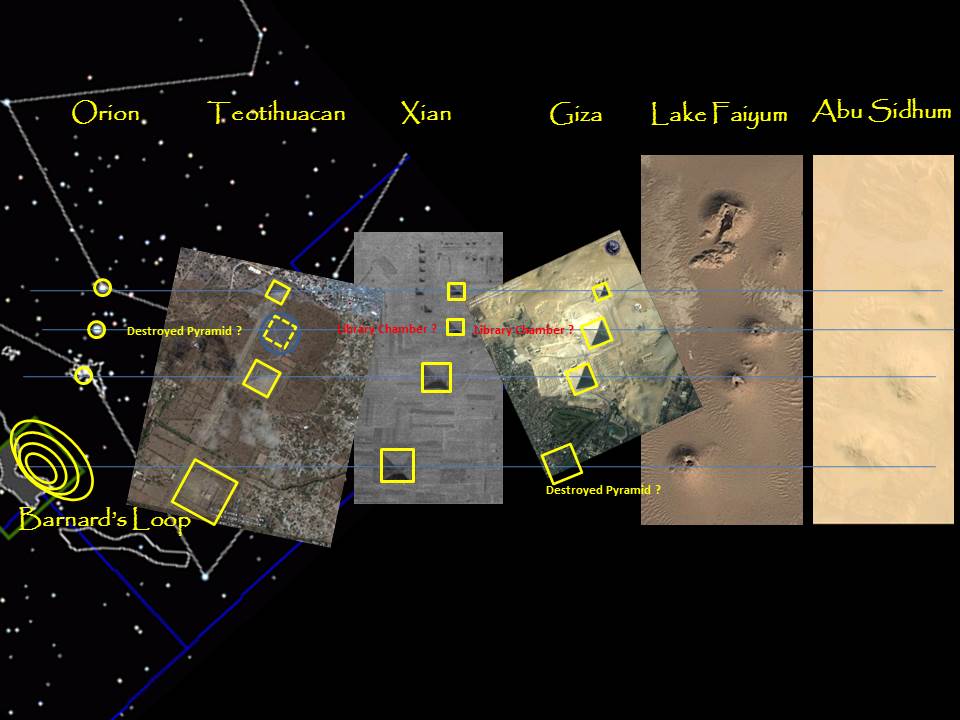
This bothers me so much. What are the chances that the pyramids were used for wireless electricity, similar to what Tesla theorized? Could the Atlantians have actually been an incredibly forward thinking civilization that, when their land began to be lost to the ocean, spread out across the world? That would explain the pyramids all having a similar shape across the world and the boat underneath the sphinx in Egypt
Listen, I know this may sound crackpot. I'm well aware. HOWEVER, if stories of a Biblical flood are true, (which every culture seems to have one, it seems plausible) then histories and culture could have been washed away. Things like the Antikythera Mechanism could also be explained easier this way.
Please, if you have any info on anything related to this, I'd love to read it. And also, if you could, upvote this post. Obviously I won't get any karma from it and it would increase my chances of hearing differing opinions on this. thank you
TL;DR Could ancient civilizations have had technologies that we don't know about? Was Atlantis perhaps a real place? or am i a crazy boy
I am no expert on Plato or the Atlantis story, but there are a couple of things I can add here that may be of use.
The first thing is that Atlantis is a story, used by Plato in the 4th century BC to make a philosophical point about his image of the ideal state. No other ancient source tells us anything about Atlantis. If the Greeks really did preserve some distant memory of an ancient civilisation, it is extremely odd that no one else bothered to say anything about it. In particular, given that Atlantis was supposed to be an expansionist sea power, it really should have featured in Thucydides' list of thalassocracies before Athens. Since no other Greeks (or indeed any other literate civilisation of the ancient world) seemed to have known or cared about Atlantis, the likely scenario is that Plato (who was not a historian) made it up.
Again, it's important to stress just how little we "know" about Atlantis. In all of Antiquity, only one source mentions it. This source places it in the distant west and nine thousand years in the past, even though the Greeks had no more than the vaguest idea of what had happened in their own country as little as three centuries before Plato. Their understanding of any event before the reappearance of writing in the 700s BC was a mix of oral tradition, fanciful legend and divine intervention; their account of anything that happened in prehistory is often staggeringly incongruous with what we learn from archaeological remains. To give just one example, they believed the Mycenaean palaces - built in Greece by Greek-speaking people just 800 years or so before Plato - were built by Cyclopes. Basically, they had no clue how those massive structures got there. Now, how likely is it that Plato (and Plato alone) had an accurate account of a land that supposedly existed 9000 years ago in the endless seas beyond the Pillars of Herakles?
The widespread existence of Flood stories hardly implies that a worldwide Flood ever actually happened. The idea of a cleansing flood or rising waters as punishment from the gods is fairly obvious; it would easily tie into the experiences of any people living near waters affected by the tide, on seasonally flooded plains, or in regions prone to earthquakes and tsunami. There is no reason why such stories should all go back to one great half-remembered worldwide event. In any case, such a flood (and the civilisations it supposedly washed away) should have left significant geological and archaeological traces, but to my knowledge it hasn't (though I may be wrong about this).
There are definitely remains of ancient civilisations that we know very little about. Most of these had no writing system and therefore can't tell us more than what we can glance from the structures they built and the art and tools they produced. But the extent to which their works baffle us is often overstated for the purposes of sensationalism. Meanwhile, the Antikythera Mechanism is pretty securely dated to the late Hellenistic period (2nd century BC - two hundred years after Plato). It belongs to a time of fairly well-attested scientific and technological advances, that also saw the perfection of torsion catapults, the accurate calculation of the circumference of the Earth, and the invention of the basic steam engine.
The pyramid shape thing was something I always kind of thought was dumb so feel free to ignore that part, I just felt like it kind of fit in