So these images are from Attila Total War. I'm playing as the Saxons and I'm about to assault London in 400 AD.
Are any of these a fair representation of what the city would look like in this time period?
I'd like to know a little about the architecture, the fortifications, and the landscape. One thing that really stood out to me were the trees in that album. I don't know what kind of trees they are, but they seem out of place to me. Maybe Roman imports, kind of like how palm trees aren't indigenous to Florida (or is that a myth?) The same for the church.
And how about the size of the city? I've included an overhead view. It's a little dark, sorry. But relative to the Thames, is that fairly accurate for the year?
Last, but not least, how about the equipment of the Saxons? There's a shot of a cavalry unit and the general's (Gewis) unit.
Any resources on the city at this time frame would be greatly appreciated, too, since I'm pretty sure I'm asking questions across a bunch of different specialties.
Wow, this game looks fun!
In general terms, a lot of this is decent. It falls apart in the specifics, but is still one of the better game depictions of this period that I've seen.
The architecture is, in general terms, representative of a late antique Roman city. I'm not as familiar with London's archaeology as I probably should be (most of what we know is from small digs that happen every time a new building is built, and I can't keep up!). I think there may have been more towers on the wall (which were largely decorative), and I can't comment on the accuracy of the street plan. But the overall effect is absolutely recognizable as a late Roman N. European city. I would probably have guessed Cologne or something similar. The church reminds me of several I've seen elsewhere in the Roman world, and fits the generic model well.
The tall narrow trees are poplars, and are native to England (though they do look iconically Mediterranean / Italian, and I suspect the designers did include them to make the city feel 'Roman'). I'm not sure if they were used in urban gardening, or if the designers chose them purely for effect. I do know that chestnuts were popular inside some cities in the fifth century.
The biggest problem with this version of London, though, is that it looks too clean and tidy. By the beginning of the fifth century, all towns in Britain, including London, were experiencing extreme contraction. They were expensive to maintain and, as Roman power shifted back toward Italy, the local elites were increasingly unwilling, or unable, to maintain the urban infrastructure. As a consequence, things like tht forum would have shifted purpose. Instead of being empty, clean, and open, you'd see wooden workshops filling the space. Some of the public buildings might have been converted into workshops, too. There should be pigs eating the chestnuts that are fallin from the trees. There should be a lot more dirt in the streets (all late Roman towns in Britain have a layer of 'black earth' (organic dirt) over their Roman pavements, meaning they weren't brushing the stones clean like in this game). Basically, the town would look more run down, but also more productive and alive than it does here. I think the designers are trying to emphasize the contrast of Roman vs. barbarian, and have shown the city as a literal monument to Roman civic accomplishment, when the reality would have been a bit more like Detroit: shabby, but full of creative energy, urban gardening, and exploitation of the now defunct public spaces.
If you want to read an academic text about towns in Britain that will go into more detail about how they changed in this period, I would recommend Adam Rogers, Towns in Late Roman Britain. If you're ever in London, do go to the Museum of London. It's not as famous as the British Museum, but it has wonderful collections and displays, and a wealth of material on the late Roman and early medieval phases of the city. Higly recommended.
The Saxons soldiers here are a mixed bag. The designers have chosen to blend together a lot of different Anglo-Saxon (and in some cases, Viking) things, rather than portraying a strictly fifth century idea of what a band of foederati (barbarians serving in the Roman army, like the Saxons were) would look like.
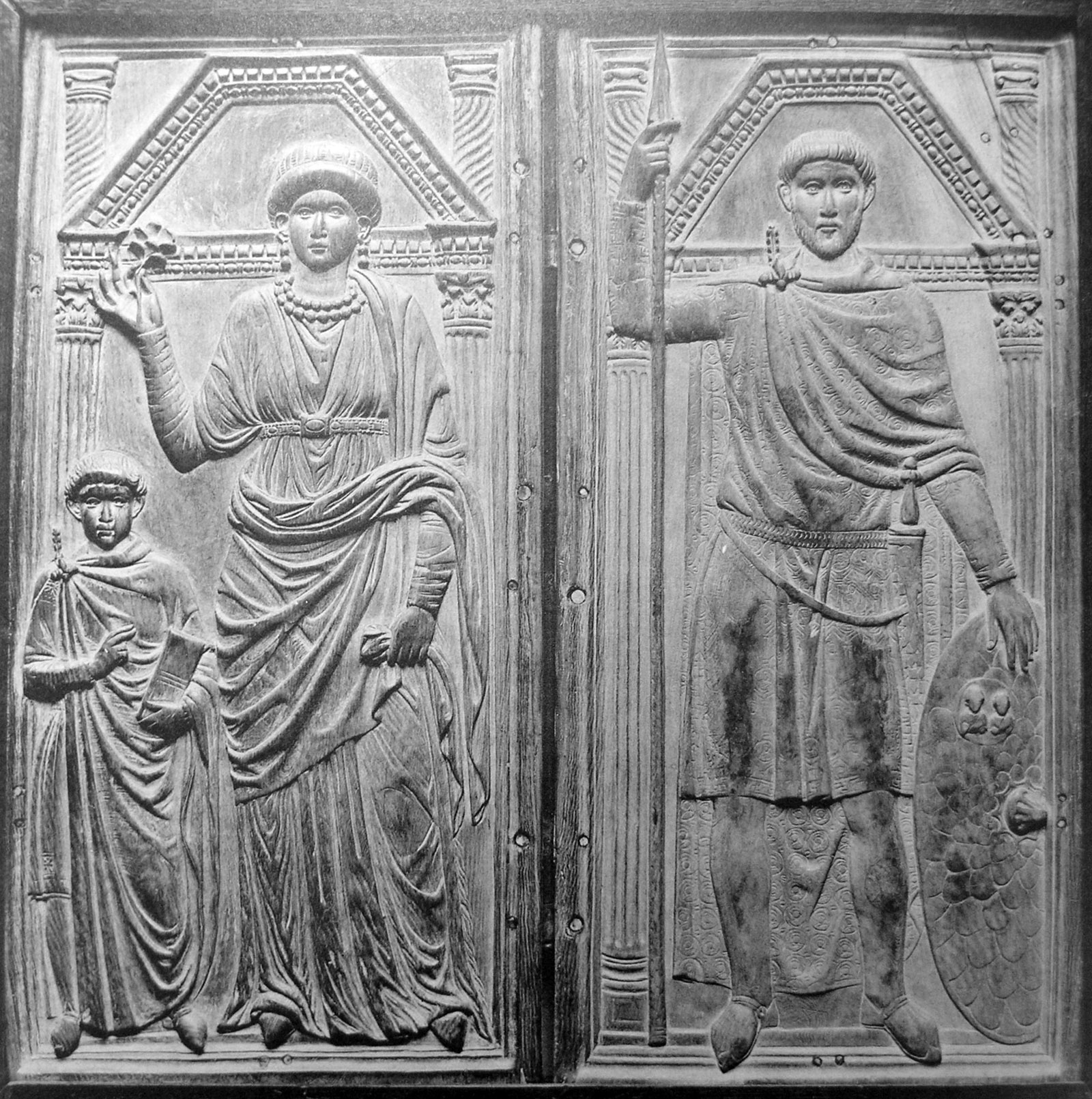
This is an image of Stilicho, a Roman military commander who was part Vandal, and who is dressed in the costume that was popular among both Roman and barbarian soldiers c. 400. We have excavated graves of warriors in England who, from isotopes in their teeth, seem to have grown up in Germany (so, they'd probably have identified as 'Saxon', though ethnicity, citizenship, and immigration can be more complicated than simply where a person's born), that date right around 400, and the stuff in their gaves is basically identical to what Stilicho has. The most famous of these burials are from Dorchester on Thames (near Oxford), but there are some burials from Mucking, at the mouth of the Thames, that are the spitting image of Stilicho: they have a shield, cloak pin on the shoulder, spear - clearly, the people who arranged them in the grave wanted the bystanders to see exactly the same image of a powerful military man that you get from Stilicho. The point? That's what you should look like if you're a soldier from 400, plus a mail shirt and helmet.
The guys we see in the game are from a wider time period. The leader's helmet is based on the helmet from the Sutton Hoo ship burial. It's the most famous Anglo-Saxon helmet, but its owner was buried shortly after 600 - that is, 200 years too late. The helmet itself was probably made in the sixth century, but still: rather far off from 400. There are also soldiers here wearing the 'Wollaston' helmet, which is also 7th century. But, I'm seeing some fourth-century helmet too that are much more like what you'd expect to see on cavalry c. 400, specifically some variations on this late Roman helmet found in Burgh Castle (England). In 400, this style of helmet would still have been in use. But there are also some later Vendel (ie this) and Viking era (ie this) helmets (7-9th centuries), which look very out of place.
The padded armor some of the figures are wearing looks like a rather tentative artists' interpretation of the seventh century Sutton Hoo warrior's possible cloth armor, but there's also a fair bit of mail on these soldiers, and this is correct for the period.
The shields are decent. Round shields are right, and I won't quibble about the shape of the shield bosses. The painting is conjectural, and should probably look more like these late Roman examples from the early fifth century. The tiny size of ghe sheilds carried by the cavalry is copying iconography you find on a lot of early medieval depictions of Germanic warriors, and is supported by the fifth century archaeology.
The spears, annoyingly, look more like this completely not medieval Cold Steel reproduction than the beautiful, graceful weapons people were really using. Ah well; people always get the spears wrong.
So, on the whole, while many of the details aren't exactly right for this specific year, this is clearly drawing a TON of inspiration from real cities, real archaeology, real armor, real art. It's not perfect, but it has far less fantasy / invention / weird stuff going on than, say, history channel's 'Vikings,' or BBC's 'The Last Kingdom'. It's the best popular media depiction of the period I've ever seen.
Don't rely on it for details, but the immersive experience you're getting from the setting they've created is plasubly late antique, and the best you can find anywhere in popular media outside of a museum or short of doing real archaeological research.