Poor phrased title, I mean: What kind of uniform did they wear and why?
Would they choose a particular branch or section of their country's armed forces over the others?
Would they hold an actual military rank?
To drastically over-simplify, men who had reached their majority in one of the great houses of Europe frequently would've been made a sort of honorary colonel of a specific regiment. These nobility would've been "full bird" colonels and held their posts sort of like a sinecure -- the actual day-to-day running of a regiment would've been left to the lieutenant-colonel, who was usually a professional officer.
A good example of this is Prince William (you know, the guy who married Kate Middleton -- you probably remember the staggering media coverage in 2011). Despite the fact that he's a major in the Royal Air Force, his status as royalty (and Duke of Cambridge) means that he's also the regimental colonel of the Irish Guards. While he probably has more direct authority as a major than as a regimental colonel, he simultaneously holds both ranks and is expected to be involved with the affairs of the Irish Guards (ceremonial events, the regimental association, and so forth). He therefore would have all uniforms associated with both of those posts. And when he inevitably becomes the regimental colonel of additional regiments later in life, he'll have uniforms for those, too.
The United Kingdom is a bit weird in that women also hold these regimental colonel ranks (Anne, the Princess Royal, is the colonel of the Blues and Royals regiment). She's also the regimental colonel of like a dozen different regiments simply because she was, at one point in time, second in line for the throne. Some regiments further complicate this -- the Rifles Regiment has individual colonelcies that are given out for battalions, not the entire regiment. This may be because the regimental colonel (styled "colonel-in-chief," is Prince Philipp).
Habsburgs and Romanovs followed a similar system. Only, y'know, women didn't hold rank. In the case of Germany in particular, it gets a little odd. You have a lot more different dynasties being involved (while Germany was dominated by the Hohenzollerns, there were a number of relatively important dynasties under them -- like the Zaehringens of Baden, the various houses with Saxe in their name [of which the British Royal Family was one prior to being rebranded "Windsor"], and some others). A number of these royals held meaningful military posts. By all accounts, Prince Friedrich Karl acquitted himself remarkably well in the Franco-Prussian War and (together with the future Emperor Frederick III) was made a field marshal after that war.
Prussia is a bit unusual in that a surprising number of her field commanders were of royal stock, especially in the 19th and 20th centuries. And this was then extended to other constituent states of the German Empire after unification; the Crown Prince of Bavaria would see extensive military service on behalf of the new empire in WWI, eventually rising to the rank of field marshal. He definitely had legitimate military authority and he was surprisingly adept at fighting what was then a modern war.
Sticking just to military uniforms (as opposed to other categories of uniform like court dress, which are another matter entirely), you see two main sorts being worn by European monarchs of the period in question.
First, a monarch would almost invariably hold the highest military rank of their country (in practice, the most senior general's or field-marshal's rank of the army, and the most senior admiral's rank of the navy), and thus would be entitled to wear the appropriate uniform for that rank.
Second, many European countries at this time (including Germany, Austria-Hungary, Russia and the UK) had a system where certain individual regiments (generally, the more prestigious ones) had an honorary colonel as well as an actual colonel (colonel being the highest rank in a regiment). A country's monarch would traditionally hold a number of honorary colonelships, and the rest would be given out to other senior nobility of the country or to foreign nobility as diplomatic gifts.
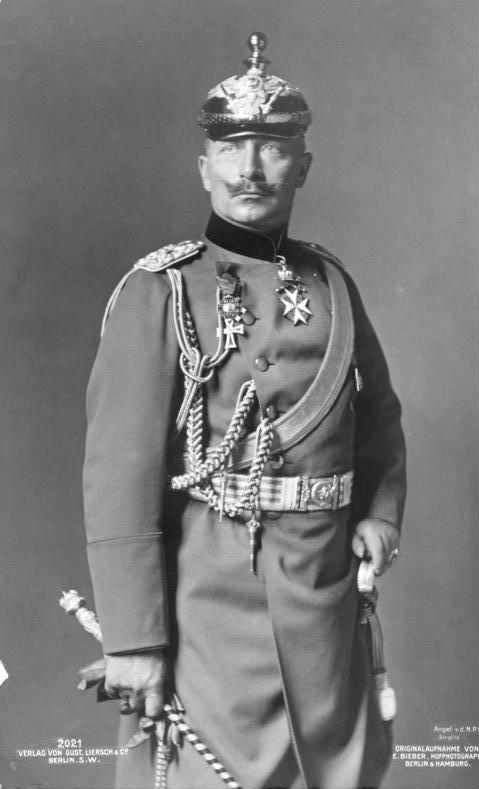
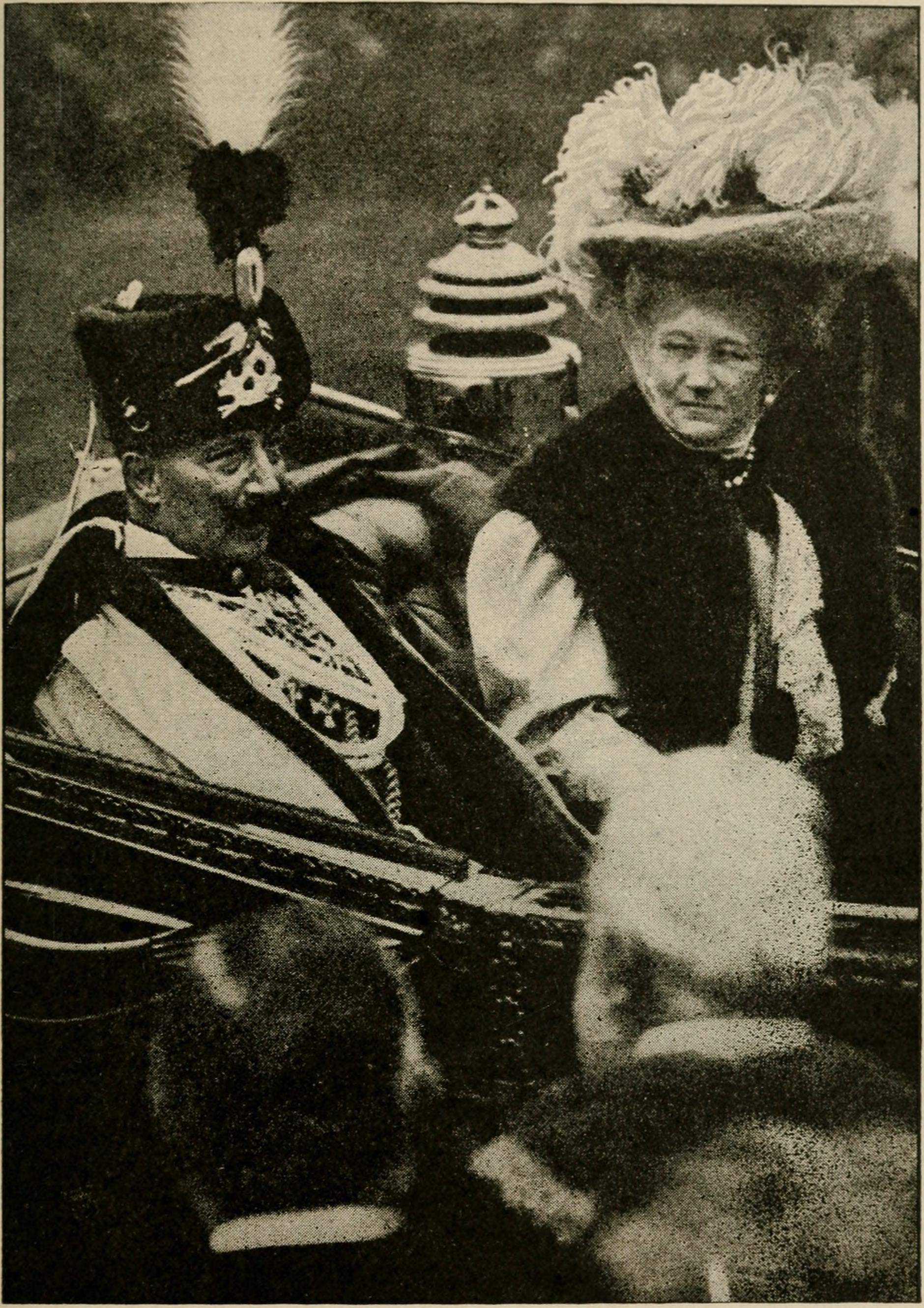
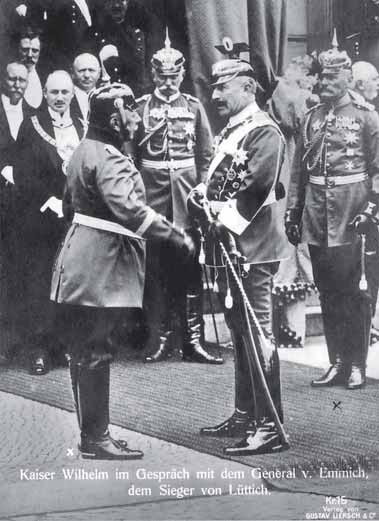
The above is very abstract and generalisation-heavy, so for a more specific example we can look at known uniform appreciator William II. First of all, as German Emperor and nominal head of the country's armed forces he bore the rank of field-marshal, and can be seen here wearing a field-marshal's uniform. He also held a large number of honorary colonelships of prestigious German regiments: we can find him photographed in the uniform of a colonel of the 1st Guard Foot Artillery Regiment, one of the two Lifeguard Hussar regiments, the Garde du Corps, the Royal Hanoverian Lancers, and so on. William II was also honorary colonel of a number of foreign regiments, among which was the Russian 13th Hussars, whose uniform he's wearing in OP's second picture. In the same picture, we see Nicholas II wearing the uniform of the German 1st Guard Grenadier Regiment, of which he was the honorary colonel.
The monarchs themselves were politically / constitutionally senior to the military command structure, which more or less precluded them having a substantive military role.
It was quite common for senior royalty other than the monarch to have military careers often culminating in high command -- seen regularly in the German and Austro-Hungarian empires, for example.
In the UK it was (and continues to be) the custom for members of the Royal Family to have a military career but usually (and by the 20th century invariably) those were 10-20 year careers which ended before the family member could be considered for promotion to flag or general officer rank.