Not really.
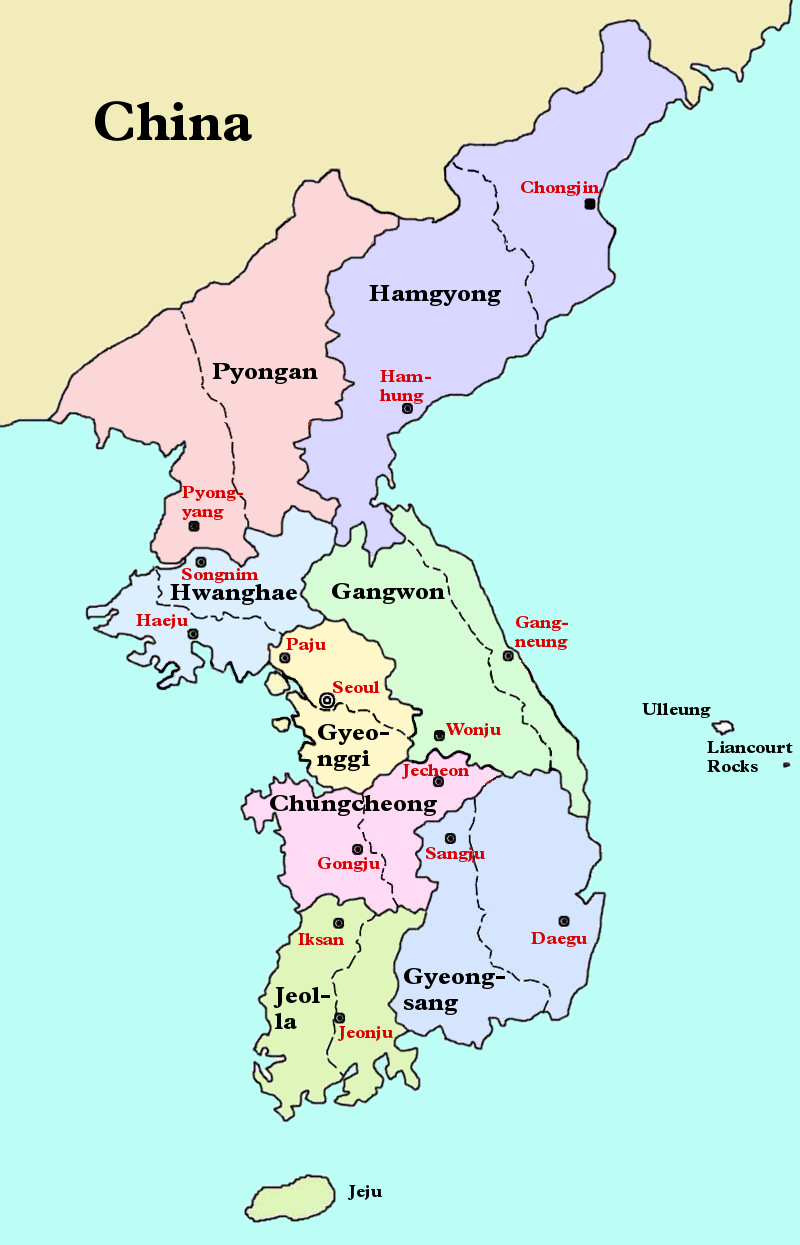
ETA: Forgot to link Korean provinces map. These would have been the provinces in the late Joseon, so the 18th century or so. Here
Culture is a very broad topic, so I'll just discuss literati identity. There were regionalist sentiments in the northwest in particular, equivalent to the Pyong'an province in the map I linked. In 1811, a rebel leader in the area declared, for example:
The government abandons the western land [i.e. Pyong'an] as if it is a land of filth. Even the slaves belonging to powerful families always call figures from the western land "Pyong'an bastards." How shall there be anyone in the western land who does not feel wronged and embittered?
Among Pyong'an literati by the late Joseon, there was a clear sense of distinct regional heritage. This is reflected very well in the Songs of the Western Capital, an anthology of poems with the explicit goal of defending and publicizing the achievements of writers and poets from "our province" - it goes so far as to include a list of writers whose writings are no longer extant, in order to impress Pyong'an civilization upon the reader. This anthology incorporates the ancient kingdom of Goguryeo as a part of Pyong'an heritage, although the kingdom was far larger than just Pyong'an. Many works are explicitly confrontational - there's one long poem where a Pyong'an literatus humiliates a guest from the southwest leading to the latter running away in shame. This is reflective of a generally confrontational attitude among literati, and this was not much helped by various central officials comparing Pyong'an people to animals or calling them good-for-nothings.
However, is this nationalism? No. A key point of the anthology is that Pyong'an is the root of Korean tradition. After introducing various ancient songs, the Songs of the Western Capital anthology says "the way of our [i.e. Korean] poems and songs all originated there." The promotion of Pyong'an heritage is intricately linked to promoting the province as the origin of Korean heritage. This is reflected in linguistic works as well, because Pyong'an dialects were phonologically conservative in some areas. To some in the province, this validated the idea that Pyong'an dialect was the correct Korean. Emphasis mine, from a 19th-century linguistics work:
In the present day, only one province, Pyong'an, has the correct pronunciation been preserved, thereby keeping the old tradition [.....] So I say, as concerns the phonology of the universe, China is to be taken as correct; as concerns the phonology of our country, Pyong'an Province is to be taken as correct. Moreover, it is Pyong'an Province whence originate our language and writing.
Again, the Pyong'an identity is part of, rather than separated from, the broader Korean one. Strong regionalism, but not quite resembling nationalism.
And furthermore, Pyong'an is just one province out of the three that are entirely in North Korea today.^1 In Hamgyong, the largest Korean province, things were very very different. Hamgyong was a frontier area in the early Joseon where expansions continued against Jurchen peoples, so because the cultural inferiority of the area was perceived to be self-evident the literati did not have a confrontational attitude towards discrimination. This was true even in the late Joseon, when the frontier was stable and mostly inhabited by Koreans.^1 Anthologies of Hamgyong works begin with the Joseon period almost without exception, and the focus of pride is not the local past but a connection to central authority, the fact that the Joseon royal family originated in the area. There is no flourishing of unorthodox strains of thought like in Pyong'an; Neo-Confucian orthodoxy (or at least Confucian orthodoxy) is abided to. And it is difficult to find the concept of an encompassing "North Korean" region in Hamgyong texts. So North Korean identity as a concept is a very modern creation, even among the educated.
I would add that regionalism is not unique to the north, and it is in fact a defining feature of South Korean politics nowadays.
Christianity was very big in North northern Korea in the early 20th century, but I am hardly qualified to speak on that. I can comment on other religions.
Korean folk religion in the north generally fits the peninsular models. The creation story collected in the northernmost reaches of the country have similarities with the creation story of the southernmost island, for example. There are distinctions, though. For instance, Hamgyong has much more folk religious epics than most of mainland Korea, including a fascinating creation myth, and Hamgyong gut, or rituals, put less focus on dancing. Hamgyong is interesting for academics in the field because it most likely represents^2 one of the two windows into Korean folk religion with the least Chinese elements, since it's so remote from Seoul and the center (similarly, the other window is Jeju Island, an island to the far south which is separated from the mainland by a strait of respectable size). But this variation in folk religion practice is all very normal in the peninsula.
The Buddhist establishment was very prominent in Joseon Pyong'an (this is relative, of course, since the Joseon government was primarily against Buddhism). But Buddhist literature in the area shows even less regionalism than the Confucian literati; in fact I can only think of one text by a Buddhist monk where Pyong'an regionalism plays a major part, the History of Myohyang Mountain in the 17th century by the monk Chubung. And that wasn't even one of Chubung's more influential works.
Confucianism (which I do not think constitutes a religion) was different in Pyong'an. The Classic of Changes (the I Ching) was more important than was the Joseon norm, which was centered more on the Four Books. There were also some issues with millenarist or religious-based disorder in Pyong'an, though a large religious revolt never did materialize (unlike in southern Korea in 1894).
No. The entirety of Korea was under Japanese rule from 1905 (direct annexation in 1910) to 1945, and Korea had its current northern borders since the 15th century.
The Northern Region of Korea: History, Identity, and Culture is heavily recommended for northern literati. But for folk religion, I don't know if there's a decent English introduction. Encyclopedia of Korean Folk Beliefs is run by the South Korean government and is very good, but last time I checked their English version was, I felt, rather poorly done. But it's still perfectly comprehensible.
^1 There were only around 4000 people left in the 1930s who probably descended from Jurchens.
^2 Or "represented," considering North Korean conditions. Most of academic study on Hamgyong folk religion comes from refugees who fled south during the Korean War. Unfortunately the gut rituals of Hamgyong are dying out in the South as well.