I am writing a novel which I settled around the 14th century. To create a good picture of my cities, I'd like to know how high were some city walls in the 14th century - and could you give some examples? (Like, Londonds city wall was so-and-so high, Viennas city wall was so-and-so high etc.).
Which regions in particular? Keep in mind that by this date gunpowder weapons were starting to be adopted in some regions.
Sorry for the late reply, here's what I can contribute:
The most prosperous and complex urban societies in the 14th century were in northern Italy, particularly Lombardy. The Low Countries also distinguish themselves, but I hold the (naturally biased) belief that the Italian cities were better at defending themselves, not in small part due to their interesting urban defense systems.
Unsurprisingly, the Low Countries and Lombardy share many qualities that contribute to urbanization, one of which is their location: a low floodplain with abundant sources of running water. Consequentially, for Lombard Cities at least, one constraining factor was the abundance of natural and man-made waterways. In this image, depicting the walls of Milan constructed in the 12th century (and never expanded until the 16th century) superimposed upon the city's current street grid by following the blue lines you can see how numerous waterways are. The presence of natural moats would be the city's fist line of defense, and make massive fortifications less than necessary. Milan's medieval walls have been all but demolished, but some gate-houses are still in existence. Here is a gatehouse within the context of the surrounding city. The towers are about for stories, or forty feet high, while the walls are around twenty-four feet high.
Another thing you can observe from the first image I linked is how Milan had two rings of walls. The first ring was constructed by the Ancient Romans, and while the Milanese found it necessary to build a second ring, many cities would continue to be defended their Roman walls right up to the advent of gunpowder. Rome itself would continue to be defended by its ancient walls which were over thirty feet tall (and the towers were even taller!) which were last strengthened in the fifth century (although some new fortifications would be built around the Vatican, across the Tiber, in the ninth and again in the seventeenth century).
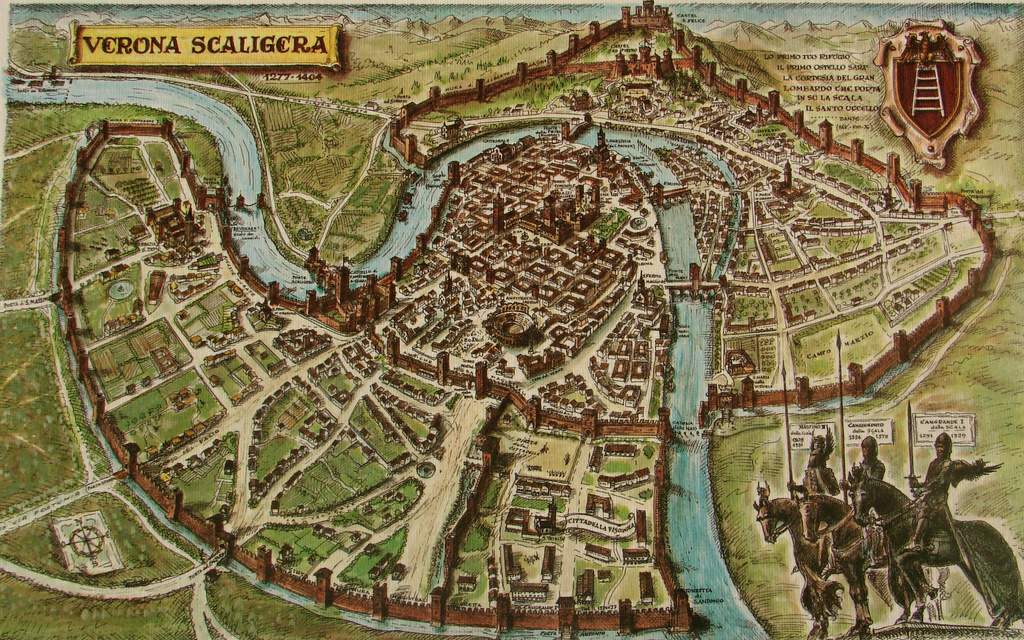
Now, you could say to me, "Wait Alvise, both Rome and Milan experienced periods of relative peace in the late middle ages, doesn't that make them bad examples?" The answer is "Kind of." The Canagrande della Scala, Lord of Verona between 1308 and 1329, waged near incessant wars against his neighbors, briefly carving out a powerful state in Northeastern Italy (which would unfortunately be dismantled by envious neighbors, and be divided between the Milanese and Venetians). Canagrande expanded the walls of Verona between 1321 and 1324. The resulting fortifications were extensive. How tall are the walls? 24 feet, with a moat.
So my point is that three stories, or 24 feet, is a recurring number in wall height. Even the Romans capped themselves off at thirty feet for the walls defending their capital. Also, in large cities which would be defended by armies in the field, walls had the purpose of forcing people to pay tolls to bring goods into the city rather than act as a defense. Vienna, for example, wouldn't have any new wall constructed between the 12th and 17th century. No fortifications would be built in London in the centuries between the Norman Conquest and the English Civil War, and the Norman Walls of London capped off at something around thirty feet (the Norman-era tower of London is ninety feet high and the walls are about one-third as tall, but I don't have a precise number).
London's wall construction is definitely boring because no foreign enemy could easily threaten the English's island home. Paris on the other hand has a more eclectic history wall construction, but that's because the city expansion varied on different banks of the seine at different times, with wall construction made necessary due to the hundred year's war. However, after the last medieval expansion by Charles the V, Parisian wall construction would stop for three hundred years. The walls built by Charles V in the mid 14th century were reportedly 39 feet high, but they stood on top of earth ramparts lined with a ditch. If the measurement is taken from the bottom of the ditch to the top of the wall, I'd safely assume the walls themselves were between twenty and thirty feet tall. So keep in mind that although late medieval walls normally cap off between twenty and thirty feet, individual cities each had different ways of planning their fortifications: the Parisians built their walls atop an earthen mound, Londoners had the Tower of London at one end of the city, and a smaller castle on the other, while Italians had complex systems of Moats and often multiple layers of walls.