Previous weeks' Tuesday Trivias and the complete upcoming schedule.
Happy Russian Cosmonaut Day! In the spirit of the first human in space, here’s an open space to talk about other famous firsts. You can take this any way you like, it can be first-person-who-did-x, or it can be first examples of something, like the first email or telephone call, or anything else you can think up. Or you can do a little mythbusting about historical firsts!
Next week on Tuesday Trivia: April is National Poetry Month, as we all know. So we’ll share our favorite poems from history!
And you may notice if you click the schedule that my trivia bag is a dangerously low on prompts, so if you have any cool ideas, please send them in!
FIRST
Apologies, I could not resist.
In my field, I get to do a lot of mythbusting. One particular myth is that the Greeks always deployed their best hoplites on the right wing of the phalanx, and that Epameinondas at Leuktra in 371 BC was the first Greek ever to place his best troops on the left. In fact, he was not the first to do so, or the second, or the third. It was perfectly common practice among the Greeks to match strength against strength; if one side placed their best troops on the right, the other might decide to place their best on the left and meet them head-on. The earliest known example of this is the battle of Salamis, more than a century before Leuktra. The first time we see it used on land, at Olpai in 426 BC, it is actually done by a Spartan. So much for the narrative of Theban innovations being too much for the conservative Spartans.
Stretching the definition of "first" a bit, but I want to talk about glazes today. Specifically, the independent invention of glazed pottery by Pueblo people in New Mexico in the 13th-14th centuries AD which was the first (and only) invention of glaze technology in the Americas (though glaze technology was independently invented in the Old World earlier).
To start with, a glaze is just a vitrified (i.e. turned to glass) coating applied to pottery. This is achieved by adding some type of flux material to the glaze before it is fired. This flux (often lead, tin, or copper) reduces the temperature at which the glaze will turn to glass.
Now, there are old-world inventions of this technique, particularly Islamic glazing and East Asian (Chinese) glazing. For instance, this lovely celadon vessel. However, the Pueblo potters of New Mexico and the Four Corners region of the Southwestern U.S. also invented a glazing technique, not just once, but twice!
The first time around was a relatively short-lived and spatially restricted invention using copper flux to create a black, glaze paint on existing black-and-white pottery. However, the second time the technique was invented (or rediscovered as it may be - we don't rightly know), the technique spread rapidly throughout most of New Mexico and was in use for more than 400 years from about AD1275 up through the Spanish colonial period, only ending with the Pueblo Revolt of 1680.
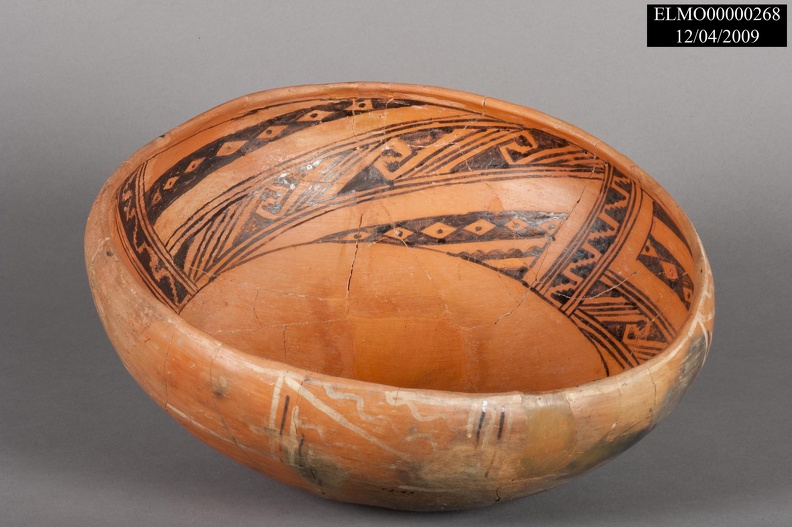
This glaze paint was primarily used on two kinds of pottery, Rio Grande Glaze Wares (like this lovely jar that really shows the brown-black glaze paint - note how the paint shines in the light) and on Western Glaze Wares, from which the Rio Grande Glaze Ware is derived. The technique uses primarily lead as a flux, and there are several known lead mines in the Southwest that contributed to this pottery. Interestingly, in comparison to Islamic and Chinese glazed ceramics which are glazed all over, Pueblo glaze was used strictly as a paint for black designs on the pottery, rather than as an overall cover for the pot.
Edit: Added an example of Western Glaze Ware, black paint on red slip.
Using submarines to land special forces on an enemy shore was done for the first time on August 17th 1942. The US Navy used their two largest submarines, USS Nautilus and USS Argonaut to land the Second Marine Raider battalion at Makin atoll, in the Gilbert Islands.
The Marines used small, two man life rafts, to cross the coral reef, and silently paddle to the unprotected side of the island. After midnight, the entire Raider battalion was ashore and undetected. Their ensuing night time surprise attack shot the place up pretty bad, but the Marines pulled out right after day break. This raid convinced the Japanese to heavily fortify the nearby Tarawa atoll.