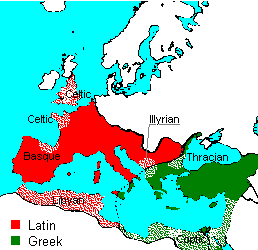
Further, how was Greek able to survive so well in Greece and Anatolia after centuries of Latin domination?
To your second question, Greek had already been the lingua franca in the Near East since Alexander's conquests. By Roman times it was the language of philosophy and learning and so thrived in the Roman world, much as Latin did among Early Modern Intellectuals. After the Roman Empire was divided in 395, the Eastern half adopted Greek as the the language of governance.
we need to look where Latin was spoken. Romans themselves spoke latin but not everyone in roman empire spoke latin and other areas other languages were used. Where latin was widely spoken is now where people speak romance languages, with some exceptions. Areas where Latin wasn't as prevelant spoke something else after collapse. Please see this map
http://peterkirby.com/wp-content/uploads/2013/10/latingreek.gif
http://www.jstor.org/stable/294470?seq=1#page_scan_tab_contents
Rochette, "Language Policies in the Roman Republic and Empire," p. 550; Stefan Zimmer, "Indo-European," in Celtic Culture: A Historical Encyclopedia (ABC-Clio, 2006), p. 961; Leonard A. Curchin, "Literacy in the Roman Provinces: Qualitative and Quantitative Data from Central Spain," American Journal of Philology 116.3 (1995), p. 464.
Herman, Vulgar Latin, p. 12.
Miles, "Communicating Culture, Identity, and Power," p. 58.