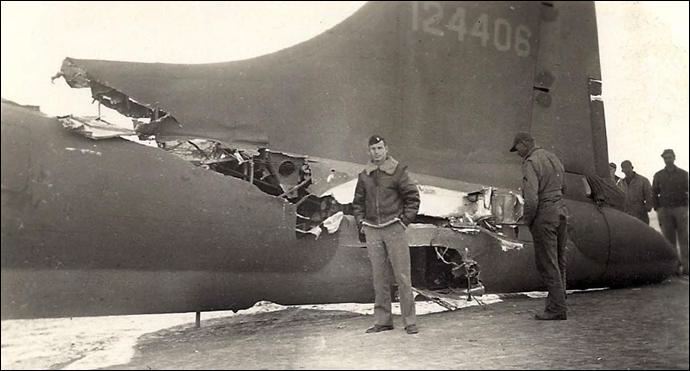
I've always seen images everywhere and heard about in historical stories and books that the B-17 is usually very durable and it can take lots of damage and make it back to safety sometimes with crazy amounts of damage. What makes it so durable compared to other bombers during world war 2 or is it's success reported and photographed more than other bombers? Thanks in advance for any help!
Here are some examples of what I'm talking about: http://www.daveswarbirds.com/b-17/fuselage.htm http://www.daveswarbirds.com/b-17/tail2.htm http://www.warbirdsnews.com/wp-content/uploads/2013/06/ATT00019.jpg
Several things made the B-17 able to be considered "durable", or more so than other bombers;
A general lack of hydraulic systems able to be punctured by enemy shells or bullets. The hydraulic system on the B-17 only operated the cowling flaps and wheel brakes. The other systems on the B-17 were controlled electrically. The control surfaces of the B-17 were manipulated and enhanced mechanically via cables running through the fuselage; there were often several cables moving one flap, not just one. In contrast, most of the systems on the B-24 such as the wheel brakes, landing gear extension and retraction, bomb bay doors, wing flaps, automatic pilot, and the nose turret were run hydraulically, with piping and cables snaking throughout the fuselage. The B-24's control surfaces were manipulated just like the B-17, except with no enhancement. This made the B-24 much more difficult to fly in contrast to the B-17; formation handling was not ideal, and having more than one engine out was a death sentence for inexperienced pilots. The B-24 also had a higher takeoff and landing speed due to its wing design, something that unnerved many pilots.
A large (in area) wing that was capable of sustaining many hits and still perform its function of keeping the plane airborne. Think of the B-17's wing as a tennis racket. The B-24's wing was more like a cricket bat, short chord-wise, fat in cross-section and very long; any damage to the B-24's wing was far more likely to hit critical spars and cause fatal damage. The B-24's wings had a nasty tendency to "fold up" and break off whenever they were damaged.
The B-17 was not without its weak spots, however. A hit to the fuselage at the trailing edge of the wing in the vicinity of the radio compartment could cause the plane to break in half. The wing spar and panels outboard of the number one and four engines were attached separately, making this area weaker than if the wing spar was manufactured as one piece. Solid hits here often caused the outer wing fuel tanks to blow up, or the wing to break off. The B-24's fuel tanks were located in the fuselage "hump" over the wings and inboard of the number 2 and 3 engines next to the fuselage.
To give it its due, the B-24 could also take serious damage and remain airborne. The caption that is printed on the archive copy and often attached to this photo (376th BG, Toulon, 8 June 1944) is dubious as the 376th BG did not even fly a mission on June 8.
Sources: