This question is strongly based on colonial America, for the British from the 1750's to the 1770's, and the Continental army (obviously) in the 1770's. I'm specifically asking about these two nations because they're the only ones I could find images for what the designs might have looked like. (did the French and Spanish also did the same thing with their regiments in colonial America?)
Anyways, wouldn't it be easier to make one uniform design for all the regiments across the colonies for every rank instead? (private, grenadier, sapper, officer, lieutenant, captain, general, you know). I don't get why they would take time to have a different facing colour and design, linings on hats, different boots and shoes. Isn't it inconvenient?
The British
why (in the French and Indian war) did each British private regiments have different coat facing like this, this and this and grenadier regiments like all of these, and then just literally 2 decades after (what is now, the the American revolutionary war) private uniforms look like this and this, and grenadiers look like this, this, and this.
Like, wouldn't it be simple enough for all British privates (during the American rev) to look something like this, and all grenadiers to look something like this? (for example). I noticed that mostly British uniforms are usually portrayed with black facings, while others are portrayed with white, dark blue, and even green facings.
The Continental Army
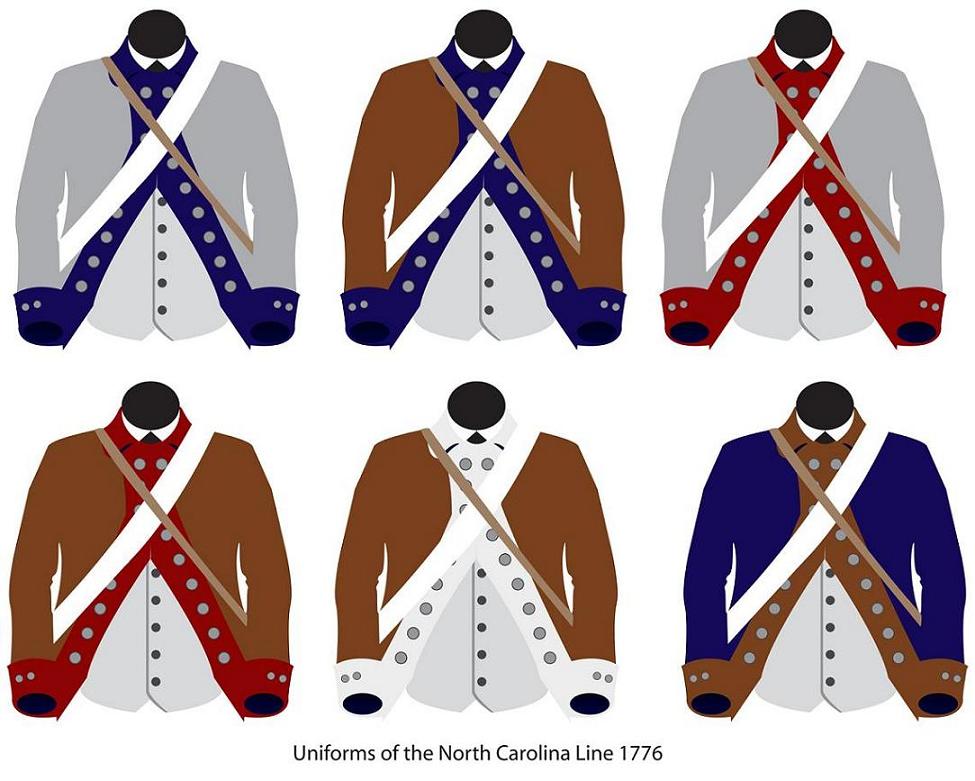
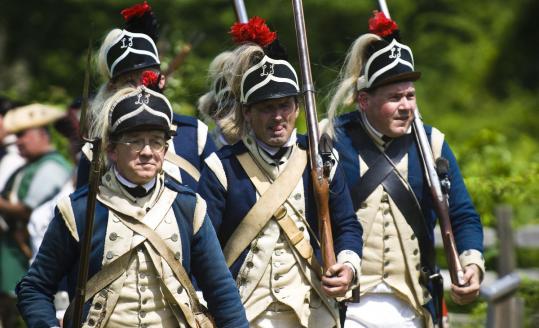
Usually the basic Patriot uniform I think of would look something like this one (but with a tricorne hat). But nooo, there are loads of other ones, like these ones from North Carolina alone, but usually patriot uniforms look like this everywhere else. And then there are these guys who I have no idea what rank those uniforms and hats come from. Why the hell do all these soldiers look different? (rank? regiment?). According to the original website that has this image of Continental officers reenactors, one officer is from Massachusetts and the other one is from New Hampshire.
It's so overwhelming. I can never know which uniforms of what ranks would have actually looked like in real life, given all these portrayals.
Would they do the same thing with their navies? Would they have different styled uniform designs for every single ship?
Your problem is you're thinking of uniforms with modern preconceptions where every man is meant to look almost identical across the entire army. During this era, the Colonel of each individual regiment was responsible for the equipment of his men. While this was in the process of changing towards a more modern centralized supply organization(where the state itself purchases, receives, and then distributes the uniforms) the situation more often meant that the regimental commander was given a budget(or in earlier centuries, was responsible for paying for the equipment himself) and was responsible for purchasing the equipment himself. With dozens or hundreds of regiments and the corresponding hundreds of men involved in the process, it meant that there was a wide variety of uniform style. Often there were general guidelines to follow for basic battlefield identification(red coat and white trim, for example) but beyond this uniform regulations were loose or nonexistent on the army-wide level. For example, while the British Army generally wore red coats, there were some units that wore other colors, such as the 95th Rifles(who wore green) or the 2nd Regiment of Dragoons of the King's German Legion(who wore blue). This was especially true among cavalry units, most often Dragoon units whose uniforms could be red, green, or blue depending on the regiment.
This problem was exacerbated in militia forces, where there often were no uniforms due to the very nature of militia forces. Some states did try to equip their militias with uniforms, but these efforts always fell short where they were even attempted at all.
Truth is, uniforms actually being uniform is a fairly recent thing.
/u/ArguingPizza has provided a good answer here, although there are also other aspects from a British perspective in answer to this question.
Occasionally, quite separately from the demands of a Regimental Colonel to provide equipment for a regiment, there was often tactical or theatrical influences to differences in uniform during the mid 18th century.
From 1758 onwards, British line regiments could call upon their own light companies that were paired with pre-existing Grenadiers within a particular regiment. With their training and equipment differing from other line companies in their parent regiment due to their role's emphasis on skirmishing and marksmanship, further variation would be extend within these companies regarding uniform, accoutrements and equipment.
Some examples of these can, even though a British regimental phenomenon be found in the American experience of the British Army - the 60th Foot (Royal Americans) that would later become the King's Royal Rifle Corps was raised, equipped and trained specifically with tactical considerations of skirmishing and fighting in wooded close country in mind.
Likewise, the light companies used by the British to fight Pontiak's rebellion were not conventionally dressed.
Now, it's entirely true to raise the counterpoint "But weren't light companies largely abandoned by the British after the American experiences of the Seven Years War"? Yes, they were.
But those experiences would still help inform the dress of some later units that would feature in later conflicts (including the re-emergence of light companies within regiments of the line) - Holmes makes the case that combat operations such as the Helder expedition resulted in some reformers arguing quite strongly for the need for light troops that, quite aside from facings or other accoutrements varying, should abandon the idea of wearing red entirely, as a matter of tactical necessity.
Adding again to the other answer in this thread, one must also take into account that whilst there was considerable variation of uniform at an individual level quite apart from what a Colonel would dictate as the regimental uniform. Officers would pay for their uniforms from tailors who, although familiar with the specifications for uniforms from different regiments, would inevitably yield differences. Men on campaign were obviously responsible for their continued maintenance of dress and equipment - where a man may lose his original hat, he'd no doubt try to replace it with something as similar as possible with the means available, but this may not result in him failing to stand out and thus catch a superior's attention. Even within the overall guidance of what a regiment's uniform may look like, you will have variations, depending on a soldier's role (be they a drummer for example) or to denote the type of company that they belong to within the regiment (again, tactical and organisational considerations being an influence).
For more information, Richard Holmes' Redcoat - The British Soldier in the Age of Horse and Musket provides an accessible read.