I'm talking about ancient times and middle ages.
It is my understanding that horses weren't fully protected (most of the time). Should a horse take an arrow, say, in the thigh, what would be the consequences ?
Horses did no better than people when hit by arrows, which is why their owners were very keen to prevent them getting shot. It has been argued that the apparent rarity of horses in Archaic Greek warfare was primarily due to the fact that they were too expensive to expose to the dangers of battle. Most rich men would not risk their horses at all; instead, they served as "mounted infantry", riding to battle only to dismount and do the actual fighting on foot. There are lots of pictures from the 7th century BC onward of heavily armed men getting off their horses, sometimes with a younger man present to take the reins and lead the horse away.
Some tentative evidence of a treaty banning the use of missiles in battle on Archaic Euboia has been interpreted in this context. The rich men of the main cities on Euboia were specifically known as the hippobatai ('horse-breeders'), and if the treaty is genuine (which is not actually certain) it probably served to protect their precious steeds.
It is perhaps not surprising that mounted combat really took off in Greece only when the Greeks mastered the art of throwing javelins from horseback, allowing them to fight at range and retreat quickly if the need arose. Even so, they were not about to let their horses run unnecessary risks. Xenophon, our best informed source on cavalry warfare of the Classical period, recommends that even the horses of javelin-armed medium cavalry are equipped with both chanfron (headpiece) and peytral (chest armour):
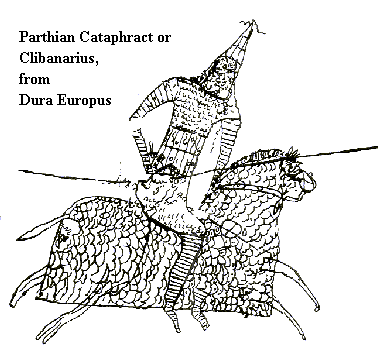
Since the rider is seriously imperilled in the event of his horse being wounded, the horse also should be armoured, having head, chest, and thigh pieces: the last also serve to cover the rider's thighs. But above all the horse's belly must be protected; for this, which is the most vital part, is also the weakest. It is possible to make the cloth serve partly as a protection to it. The quilting of the cloth should be such as to give the rider a safer seat and not to gall the horse's back.
-- Xenophon, On Horsemanship 12.8-9
There is little doubt that Xenophon himself knew such armour from his mercenary service in the Persian empire. In those parts, cavalry armour became steadily more comprehensive, culminating in the fully armoured cataphracts of the Hellenistic and Roman periods.
Fairly poorly. Their riders tended to avoid situations where they could get hit, as a warhorse represents a fairly significant investment.
A book that I read a while ago that has quite a bit about this is Usamah ibn Munqidh's work, translated into English as 'Islam and the Crusades'. It is a collection of anecdotes by a 12th century Syrian nobleman who had fought for various rulers in Egypt and the Middle East. One relevant story he tells is about a time when he was approaching a 'Frankish' (western, not necessarily French) town along a narrow road with one companion, when they were met by a small party of Frankish knights (7?). Usamah and his companion charged at them, and they ran away, but then a Frankish soldier with a crossbow appeared, and, as he was at the top of a cliff where they couldn't get at him, they were forced to run away for fear of their horses getting hit. There's another fairly similar event described during a battle in Syria, where noblemen and their mamelukes are forced to run from archers who are on top of a waterwheel (probably not one of those specific waterwheels, but in the same place so presumably a very similar design). The concern for the value of the horse is also displayed by Franks, Usamah has another story where Frankish knights are reluctant to press home a charge until the king promises to pay compensation for any killed horses.
It shouldn't be too surprising that attitudes like this were very common at the time, as twelfth-century body armour was quite good, but horse armour was very rare.
As to what happens if a horse is hit by an arrow, I can't remember Usamah mentioning it, but it wouldn't necessarily put the horse out of action. Usamah has a story about a battle where the horse he was riding was hit with a lance, making a massive wound on its belly, and it kept going, it was only after he dismounted some time later that he noticed what had happened, the horse hadn't behaved any differently (of course this is immediately followed by a story about a horse dying very easily, as his theme is something like 'odd stuff happens, isn't Fate/the Will of Allah interesting')
I should point out that I had the book out from the library a couple of months ago, so I'm not entirely clear on one or two details. Get it yourself if you're interested, it's pretty good.