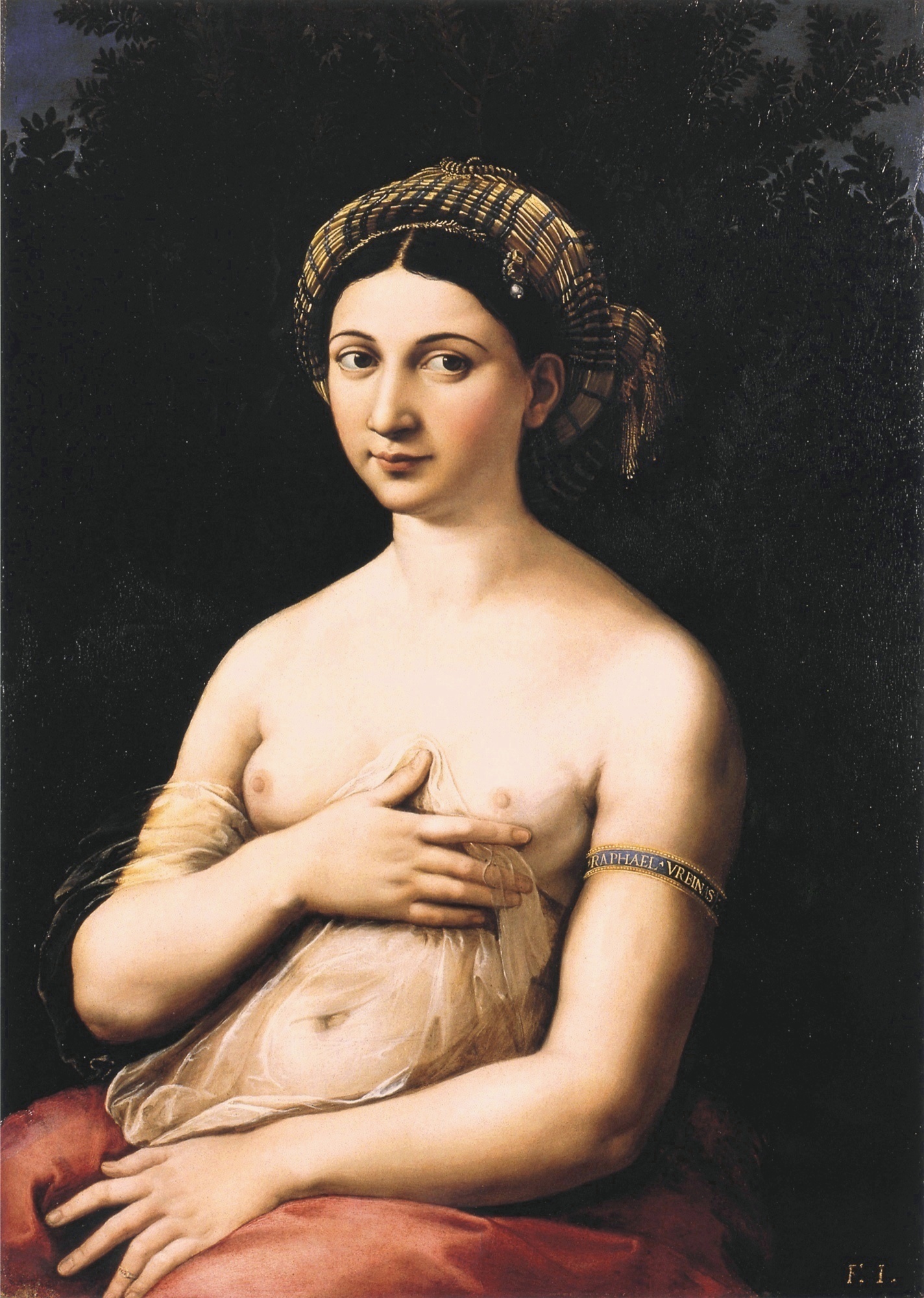
Was this simply a beauty standard and that all females being painted requested that their breasts be painted appropriately?
Furthermore, I also observe that most breast sizes are almost exactly the same with very little variation, whereas body-type may fluctuate.
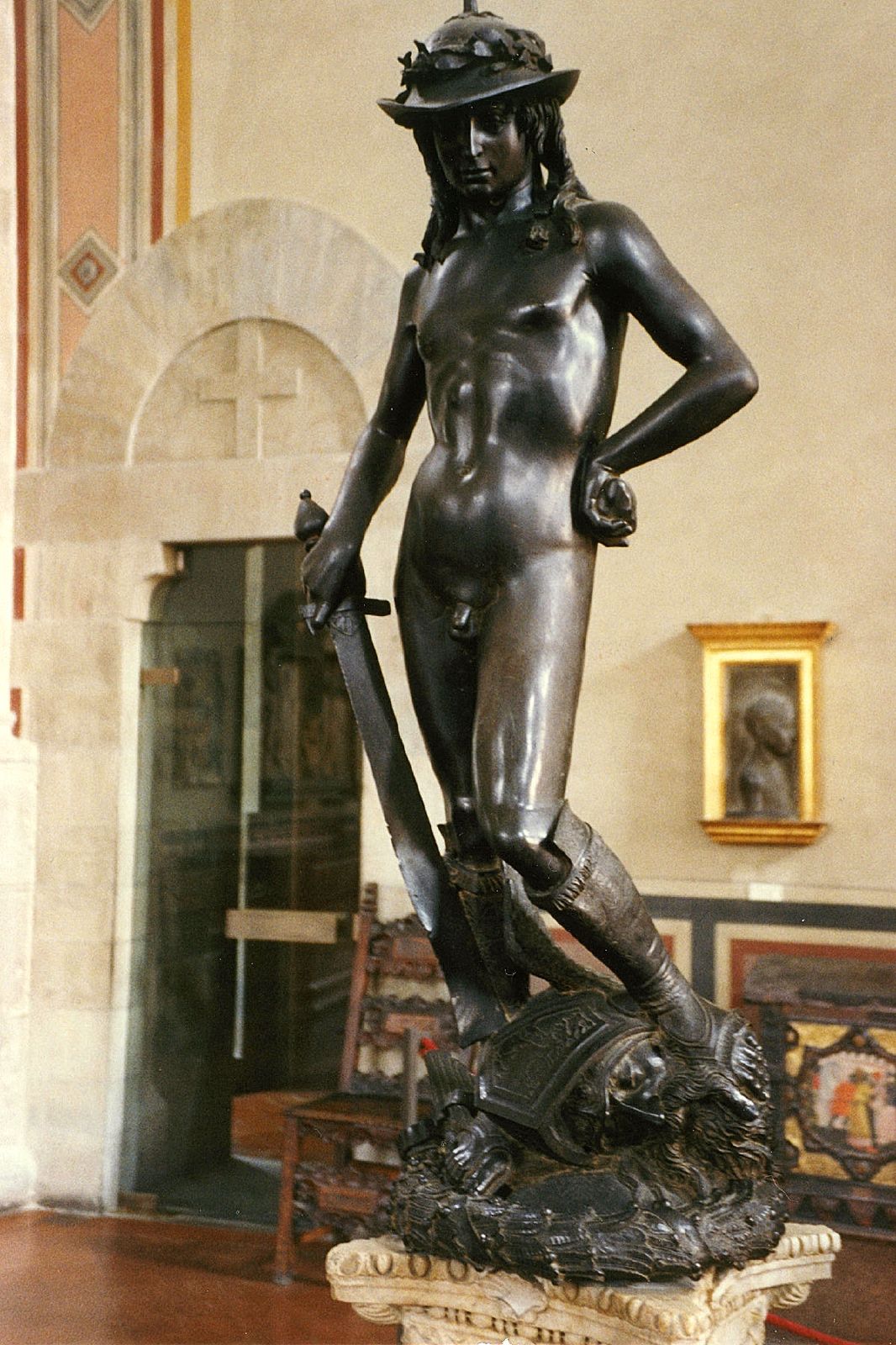
Is this similar to the generic "David Sculpture" body that is pretty much always used for most male sculptures? Or am I wrong on this point as well?
Edit:
From the amount of upvotes I assume that this is a question that many others find interesting and worth while to find the answer. Firstly, sorry for the poorly worded question, as I realized this too late. Second, even though I welcome the apparent humorous side of my question, it was a serious one from my side. It is puzzling to me that body shape/size was variable across the arts, while the breast size was not. I simply wonder if this was because this was the actual norm female breast shape/size of the times, or whether this was "enforced" beauty standards.
Thank you in advance for the answers as well as the attempts that may have been removed as I understand that this question may be difficult to answer.
Edit:
Wow! Thank you for the answers! They were really interesting, as well as educating, to an "average Joe" like me. In particular thank you to /u/explicit_snark and /u/Fairwhetherfriend who, combined, gave me exactly the answers I need.
Final Edit:
Also, and I apologise for the amount of edits, I want to thank the mods who, I am sure, had their work cut out for them with this slightly controversial question. You guys are doing a great job!
This question is a tricky one to answer, as it is hard to make any generalizations when it comes to how artists were influenced to depict their subjects on canvas or in stone, as many different factors would have went into the artist's choice.
Going back to the roots of art in history, we see pieces such as the Venus of Willendorf which depict feminine beauty as being derived from a woman's heavy weight and large breasts. It is believed that, during the time of this statuette's creation over twenty thousand years ago (28,000-25,000 BCE), a woman of this body type would have had a greater chance of bearing healthy children from birth into adulthood due to her nourishment. However, it is hard to pinpoint any specific details on pieces this old, as no literature exists to corroborate these facts, making them educated guesses, which are often avoided in the field of art history when necessary.
We see a shift from this larger, Rubenesque definition of beauty to a somewhat more contemporary idea of beauty rise from the ancient Greeks (800-600 BCE). The Greeks were one of the first to derive beauty in mathematics, and look at beauty as more of a scientific phenomenon than any sort of opinion. This is more clearly seen in ancient Greek architecture, where the tenants of balance, order, and symmetry were seen as being the major three building blocks of pure beauty. Plato would be the first philosopher to bring this idea of beauty in architecture over to beauty in humans, believing that men and women whose body parts were proportionate to one another had achieved pure beauty in their appearance. This would disqualify the Venus of Willendorf from being considered beautiful in the eyes of the Greeks, as her larger body was disproportionate in a way the Greeks considered chaotic.
With the Greeks also came the importance of the athletic physique, which is still very much alive in our society today. Rather than celebrating the heavy weight and large breasts which the people of the paleolithic era would have found healthy in bearing children, the Greeks celebrated the muscle and strength of the athletic body, most notably in athletic competitions such as the Olympics. This type of athletic beauty is perfectly depicted in the ancient Greek sculptor Praxiteles' Aphrodite of Knidos (c. 400 BCE), where we see a slender and fit Aphrodite displaying the Greek's ideas of a perfect athletic beauty. Her smaller breasts are in proportion with her wide hips, as well as her shoulders, a stark contrast of beauty in comparison with the Venus of Willendorf.
In the art of the Romans, we see a continuation of the "perfection" in the art of the ancient Greeks. The Romans felt that the Greeks had achieved perfection in their art, and sought to further this perfection in copying the sculpture and architecture of the Greeks. Renaissance Europe would continue in very much the same way, with the elite during the Renaissance feeling that the perfection of the Greeks and the Romans could not be matched, with the various European civilizations seeking to replicate the perfection their Greek and Roman forefathers had achieved. The Greek ideas of beauty would be carried over as well, with the Roman's and later the civilizations of Renaissance Europe finding the athletic, fit bodies of Greek sculpture to be the epitome of perfection and beauty.
I hope I have answered your question, if I have not feel free to ask any follow-ups you'd like and I'll to my best to clarify.
Sources:
Adovasio, J. M., Olga Soffer, and Jake Page. The Invisible Sex: Uncovering the True Roles of Women in Prehistory. Walnut Creek, CA: Left Coast Press, 2007.
Eco, Umberto, and Alastair McEwen. History of Beauty. New York, NY: Rizzoli, 2010.
Gero, Joan M., and Margaret Wright Conkey. Engendering Archaeology: Women and Prehistory. Oxford, UK: B. Blackwell, 1991.
Havelock, Christine Mitchell. The Aphrodite of Knidos and Her Successors: A Historical Review of the Female Nude in Greek Art. Ann Arbor, MI: University of Michigan Press, 2007.
Plato. Phaedrus. Translated by Alexander Nehamas. Edited by Paul Woodruff. Indianapolis, IL: Hackett, 1995.
Seife, Charles. Zero: The Biography of a Dangerous Idea. New York, NY: Viking, 2000.
Vasari, Giorgio. The Lives of the Artists. Edited by Julia C. Bondanella and Peter E. Bondanella. Oxford, UK: Oxford University Press, 1998.
Edit: Dates and formatting.
In general, yes, the small-ish sizes of women's breasts can be attributed to a certain ideal.
"Renaissance" literally translates to "rebirth" - in other words, the rebirth of the Classical ideals in art. It's why it's weirdly difficult for the uninitiated to differentiate between sculptures created during the height of the Classical era and during the height of the Renaissance: they look intentionally similar. Which, among other things, included a certain idealization of both the male and female figures.
Consider that it might be strange for a society like those of the 14th to 17th centuries, which we might consider comparatively prudish, to so consistently paint nude women. The key here is that the paintings were almost always of goddesses or, sometimes, of a specific person as a goddess. This is why there are an absolutely ridiculous number of paintings from this period, all of naked women and all titled after Venus. The very concept of painting a "real" woman naked was scandalous. For example, take Manet's Olympia (which, incidentally, was technically painted outside the range of the Renaissance period, but I assume you're using the colloquial definition to refer to pretty much all paintings that aren't modern art rather than the technical definition), and compare her to the Venus of Urbino. I think it's fair to assume your average viewer would look at those and not see much of a difference, beyond the basic reaction that the Venus is somewhat more pleasant to look at. However, it's important to note that these two paintings, despite the fact that they're intentionally very similar, received drastically different receptions from the public. The Venus was considered a masterwork while the Olympia was incredibly offensive. Why? Because Olympia was a real woman - a prostitute, in fact - and the Venus was, well, Venus.
So, the fact that the great majority of these works depicted goddesses makes it, then, somewhat less surprising that they'd all adhere to the same ideal figure. Even those that didn't (like the Olympia) were often plays on previous paintings (Olympia was a direct response to the Venus of Urbino, for example) and hence maintained a similar figure for the purposes of drawing on the similarity to make a point.
In her book "History of the Breast" Marilyn Yalom makes, in my opinion, a very convincing argument that there was a stereotype of the small breasted noble woman, versus the large breasted commoner. The commoner might use her breasts for work (as a wet nurse) whereas the noble woman's breasts were preserved instead for beauty. So the smaller bust ideal also led, in part, to the fashion of compressing the chest as flat as possible with a busk and "pair of bodies" which was the precursor to the corset.
Combine this fashion and stereotype with the fact that subjects commissioning a painting of themselves rarely sat for more than the painting of their face. Paintings generally came out as an idealized version of the subject, sticking to the fashionable beauty ideals whenever possible.
What constitutes a smaller or larger bust? Smaller or larger than what?
Does Giorgione's Portrait of a Young Woman represent a "larger" or "smaller" bust? Relative to what?
More broadly, what do you mean by the Renaissance, which encompassed so many cultures each with their own standards of beauty and artistic traditions?
And the bust measured how--in what context? Nude? Or clothed in costume that presents the body, compresses or emphasizes the bust so differently in different cultures and social contexts?
Is Titian's Woman with a Mirror a "smaller bust"? How can you tell?
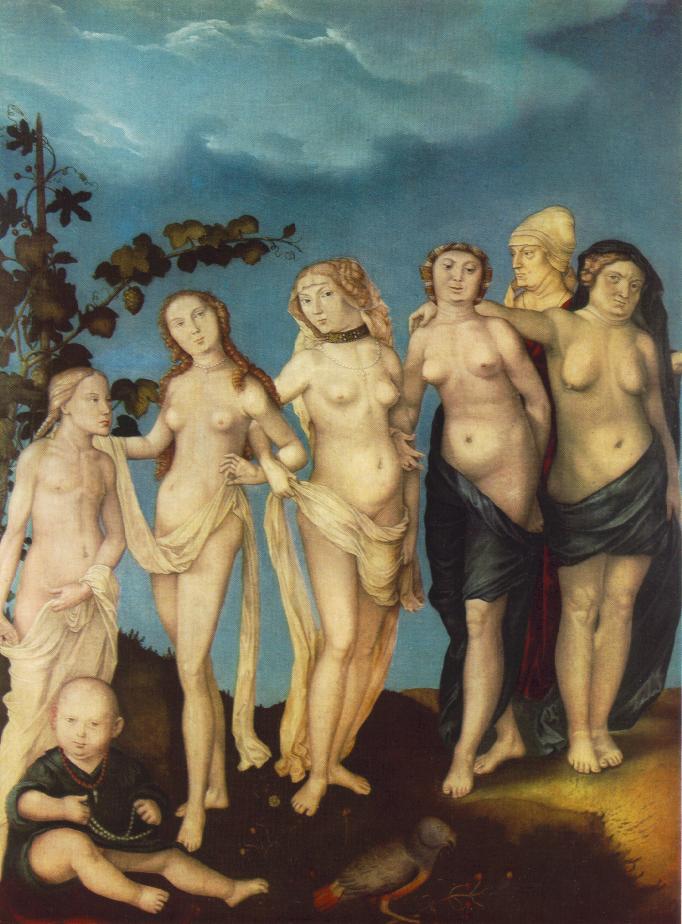
Hans Baldung's The Seven Ages of Woman raises the question: How old is the subject? Are we talking about the generic youthful body (the type usually associated with allegory, for example), or a middle-aged or elderly body?
Art certainly represented the body as an ideal according to quantifiable canons of proportion, a subject on which Dürer wrote a book, extending classical traditions of canons of beauty.
Not every body was intended to represented an ideal, as in Quentyn Matsys' so called Ugly Duchess. Genres mattered. Portraits operated according to different standards but always idealized or at least stylized the subject.
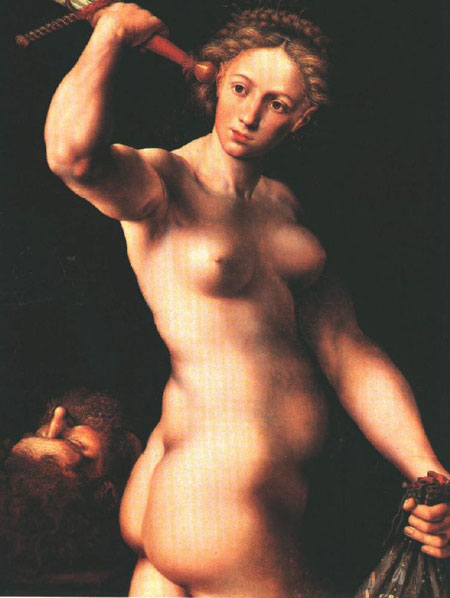
The truth is that a great many body types were depicted in Renaissance art. You are seeing a unity that just isn't there, for depictions of both male and female bodies:
Jan Sanders van Hemessen, Judith
Bernardino Licinio, Portrait of a Lady
[Bernardino Licinio, Portrait of a Lady] (http://3.bp.blogspot.com/-yT4KMW2T20A/TzaLS7E3_tI/AAAAAAAA3e8/mzLpRmVOBYI/s640/7%2BBernardino%2BLicinio%2B%25281489-1565%2529%2BPortrait%2Bof%2Ba%2BLady%2B%25282%2529.jpg)
A classic juxtaposition of body ideals in the Italian Renaissance:
Something else I've noticed, anecdotally, is that you never see female breasts with distinctly large areolas in pre-Renaissance/Renaissance art. Actually, they're often very small. Is there an explanation for this?