I already know that they had no reason to sail east before the Americas were discovered. Europe wanted to trade with China and the Indies more easily, but China was rich enough to not care about a shorter route to Europe. They didn't desperately need anything that Europe would want to sell.
But once word got back that there was a new landmass filled with weird new plants, weird new people, and mountains of gold (and probably a few angels too, with the game of telephone going on), wouldn't they have been interested? There wasn't a major domestic problem to worry about, as far as I can tell. They might not have needed to settle there any more than the US needed to land on the moon, but didn't they at least want to check it out?
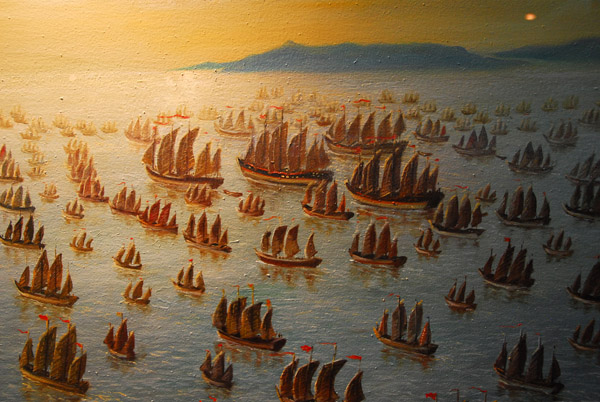
The early Ming Dynasty was quite interested in oceanic exploration. This was characterized by the famous voyages made by Zheng He and his fleet of 300 Bao Chuan (lit. "treasure ships"). They sailed all over the place. And make no mistake: they were no rink-a-dink rowboats like what Europe was setting out with at that time. At 3-400 feet long (far more contentious than it seems, please refer to Reddit's resident wood-ologists for maximum length a wood seagoing vessel can reach) , a Bao Chuan could have smashed into the Niña, the Pinta, and the Santa Maria all at the same time, and the crew might not have noticed. It certainly wasn't a question of technology - it was the Chinese, after all, who invented the magnetic compass the likes of Magellan and de Gama used on their voyages.
The thing is - China wasn't interested in colonies like Europe was. The explanation for why has more than a few moving parts, but let me try to break it down:
Colonialism, at least in the European sense, is a result of the economic system that characterized most of its kingdoms in the middle ages: Mercantilism. Now for those of you who already know, feel free to skip ahead, but for anyone who may have forgotten: mercantilism is, at its barest bones, the desire to keep all economic production and activity within the purview of a single government. In its "perfect unicorn" form, a kingdom would produce absolutely all of its raw materials within its own borders, and therefore buy nothing from another kingdom, but only sell finished goods to them. You can think of it as a zero-sum game, where everyone wants all the gold, and no one wants to have to spend any of theirs. The problem in Europe was that all those kingdoms were competing for much of the same resources, and had very little space to "naturally expand" ... hence a "New World" provided a major outlet, both for social pressures and for production of raw goods.
Meanwhile, the economic situation for Ming China was beset by both a different set of economic pressures, as well as a completely different sociopolitical outlook - which are so interwoven I'm not going to be able to help but talk about both, almost at once. Prior to the establishment of the Ming in 1368 by Zhu Yuangzhong (AKA The Hongwu Emperor), China had been ruled by the Yuan Dynasty (AKA the Khans of Mongolia gone native). The Yuan conquest of China linked it to the yassa of the Khannate, and its panAsiatic trade network - essentially connecting it to a supercharged Silk Road from the time of the Han. That economic influx, however, came with foreign rule. The ethnic Han Chinese were locked out of high office by the Yuan emperors who trusted only ethnic Mongols or foreigners above the Chinese to rule over the land and its people.
So on the one hand, coming into the Ming where Hongwu throws off the last vestiges of foreign domination and re-establishes Chinese rule again, you've got the crumbling of the yassa edicts guaranteeing safe trade routes across Asia, and a newly re-empowered ethnic supermajority who has quite a lot of justifiable hostility toward foreigners.
Economically, China did not need to expand geographically, and when it did it almost uniformly pushed in a Westward direction,r ather than eastward. This makes perfect sense, of course, since to the east you've just got endless oceans with minuscule islands stretching on into infinity, whereas to the West! Ah, the West! Trade routes, foreign good, foreign markets... not to mention thousands of miles of deserts lined with bloodthirsty tribes, but hey, stay positive: profits! The Western expanses of central and north-central Asia have been the frontier for China since its inception as an Empire under the Qin. Heck even to this day the northwest autonomous region is known as Xinjiang (新疆), meaning "New Frontier." And if you think that cultural "inertia" toward a specific idea/direction wouldn't have been a factor, I'll direct you to the (ongoing) American love affair with the idea of its own Western frontier.
Back to Zheng He and his thousands upon thousands of merchant sailors, though... as I mentioned his 20+ years of voyages were in large part seeking to re-establish the old trade routes with foreign powers that had been last cut off with the collapse of the Mongolian Empire. Overland travel via the Silk Road was an invitation to disaster, even with official protection... banditry along that route was quite literally legendary (and still is, it should be mentioned). Thus a reliable sea route Westward had been on the imperial agenda since the Eastern Han at least, but not so high up that it had every really been a "priority" ... just really something that might be nice if it ever, y'know, happened.
Zheng He's voyages can be characterized as nothing less than a monumental success (Seriously, you can't come back with a giraffe as a present for the Emperor and not have done a good job). However, following the Jianwu Yongle Emperor's death in 1402 1424 (FML, that's what I get for writing about 2 dynasties in the same day. Thanks for /u/_dk) the imperial attitude toward associating with or interacting with foreigners at all began to swing the opposite direction.
China for long stretches of its past has been marked insular - and at times out-and-out isolationist. Again, it's not hard to see why: geographically it's incredibly isolated with a central "breadbasket" surrounded by virtually uninhabitale high plateau, mountains, and/or desert. Sociaoculturally, too, its foreign policy was even at the most expansionistic of times solely concerned with its immediate neighbors, rather than far-off affairs or administering distant colonies. It was the literal center of the world, after all, sovereign of all four seas. Any people or place too terribly distant from the centerpoint of the universe and Heaven ... well, they can't possibly be that important, then, can they? It wanted cultural and political hegemony over its neighbors who would acknowledge it as the paragon of civilization and pay it vassalage... It didn't need colonies economically, nor did it need them to relieve social pressures. Personae non gratae could be shipped off to the frontiers to languish, there was no need for an ocean when sending them to a desert outpost 3000 miles away worked just as well.
So, as the seemingly inevitable tide shifted against interaction with foreigners thanks to the Mongol hangover, China was in a very good position - as it ever was - to "turtle up" close off its borders, and isolate itself behind closed doors. The policies were based around the idea that China had to be first, last and only for the Chinese, and that "look what happened the last time we let those foreign devils in here! They wrecked the place!" Thus, the isolationist policies that both forbid foreigners entry to Great Ming, and also disallowed imperial subjects from leaving without special imperial dispensation would continue all the way up until the Steppe barbarians showed up on their horses again in the 1640s, but this time from Manchuria, declared a new dynasty and made everyone get really funny haircuts.
Chan, Hok-Lam. "The Chien-wen, Yung-lo, Hung-shi, and Hsuan-te reigns, 1399–1435", in The Cambridge History of China: Volume 7.
Deng, Gang. Chinese Maritime Activities and Socioeconomic Development, c. 2100 BC - 1900 AD.
Dardess, John W. Ming China, 1368-1644: A Concise History of a Resilient Empire.
Mote, Frederick W. Imperial China: 900–1800.
P.S. Come check out The History of China Podcast! We're in the mid-Tang Dynasty (ca. 720) right now, it's a hoot!
This is an excellent question, though I'm always a bit wary about the "why didn't China do X that was normal for us Europeans"-type questions, so I want to start off with a couple of grains of salt.
First off, I don't think there's an easy answer, and I certainly wouldn't use stereotypes about "civilizations" or "world views" to describe 500 years of history. This time period includes, I should add, two major empires in what is today China, each with its own very particular historical context.
Second, as for the "why not" question, keep in mind that only a handful of European states actually colonized the Americas. Spain, Portugal, England, France, the Netherlands primarily, with non-permanent colonization by the Norse, Scotland, Sweden, the Basque, Russia (and maybe one or two that I missed). There were several European powers that could have and didn't for whatever reason.
With that out of the way, the question becomes, why colonize? It didn't happen by accident. There is the obvious statist reasons, such as power, prestige, and wealth, but there's also the less obvious (and IMO, more important), such as a place to move surplus populations, access to commodities, etc. Like a lot of material and economic historians would argue, commodities are extremely important. Wealth generated in the New World was what allowed European and Euro-American states to become wealthy in the first place (because they certainly weren't in the middle ages) and do things like buy a hell of a lot of Chinese porcelain and silk.
In fact, China became known as a black hole for silver mined by indigenous slaves in Spanish Peru, and remarkably early on, triangular trade between the Americas, Europe, and China was established. And as Timothy Brook's outstanding (and very readable) book, Vermeer's Hat, shows, even as this was taking place, Europeans still didn't quite get over the idea that the Americas were not part of Asia, and early French explorers in what is now Ontario, Canada wore Chinese silks while signing treaties with local indigenous nations, thinking it was local custom! Furs would later be exported not just to Europe, but places like Hong Kong where there was huge local demand. In return, Europeans bought -- as I mentioned -- Chinese porcelains, tea, and silk en masse. Porcelain especially was cheap to produce, Europeans wanted it, they didn't yet have the technology to make it, and they were willing to pay a lot for it, and Europeans paid for it with wealth generated through New World colonialism.
In other words, China was very much reaping the material benefits of colonialism without actually colonizing. Moreover, areas where they might have colonized for direct material rewards, such as Peru, were occupied by European powers early on and the frontier was closed.
The second major thing to consider is that China was colonizing during this time. The Ming, and then especially Qing pushed south and westward into what became Yunnan, where they subjugated indigenous groups and moved in soldiers, merchants, and then settlers. In the west the Qing later massacred maybe 75% of the Uighurs, and to this day continue to send settlers. While the frontier with Russia was closed in the 18th and 19th century, and China itself became a victim of European and then Japanese colonization (which is directly related to European frustrations over China being a black hole for European gold and silver), this did not stop. If anything, as studies by Duara or Gladney show, Chinese subjugation of minorities in the Qing Empire, the Republic of China on both the mainland and Taiwan, and then the People's Republic of China increasingly cast the colonized minority groups as akin to Native Americans.
So, to answer your question TL;DR style: they were making a fortune off of the European colonies without spending a dime, they had plenty of land for their own settlers, and started treating their own frontiers as European-style settler colonies.
Sources:
Timothy Brook - Vermeer's Hat
Prasenjit Duara - Sovereignty and Authenticity
Dru Gladney - Disclocating China
And I don't like the book at all, but...
While the Chinese state made no effort to acquire New World territories (that I know of), many Chinese people were absolutely interested. Maxine Hong Kingston's book China Men documents one family's experience in moving between the Old and New Worlds--sometimes quite imaginatively so, but still referring to real people who did real things. She had grandfathers and uncles who migrated back and forth between their family's village in Guangdong and Hawai'i, to work on sugar plantations, and California, to work on mines and railroads. Her father was born in China and raised as a scholar, but mailed himself in a box to New York (or maybe snuck in with forged documents through Angel Island in San Francisco).
Hundreds of thousands of Chinese people emigrated to the New World and elsewhere, especially after 1850. At least 10k came to California in the first couple years of the Gold Rush, and I believe that at the time of the Chinese Exclusion Act in 1882, there were about 100k living in the United States. The Chinese Diaspora is really not colonial in nature, but it does share features with colonialism: a significant population traveled to a foreign land and faced the problems and opportunities of integrating with a group of people alien to them; and the human web that connects two distant places became much tighter.