Is it better if I just leave the link or should I copy the text from it and post it here as well?
https://www.reddit.com/r/vexillology/comments/4ge8cp/south_korea_what_happened_to_yellow/
Your question from the other post seems to be, "what happened to the yellow in the Korean flag," and you're referring to the three part yin/yang symbol, correct?
Simply put, they never used the yellow as part of their national flag.
A brief overview of the flag.
The Korean flag, called "Tae-geuk-i" (태극이), has a yin-yang symbol in the middle (called "eum-yang" (음양) in Korean, or "taegeuk"), and 4 "bagua" (or pal-gye (팔계) in Korean) that surround the middle. The eumyang represents Heaven and Earth, while the four symbols on the outside represent from top left clockwise, Heaven, Water, Earth, Fire. The symbols are opposite each other, and they are opposites of each other - Heaven is 3 solid bars and Earth is 3 broken bars, Fire is a solid, broken, and solid bar, while Water is a broken, solid, and broken bar.
The yellow "pa" represents humanity. It's been used on what's known as the "Samsaek-ui taegeuk", which literally translates as "Taegeuk of three colors" or "tri-color taegeuk". I have not been able to find any evidence of it ever being used on a Korean flag. The South Korean flag has not changed since it was created, other than codifying sizes, dimensions, and colors, and prior to that, independence activists used the two-part red/blue taegeuk on their flags. Many of those old flags did have longer, curly tails on the taegeuk, but there were still only two colors.
Okay, then what IS it for?
In 2009, ( related article in English an example of a taegeuk was uncovered in South Jeolla province that was 1400 years old, placing it near the end of the Three Kingdoms Period, early 600's AD. It is a two-tone taegeuk. The article points out that the Taegeuk is related to Taoism and shamanism, and therein lies your answer.
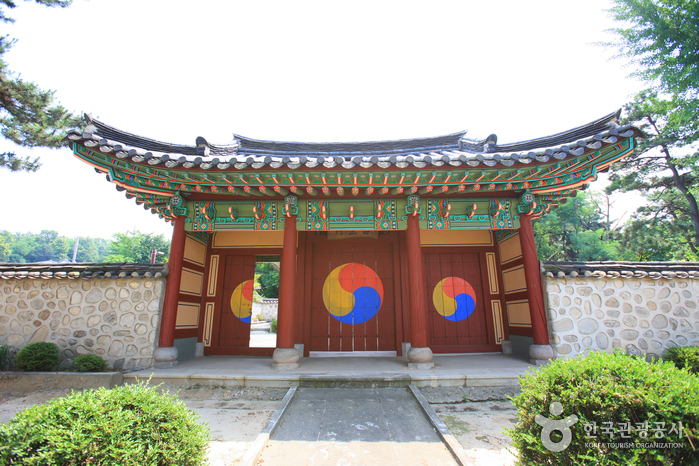
In your main post you mentioned that the tri-colored taegeuk is on most gates. At the same time, you also pointed out that the two colored taegeuk appears on other gates. The first picture, as best as I can tell searching google, comes from Geumgang Park, Busan, and its a gate to a cemetery. The second photo, I can't really tell what it's from. My Chinese is non-existent, but the translation I came up with for the first board is "Left Door" and the second board, I believe, is "Armory." This leads me to believe that you're more likely to see the tri-color on gates at religious/spiritual places and the two-tone taegeuk on government/non-spiritual places.
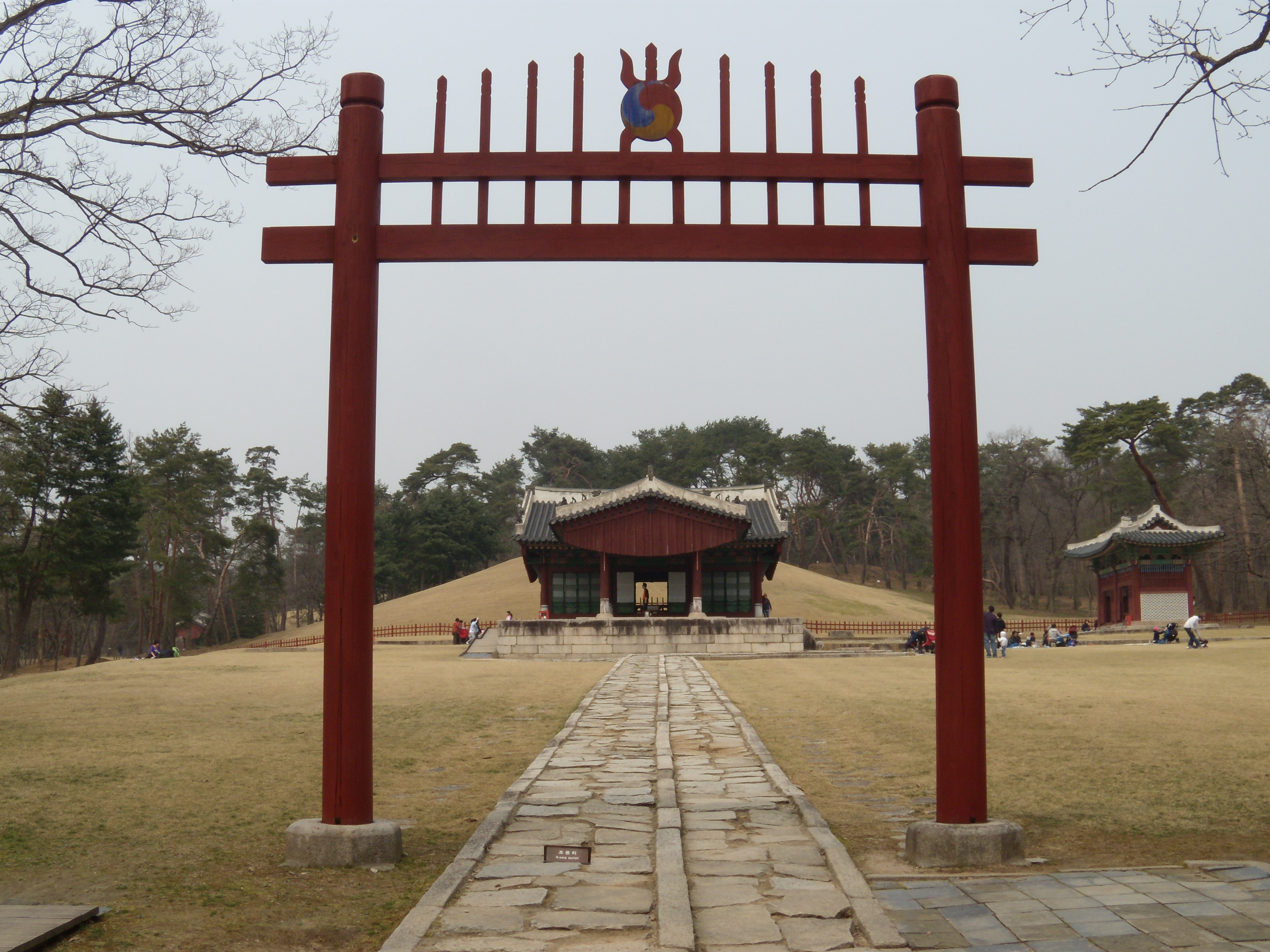
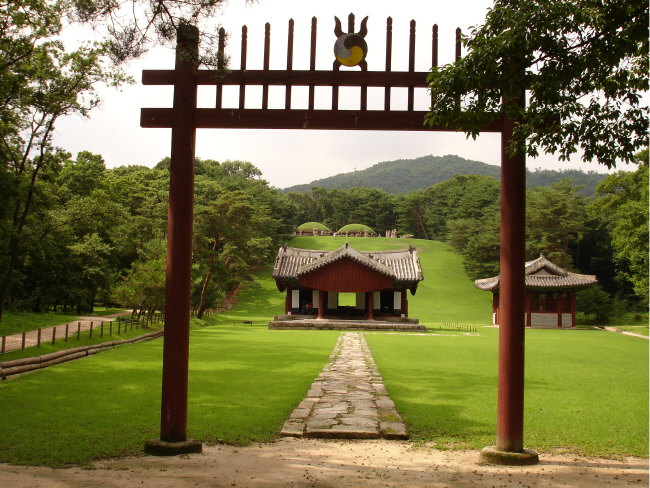
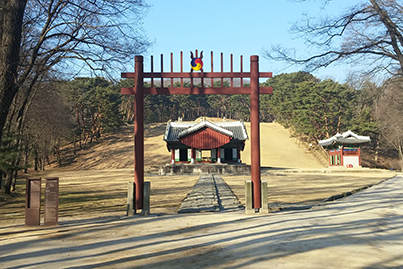
If you take a look at the Royal Tombs of Joseon, you'll see that each tomb has a gate with the tri-color taegeuk on it.
There's about half a dozen more, but you get the idea with these ones. If you look at the gates, you'll notice that they're all the same. When were they built, I don't know, but it's safe to say that, at a minimum, they have been re-painted recently. If they were installed by the Cultural Heritage Administration sometime in the past 60+ years, it would not surprise me, but they would at least have a solid basis for choosing the tri-tone vs. the two tone taegeuk.
The Korean government was pushing for 9 Seowon, or private academies, to be listed as World Heritage sites. I found photos from 8 of the 9 showing that 2 of them have tri-color taegeuk on the gate while 6 have the two tone taegeuk, and 1 was rebuilt and have neither.
Tri Color
Two Tone
Neither
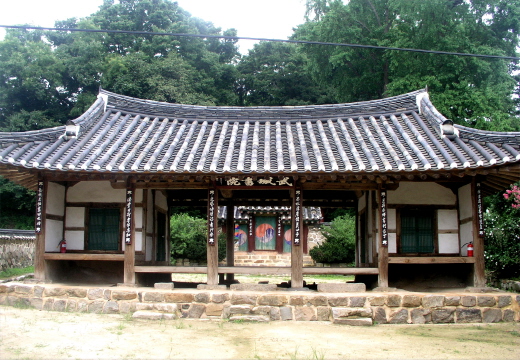
I've also posted a couple of photos before of two hanggyo - one in Incheon which has a two-tone taegeuk, and one in Yeosu which, if you look carefully behind the shitty delivery bike, you can see a tri-tone taegeuk.
So where does that leave us?!?
First, your assertion that the tri-tone taegeuk is on most gates is false. It is definitely not rare, but it is in the minority. I don't have a photo handy (and can't be bothered with more google, unless someone insists), but Heunginjimun (Dongdaemun) has 3 part taegeuk's painted around the top, but they are all black and white, no color. I'm not sure about Seungnyemun (Namdaemun) or any of the other regional gates, but I wouldn't be surprised if they had 3 part taegeuks there, as well.
Second, you're MORE likely to see a three-part taeguk at a shrine/daoist/religious site than you are other places. Finding them on the gates shows the governments position on religion. Under the Joseon dynasty, Buddhists were reigned in/persecuted while state-sponsored Confucianism was pushed. Compared to the religious side, the two tone taegeuk is a more nationalist symbol, hence the use on the independence movement materials/flags of the late 19^th-early 20^th century groups.
Here is a bit of information on the religious side of things.
If you'd like to read more about the symbol itself, I've got nothing. I'm drawing this all together from my knowledge of the Joseon dynasty and their relation to scholars and religious figures, the relationship between hanggyo, seowon, and seodang and the state/state tests/scholars of the day, and the use of the two-tone taeguk during the late 19^th and early 20^th century. If someone wants to come in with a source that is specifically on point and totally destroy the case I've made here, I'd love to hear it, but I feel confident that the conclusions here are solid.
For more information on what I've just mentioned, take a look at:
A New History of Korea by Ki-baek Lee
A History of Korea by Michael Seth
These two books cover the basics. As far as the specifics of the hyanggyo, my knowledge on that comes from actually visiting them and reading the information there. There are a few books, but they are in Korean (I've had bits and pieces read to me, but I'm about 4 years old when it comes to my Korean, so I can't really say much about them. Sorry!).