I'm currently enrolled in a college course studying Spanish literature from the medieval period through the Baroque period, and know quite a bit about Spanish history. However, one thing I really feel like I don't know enough about is the origin of the language of Catalan. I know that it was the language used in the Kingdom of Aragon in medieval times and I know the basics of the differences and similarities of it and Castilian Spanish, but I really want to know more of the origins and how those origins caused it to differ from Spanish, Portuguese, and even Occitan (which I've seen compared to Catalan as being one of the most closely related).
So essentially, if you had to make a family tree of Romance languages, how would Catalan fit in (would it be the same branch as Spanish or not, and where would it branch off)? How did any major differences come about? Any information is greatly appreciated!
just to point it out, Catalonia wasn't part of the "Kingdom" of Aragon, it was part, together with the Kingdom of Aragon (and others), of the Crown of Aragon, but they remained separate entities both at the legal and administrative level, as in each retained their parliaments, etc.
On the language front there is some dispute as to wether include catalan into the Gallo-romance or Ibero-romance families (or something in between).
https://en.wikipedia.org/wiki/Gallo-Romance_languages
https://es.wikipedia.org/wiki/Grupo_Ibero-Oriental
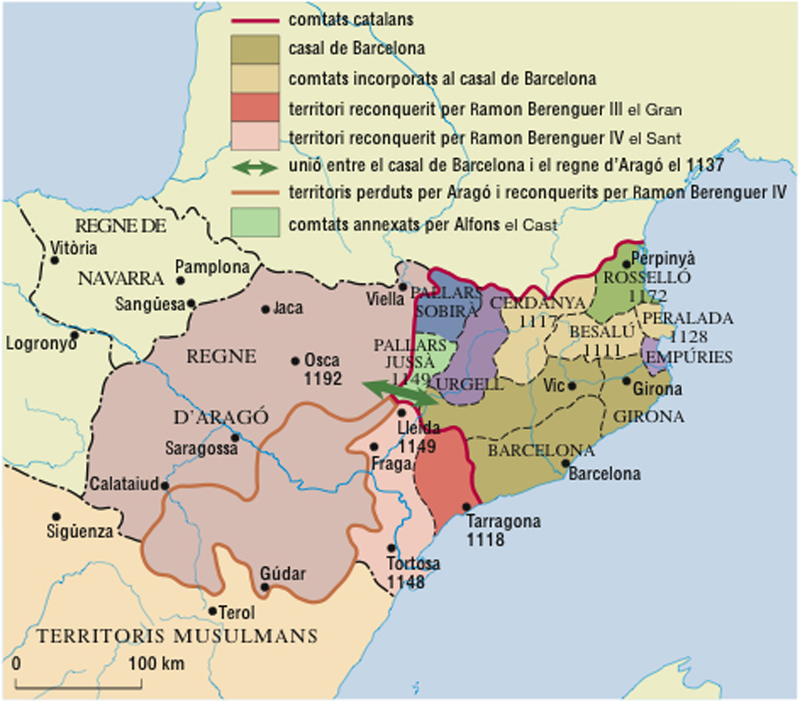
Nevertheless, the process of "creation" of the Catalan, Occitan, Portuguese, Galician, Castilian, etc. Was mostly equal to that of all the romance languages during the final phase of the early middle ages (around X-XI centuries). Due to the geopolitical situation in the Iberian peninsula of that time there wasn't much communication between the East-West axis (there were mountains, prairies, deserts and few roads) of the Peninsula, and Catalonia was much more focused on its relation with the Frankish Kingdom and the Occitan lands to the north, so major interaction with the Castilian (spanish) language wouldn't happen until much later -around the XIII century onwards- with the "reconquista" (a term which is disputed as well) well under way
The Catalan language in the XIII century:
http://www.conselldemallorca.net/?id_section=1281&id_son=1283&
Extension of Catalonia in the Iberian peninsula in the XII century
http://www.enciclopedia.cat/sites/default/files/media/FOTO/4628.jpg
While this might be better suited for r/linguistics, the difference between Catalan and Castilian Spanish basically boils down to that between any other two Romance languages. They evolved separately from vulgar Latin. Catalan was also less influenced either by the Ibero-Basque substratum or by Arabic.
Note that the meaningful barrier was not between Catalan and Castilian but further East, between Catalan and Navarro-Aragonese, an Ibero-Romance language that got later supplanted by Castilian Spanish almost everywhere except for some high valleys in the central Pyrenees where it still survives as the modern Aragonese.
As some linguists argue, Catalan and Occitan formed a single pluricentric language well into the 13th century. Politically, up to at least 1213 the Catalan counts of Barcelona had significant interests in the South of France, an area that they dominated jointly with the counts of Toulouse. The Albigensian crusade marked a turning point. Count Pere (or King Pedro II of Aragon) intervened to protect his vassals in the Languedoc from Simon de Monfort and got himself killed at Muret in 1213. After that his heirs re-oriented the kingdom, so to say, towards Moorish lands in the south and overseas expansion in the Western Mediterranean. But for several centuries before that point Catalan lands in the south and Occitan lands in the north formed a single cultural and probably linguistic continuum. For instance, when a Provencal troubadour, Albertet, asked who was better, the French or the Catalans, he specifically mentioned that he included in the latter category Gascony, Provence, Limousin, Auvergne and Viennois.
EDIT: I accidentally a word.