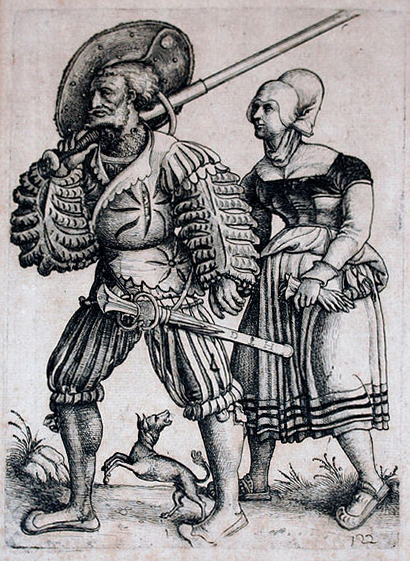
I have seen several discussions lately on r/swords where a lot of people seem to have entirely different opinions when it comes to the question of swords being used as primary weapons on the medieval battlefield and how common it was.
The usual argument I see against this, is that soldiers would usually rather fight with poleaxes, halberds, pikes etc and then use swords as sidearms instead.
What is correct? I know some soldiers used swords as primary weapons, but was it common at all?
Defining primary weapon as whichever weapon the soldier uses first then the answer is almost universally no. In general the one-handed arming swords, bastard swords, and two-handed swords all had blades of roughly the same length which was short enough to be comfortably worn in a scabbard on the hip freeing the hands to carry a lance, poleaxe, bow, javelin, etc. The exception to this were "great swords" like the German zwiehander from the late middle ages which had a very long blade and handle and would be carried and wielded a bit more like a polearm. The sword would then be used once all the missiles were gone or the polearm was lost or broken.
According to George Silver, polearms generally held the advantage in both single combat and massed combat but he still stressed the arming sword as a reliable self-defense weapon (with the two-handed sword or sword and buckler being slightly better in single combat, while the sword and target was slightly better in massed combat). William Barret, writing at around the same time considered a pistol-proof shield, sword, and pistol to be the best weapons for storming a breech in the enemy's walls, but still only recommended 2 or 3 shield men per 100 soldiers.
The 13th century King's Mirror, on the other hand, made it pretty clear that soldiers should be relying on their spears in a medieval shield wall. "never to throw your spear, unless you have two, for in battle array on land one spear is more effective than two swords."