Generally yes, the methods you see on that channel are accurate. However, two important disclaimers: First, that I haven't watched all the videos (only about half), and second, that while the techniques are generally accurate there is a huge amount of variation, historically, to the various technologies displayed on the channel, both in terms of form (so the kind of housing produced) and in terms of the specifics of the techniques and the raw materials used. You can't really generalize to one set of technologies used by early humans, but what is represented on the channel is generally consistent with what you could find being used by people even up into the present, not necessarily even just "early humans".
All that said, there are really four kinds of technologies he is utilizing: wood, stone, basketry, and pottery/ceramic. The stone tools he used primarily to shape and collect the wood, and he does so in a very recognizable fashion for archaeologists who come across all sorts of stone tools that look very similar to what he is using. For instance, one of the most common stone tools - contrary to popular belief - is not the arrow head or stone point, but rather the hand axe. You can see him using these in several videos to cut and shape wood. They tend towards a teardrop shape and you find these all over the world because they are extremely versatile, being useful for any sort of chopping motion including shaping/felling wood and dismembering animals. In fact, some of the earliest stone tools we have (from human species other than Homo sapiens) resemble the hand axe.
He also produces some other stone tools, like projectile points and a proper adze, and the techniques he uses here are roughly accurate though there is considerably more variation in how human produce these kinds of tools. I only single out the hand axes because they are one of the most common tools in all of human history.
In terms of the shelters he builds, there is going to be a tremendous amount of variation historically depending on environmental and cultural contexts in how exactly homes are built, but very broadly he builds a shelter that you could find in many places across the planet for much of human history. The big divergence would be his use of a tiled roof - this is pretty exceptionally uncommon historically, with thatch/sod roofs being far far more common than any sort of ceramic roof. Producing that many tiles is a huge expenditure of effort when a thatch roof can actually provide a very comparable level of protection from the elements with a much smaller expenditure of effort. The only downside being that a thatch roof will probably need to be replaced or fixed much more frequently than ceramic, but on the other hand replacing a single broken ceramic tile is going to be quite a pain in comparison to just rethatching the roof entirely.
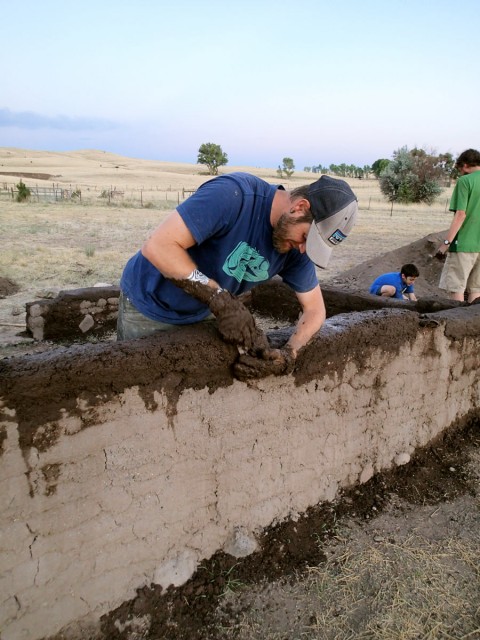
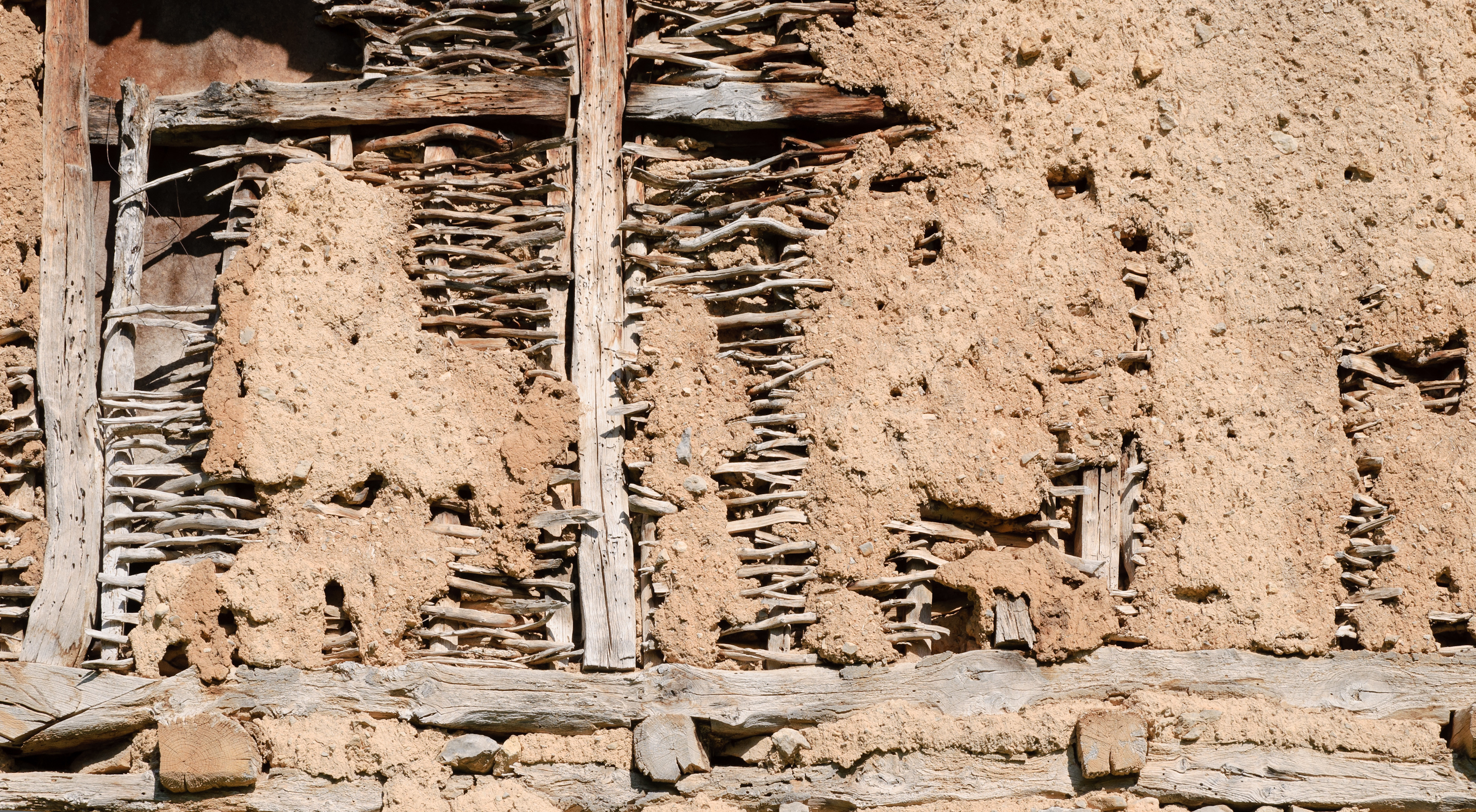
Otherwise, I'm a little surprised he built up the walls of the hut by just layering clay-rich mud (what we call puddled adobe construction). Generally (but again, this is going to vary everywhere), a technique known as wattle and daub (sometimes called jacal construction) is used where a skeleton or frame of branches (the wattle) is created upon which a mud daub is applied to create a wall, like so. This is an extremely common building technique world wide because of the availability of the materials and the strength of the resulting walls. Puddling refers to building up successive layers of mud, but adobe more generally refers to using mud as a building material. This can range from the most formal - where you produce baked or sun-dried mud bricks - down to the most informal and expedient, the puddling style you see used in the videos.
Generally, the puddled adobe technique he uses is found more frequently in areas were wood is so scarce that building the wattle is prohibitive. Rain also tends to damage these adobe walls very quickly, unless they have been fairly high-fired (to the point of becoming more like bricks than soil). For instance, puddled adobe construction is very common in the U.S. Southwest because of the abundance of clay-rich soils but general lack of wood. The arid, desert coastline of Peru also sees the fairly extensive use of adobe construction, as do parts of the Mediterranean and Middle East. In environments with higher rainfall and abundant wood (like the one in the videos, I presume) this type of construction is fairly uncommon given the environmental constraints. A simple daub over a wattle core is much easier to replace when damaged by rain and humidity than rebuilding an entire puddled adobe wall. That said, his fired clay tile roof should help reduce any water damage to the walls since it is likely far more impermeable to water than a thatch roof (though thatch can work surprisingly well to keep out even hard, tropical rains).
Other unusual features are the chimney and the heating platform. While neither of these are totally unheard of historically, they, alongside the tile roof, are not common in vernacular architecture globally. Chimneys usually take a much less elaborate form, with some sort of modification made to the roof instead (even as simple as a hole in the roof in very arid environments). The heating platform under the hut is probably the most unusual feature, but again, not completely without precedent. The utility of that feature in what looks like a tropical or sub-tropical environment seems up for debate.
He is also quite a good potter. He sources his clays well - you need to find soils naturally rich in clay, and you'll notice that for both the walls of the hut and the pottery he makes he collects soil from the bank of what looks like a small creek. This is a very common collection zone for clays in many societies since rivers and other water features tend to produce clay-rich soils. The action of water naturally sorts different soil particles by size, separating the fine-grained clay particles from the larger silts and sands. However, pure clay would be disastrous to make pots with as they are liable to break when being fired. As such you can see that he grinds up some of his spare tiles to incorporate into the clay. Because the tiles are already fired they are less vulnerable to thermal stress, reducing the vulnerability of the pot as a whole to thermal stress both while cooking with it and firing it initially. Using pottery as a temper (i.e. aplastic inclusions in clay for pottery) is a common technique, but other tempers are viable. For instance, crushed rock (especially igneous rock), bone, shell, sand, and organic tempers like straw. Generally you see a greater use of rock and sherd tempers in arid environments and a greater use of bone, shell, and organic tempers in tropical environments, but this isn't a hard and fast rule so I don't see any problem with him using that technology.
In summary, the stone tool technologies he employs are very accurate and something you could see at just about any point in human history. The construction technique he employs for the hut is generally accurate, but the use of a tile roof is unusual and the sparse use of wood in the construction (despite being in a heavily forested environment) is unusual, but the puddled adobe technique is found in many parts of the world (just not usually tropical environments). The sub-floor heating and the formal chimney are also unusual features (especially for a tropical/sub-tropical environment), but neither is totally without historical precedent.
The pottery he produces is also very much in line with pottery production across the world, using alluvial (riverine) clays, sherd temper, and employing a coiling technique to construct the pot itself (instead of a potter's wheel, which is not very common in pottery production for most of human history).
So basically most of the channel does represent actual techniques used by people globally for quite a long time, but not all of these technique necessarily suit the environment he is working in. That said, the amount of variation in technology globally means even what we think of as "typical" for a particular environment is almost always bound to have exceptions. All the techniques individually are more or less accurate, and so their combination together is the only real stumbling point (but a forgivable one given all the variance globally).
Edit: As was pointed out in several comments, he actually builds a wattle and daub structure in an earlier video (as well a completely thatched structure). Between the three he covers what are some of the most common building techniques worldwide and historically.