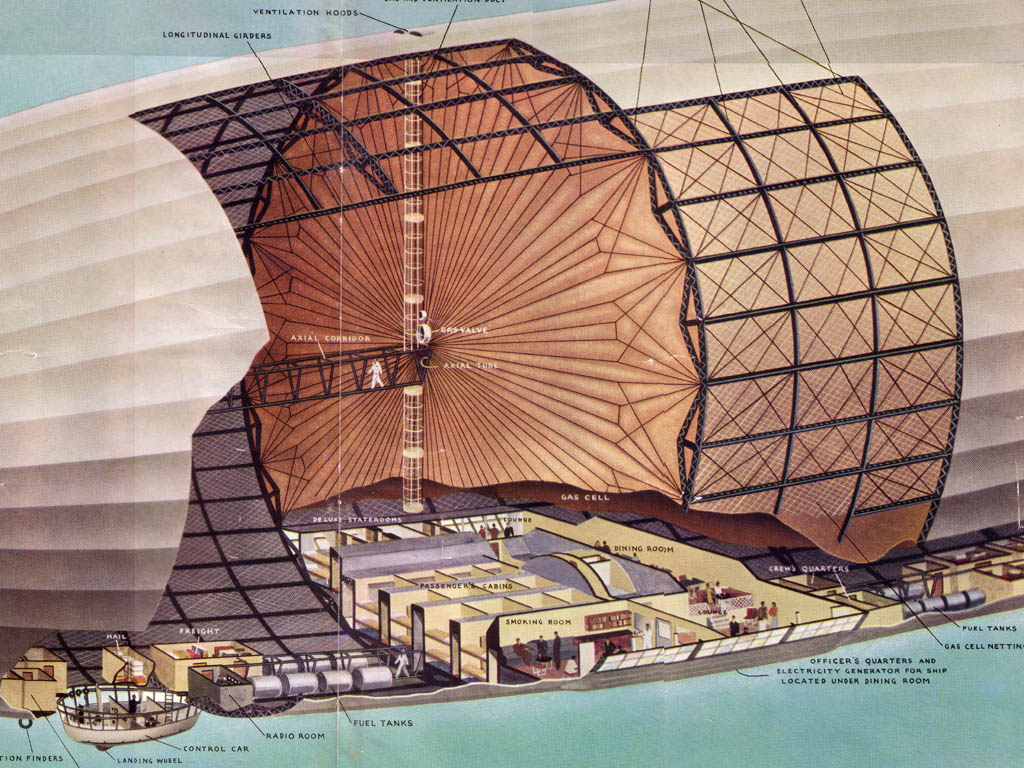
Early in the war, Zepplins were tremendously effective. First, they could fly at 10,000 feet -nearly two miles in the air. They could easily travel hundreds of miles, making attacks on London from bases on the continent possible. There was no radar in WWI and Zepplins made very little noise making acoustical warning systems almost useless. They attacked at night, and later only on cloudy nights, making visual observation very difficult. Airplane searchlights were a new invention developed in response to Zepplins. They could carry more than two tons of bombs each and raided in groups.
So, they wouldn't be observed until they started dropping their bombs, the British (again, early in the war) had no anti-aircraft weapons with sufficient range to attack them, and by the time an aircraft of the day could be launched in pursuit and reach their altitude, the Zepplins would be many miles away hidden in the clouds.
As anti-aircraft guns, searchlights, and aircraft improved, along with the establishment of observer posts along their flight paths, the Zepplins became less effective.
Well, at the start of the war, they weren't easy to shoot down.
Zeppelins were huge rigid airships (unlike blimps, Zeppelins have metal frames in which several gas bags are inflated) and nobody had developed powerful anti-aircraft artillery yet. Fighters could - and did - take shots at them with machine guns, but all that would do is put several small holes in the gas bags, and that alone wasn't enough to down a Zeppelin (that would just cause slow leaks). They wouldn't just pop like a balloon. Additionally, early fighters had great difficulty climbing to the altitudes that Zeppelins could operate at (which made one technique - dropping bombs on Zeppelins from above - difficult to carry out).
WWII-style anti-aircraft artillery guns would have demolished Zeppelins... but those weren't around yet. Large-calibre guns were developed, like the QF 3-inch 20 cwt, but they took time to be introduced in large quantities. The British hadn't predicted that they'd be on the receiving end of aerial bombardment before the war, so at the start of the war there were basically no AA defenses over Britain.
By 1916 the British developed incendiary ammunition for their fighter aircraft to use, and at that point it became easier (though still not "easy") to shoot Zeppelins down. /u/Bigglesworth_ described those rounds in a previous AskHistorians answer.
Here's an account of a fighter pilot who took down a Zeppelin using incendiary rounds. As one can see, it still wasn't "easy" - he had to put three drums worth of ammunition into it (each drum had 97 rounds).
Remembering my last failure, I sacrificed height (I was at about 12,900 feet) for speed and nosed down in the direction of the Zeppelin. I saw shells bursting and night tracers flying around it. When I drew closer I noticed that the anti- aircraft aim was too high or too low; also a good many shells burst about 800 feet behind-a few tracers went right over. I could hear the bursts when about 3,000 feet from the Zeppelin. I flew about 800 feet below it from bow to stem and distributed one drum among it (alternate New Brock and Pomeroy). It seemed to have no effect; I therefore moved to one side and gave them another drum along the side - also without effect. I then got behind it and by this time I was very close - 500 feet or less below, and concentrated one drum on one part (underneath rear). I was then at a height of 11,500 feet when attacking the Zeppelin.
I had hardly finished the drum before I saw the part fired at, glow. In a few seconds the whole rear part was blazing. When the third drum was fired, there were no searchlights on the Zeppelin, and no and-aircraft was firing. I quickly got out of the way of the falling, blazing Zeppelin and, being very excited, fired off a few red Very lights and dropped a parachute flare.
Having little oil or petrol left, I returned to Sutton's Farm, landing at 2.45 a.m. On landing, I found the Zeppelin gunners had shot away the machine-gun wire guard, the rear part of my centre section, and had pierced the main spar several times.
As a follow-up question, was there ever any attempt by a pilot to fly directly into a zepplin to destroy it?
Hi! Not discouraging any of the military/aviation experts from jumping in here, but check out these posts, which have some great info on blimps (or zeppelins or dirigibles or airships... clearly I have no idea which are which) generally, and in warfare specifically
The lost history of dirigibles - deep dive: see the multi-part post by /u/jberd45
How were Airships/Blimps used by military's? - /u/DBHT14 talks about blimps in the US Navy
How were zeppllins used in ww1 and early ww2 and what were they used for - /u/MeneMeneTekelUpharsi on WWI and II
Are there any examples of airship-to-airship combat? If not, how close did they come to engaging each other? - a long thread featuring /u/ArchitectOfFate
What was the effectiveness of the airship bombing of England during WWI? - blimps on the attack
as you suggest, they did get shot down:
How many Zeppelins were really shot down in WWI? - featuring /u/SlothOfDoom
In WWI what was the strategy used by pilots to take down enemy zeppelin? - featuring /u/Bigglesworth_
the end of blimps in war:
These posts have all been archived by now, so if you have followup questions for any users, just ask them here & include their username to notify them
I'm hijacking this question to ask; why don't we see much of blimps these days? Wouldn't they be nice for the tourism industry as a relatively quiet and comfortable (I think?) sightseeing vehicle?
If I recall correctly pbs had an episode on the secrets of the dead about zeppelins in ww1 that was very enjoyable if a little over the top.