I want to work as a historian or become a history professor. Some people I ask lately are painting a pretty grim picture. I am in love with history and would think it would be the best job in the world to be able to do this. Is there any advice for me who is about to embark on this endeavor?
I too have similar ambitions! It seems to be a professional historian you must write and be funded by your works or go into academia and get funding from universities.
The more straightforward (though not necessarily easy) way to go about it would be to work your way up the academic ladder to becoming a professor. For this you'll need a doctoral degree and employment at a university. If you follow this path you may be introduced to some other work in say research or just getting paid by a university to write, that you'd rather do and that's great too.
Secondly, having completed your studies you could choose to write, anything from books to articles to documentaries or even becoming a historical adviser on a film set! For this you really need prestige in order to get noticed, traditionally attained through again the level to which you have studied your area. Although prestige can be earned in other ways, Bernard Cornwell started out writing fiction but now has published his first history book.
Overall my advice to you would just be to keep pursuing what you enjoy professionally and then you won't be unhappy.
I'm the end-stage of one of those forks: the tenured history faculty. The grim outlook is very realistic, and good to hear early and often. You do face an uphill battle, unless you start out with massive advantages in skills, schooling, and connections. You can do things to improve your chances on an academic track (publish! present! teach!), but it's still a very difficult process with a less certain outcome each year. Unless you're in one of very few growth fields (Middle East, Latin American, possibly Africa, and global/environmental themes; gender may still be growth too), the jobs are becoming scarcer all the time--and at least in the US, job security is now being assaulted at a lot of institutions.
You don't mention where you are in this journey now, but start getting to know people who work on what interests you. If you're in university, get to know a faculty mentor. Find courses that push you, and start getting some exposure to reading and analyzing primary source material. When the time comes, if you've got great grades, strong recommendations, and a clear sense of where you want to go and who you want to work with, you can get into a strong PhD program. (And yes, if you can't get into a fully funded PhD program in the top 10 or so for your field, you should think about plan B.)
If you seek to become a public historian or popular historian, much of the same training can come in handy--but you will be blazing a different trail, one I did not take. It's a viable plan B if you have a good ability to communicate relevant, interesting history to a wide public audience, but I can't speak to the skills necessary. In either case, good luck!
Writing as someone recently accepted into a MA/PhD program in American military history. I can say that I have had a passion for this type of work since high school and modeled my undergrad research and classes to put me in the best possible position to enter into this field. It's a lot of work. Honestly most of it isn't even history, but knowing where you as an academic fit best into the current historiography, what programs and faculty can best attend to your research needs, and where you can go (as a student of faculty) to continue those research needs.
Certain fields are better for funding/hiring than others. IE African History over American, Gender History over Military, etc. etc. Most schools (in the US) are either getting hit by the college bubble or are still recovering from the recession (or both) making funding and employment difficult. That being said I have faith (as someone who is still 5 years from a PhD) that the economy will improve enough to make it a worth while endeavor. I mean it's only the rest of my 20's, I wasn't using them anyway.
I'll keep the wall of text short and answer any questions you might have in the comments. One more note, there are plenty of other jobs out there that work with and around history. Librarians, Archivists, and various government agencies are all careers that either straight up need people with a love of history or the skill sets required to write and research it. I have met quite a few people just in my journey who have gone that route and still feel content with their day to day interactions with the craft. I myself and keeping my options open to it as I go about my grad school education. Anyway, my two cents. Hope its helpful.
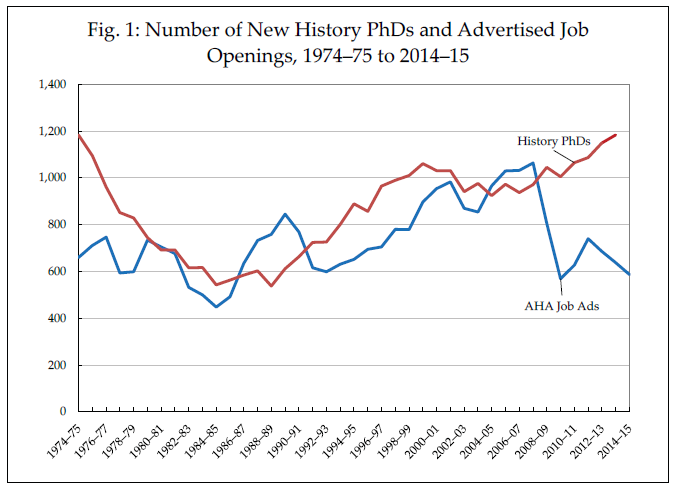
The reason people are grim is because the job market is bad. Here are the latest job figures, as compared to the number of new PhD degrees. So at the moment it is a very small watering hole and a lot of restless animals. There are other changes in the nature of at least the American university system which do not make many people think that this is going to be resolved anytime soon (e.g. the increasing reliance on adjunct labor).
But any good historian will also tell you that 1. we can't predict the future (if you started a PhD program today, you'd be looking for jobs in 6-10 years, and so who knows what will happen between now and then), 2. people are more than the numbers, and 3. jobs are not allocated on a random, lottery basis and so there are ways you can increase your odds (the program you get your PhD from matters immensely, and there are many choices with regards to your area of study that can help you stand out from the pool, maximize your chances, etc.). And, again, we don't know how those numbers are going to change over time. If you look at the graph again, you'll see that the situation we are in now is as worse as it has been since about 1975. But thing did improve after that crash. What we haven't seen yet is a decline in the number of PhDs produced — and that is a bad sign, since the number of jobs produced has never been at that level. So clearly not everyone with a PhD is going to get a job even in the most optimistic of worlds, which would ignore the fact that there is a 4-5 year "queue" of people who got their PhD and are still trying to get permanent jobs. Even very "bad" jobs — e.g. in remote locations at underfunded institutions — get on the order of a hundred in the current market. "Good" jobs — in places people prefer to live in, like big urban areas, or at places with high prestige/funding — get hundreds of applicants, including many from people with very good "academic pedigrees."
But this is why people are grim. And why, if you are going to pursue this path, you should do it with eyes very much wide-open. Don't be a wishful thinker about it — there is no guarantee that "something will work out." Be strategic, be aware of the issues, be deliberate in your choices.
Since some people are in anecdote mode, I am a tenure-track assistant professor in history, having got this appointment in 2014. Things have worked out pretty well in the end for me but there were times of massive uncertainty. I started grad school in 2004, which, as you can note from the graph linked to above, was a "boom" year. In 2008 the entire market dropped to nothing. I graduated in 2010. I had two postdocs, and then got my present job. Of my PhD cohort of 8 incoming students, only three others are tenure-track professors. Two are in some kind of postdocs (a temporary position), one left academia for a career in a major government agency, one has a good position in a museum/archive, and one ended up dropping out of the program after maybe 10 years and has rather marginal employment at the moment. This gives you a sense of the odds involved. Not impossible. But not easy. And this was for a very prestigious university — things are harder if your degree program is less prestigious.
I feel very fortunate to be able to do what I do. It is a pretty great job. I teach three days a week, and the rest of the time I spend doing research, working on projects, going to talks, or just enjoying having a relatively large amount of freedom compared to most people in the world. (I spend about half of every Friday just wandering around New York City, taking it in as a form of exercise — who else gets to do that, and still get paid?) It is pretty wonderful, even taking into the account all of the little things one might complain about (inadequate compensation, endless grading, committee meetings, departmental drama, and all of the other things that come with any real-world job). I had to be both very good and very lucky to get my job. It happened to work out in my case. (And my wife managed to get a great job in the same area at the same time — we really beat the odds on that one.) But there are other people who I know who are also very good, but were not so lucky. (And one also runs into people who are very lucky but not so good — so frustrating!) So it is definitely a crapshoot.
I'm not saying "don't do it," but I am saying, if you are going to pursue the degree, go into it knowing what it is, and have several plans in mind about what you might do with it. And be aware that many of the people who currently have tenured positions got their jobs under very different circumstances (refer to the graph! If they got their job in the 1990s they will have experienced a completely different job market) and may or may not be aware at how difficult it is currently. Do not be lured in by their nice-sounding platitudes about how things will always work out! They don't suffer if you don't get a job — you do! So look out for yourself.
As someone who is doing a Masters in early 20th century Chinese gender history, work on languages as soon as possible. I cannot emphasis this enough. My Mandarin is good enough, but I am limited in classical Chinese. I also need to get my Japanese started. Even if your interests in lie in US history, language may be of benefit and helps to set one apart. Perhaps Latin, French, Spanish, or aboriginal languages will help your research.
Their have been comments on here about funding and price. Don't be afraid to go abroad. The competition is lighter and funding opportunities are much better. I had the fortune of getting a great scholarship package at my current institution. And if you don't find competitive packages, at the very least universities abroad are significantly cheaper than the US.
Since you've heard from the professors... did you know you don't have to be a professor? Check out this old AMA we did in /r/teenagers for jobs that are a different path. You should also look at public history materials, there's the NCPH and various masters programs you can read up on.
Cultural heritage jobs (meaning libraries, museums, archives, art galleries, parks, etc) are also a tough market, but it's largely stable after the 2008 stuff. You are not guaranteed a job by any means, and if you're not the very best (like no one ever was), you should probably jump ship earlier than later on this field. But there is interesting, satisfying work in history that does not require tenure packets and grading papers.
I am studying for a teacher's degree in Germany. My majors are history and english studies.
In addition to all the other (great) advice so far:
This is the time to learn another language, besides english. I am taking a course in Roman history this semester and took one in Latin American studies last semester and struggle with not knowing Spanish and proficient classical Latin/Greek. It will only get you so far learning the translations. If you want to succeed and work with enough sources, you need to know the language associated with it.