Or was it more of a "Oh, that. Meh, it's been there forever" thing?
I only ask because it recently struck me just how long some ruins in southern Europe have been around.
Related question/expansion on OP's question: in one of Dan Carlin's Hardcore History podcasts (the one about the "dark ages" specifically), he essentially claims that there were people post-fall of Rome who would walk around seeing huge old roman aqueducts and other public works, and legitimately wonder "what kind of giant humans once roamed the earth could have built those??"
I've always wondered how he came to this conclusion. Did some uneducated people genuinely believe that certain Roman era architecture was manufactured by a giant race of humans, as opposed to engineering masterminds of the past?
I have less experience with Rome of say, the 9th or 10th century, but in the early to mid-1300's we have authors like Dante and Petrarch writing about the past glory of Rome, and the sense of nostalgic mourning they feel when they look at the ancient ruins that surround them. (Some scholars consider the great Tuscan triad of Dante, Petrarch and Boccaccio to be medieval authors, some consider them to be Renaissance. How you categorize them seems to depend on your scholarly biases, and if you study the medieval era or the Renaissance.)
In 1367/1368 Petrarch visited Rome, and wrote:
Although when I first... went to Rome, almost nothing was left of that old Rome but an outline or an image, and only the ruins bore witness to its bygone greatness, nonetheless, among those ashes there were still some noble sparks; but not the ash is long extinguished and grown cold.
Almost two decades earlier, Petrarch wrote letters to his long-dead ancient Roman heroes, and his texts for Marcus Tullius Cicero and Livy have a similarly melancholy undercurrent. He yearns to be enfolded into their world, but he is deeply aware of his own inadequacies and those he perceives in his 'modern' Italy. He is surrounded by the vestiges of these authors’ lost world–architectural remnants, sculpture, texts–but physical proximity is not emotional proximity, and roughly a thousand years of history separate him from his heroes. He signs his letter to Cicero:
Written in the land of the living; on the right bank of the Adige, in Verona, a city of Transpalpine Gaul; on the 16th of June, and in the year of that God whom you never knew 1345.
My favorite academic text for dealing with the late medieval longing for and perceptions of Antiquity would probably be Leonard Barkan's Unearthing the Past: Archaeology and Aesthetics in the Making of Renaissance Culture. If you're looking for something more in terms of an armchair read, I would recommend Ingrid Rowland's “Roma aeterna. Ancient Rome in the perception of Middle Ages, Renaissance and modern times,” in The Cambridge Companion to Ancient Rome or Marina Belozerskaya's To Wake the Dead: A Renaissance Merchant and the Birth of Archaeology.
Seeing as there is an outright maniacal obsession held by the German Kaisers with descending into Italy and finding a Bishop to crown them "Holy Roman Emperor" I would say the memory of Rome was alive and well, at least among the intellectualloid class after the crowning of Charlemagne (the word "Rennaisance" literally refers to the "Rediscovery" and "Rebirth" of what were perceived as classical-era values and aesthetic).
You might argue for some decline of Roman-ness between the sixth and eighth centuries, but I would say it varied depending on where you were. There's a scholar of the city of Rome who could tell you to what extent Imperial-era buildings were abandoned in Rome, but keep in mind that the circumference of the Aurelian Walls is absolutely mind-mindbogglingly massive, so there's a pretty unique phenomenon occurring in the fact that when the city population started to grow again the city center moved farther north while still remaining within the city walls, leaving behind a large number of ruins within those same city walls.
Milan, for example, had a much more complex hydrography than Rome, making sprawl difficult and resulting in a very dense urban landscape. As a result, you have fewer "ruins" for the populace wonder about because old buildings were being re-purposed. Look at the Basilica of St. Lawrence from behind for example, you can see three different architectural styles in the same building! In fact, the word "Basilica" used to denote a church with special privileges (often but not always the oldest church in an episcopal seat) comes from a Roman word denoting a judicial building where the negotiation of business and legal contracts were stipulated. The Basilica of St. Lawrence is one such building.
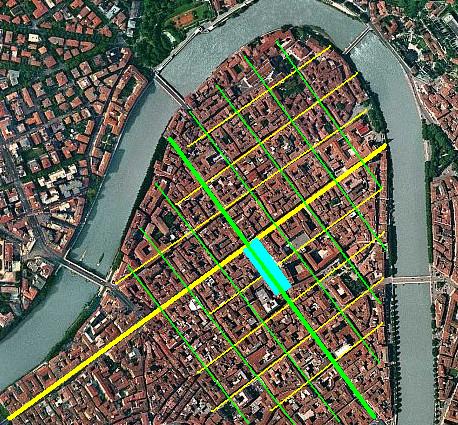
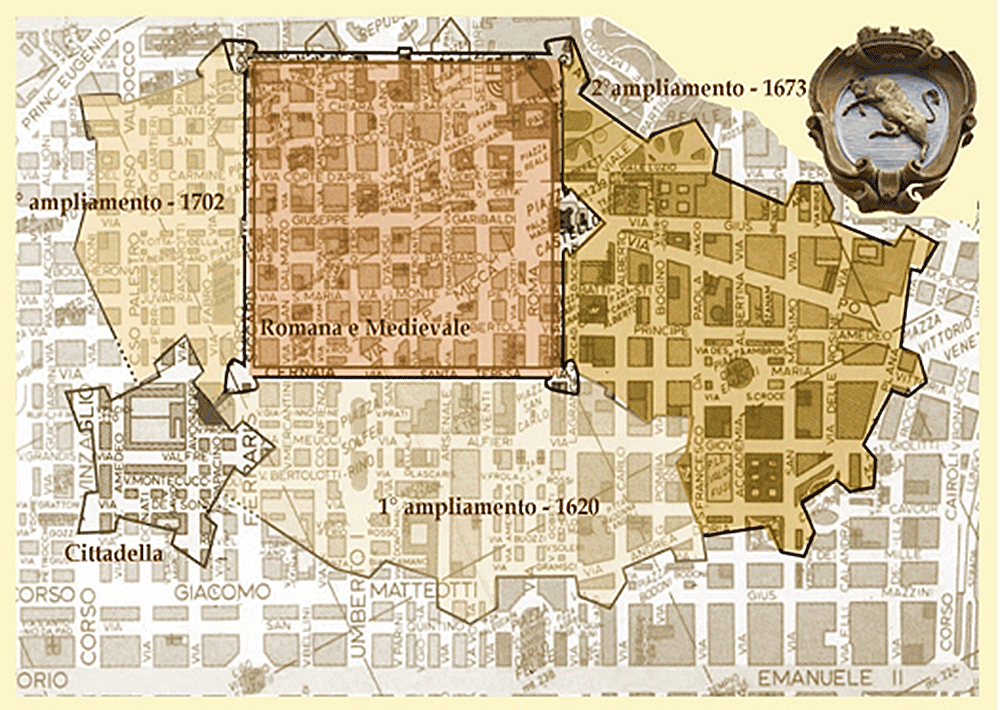
Similar things happened in other northern cities like Verona, where the old Roman center is the current urban center. Same goes for Turin, which didn't expand beyond its Roman walls until the 17th century.
Maybe in the south of Italy you have more ruins unattached to urban environments; I actually don't know. However, I do know that large Roman-Era cities (Neapolis, Brundisium and Tarentium) continued to be inhabited through the medieval era to the present day, Neapolis is modern Napoli, Italy's third-largest city (although Brundisium and Tarentium were eclipsed in importance by Bari).
Unfortunately, we can't know if the memory of Rome was still alive among the people who weren't doing any writing, crowning Holy Roman Emperors. or re-purposing basilicas without some elaborate guesswork.
Avete, moderatores!
This thread's unfortunately seen a whole pile of incorrect, speculative, or otherwise disallowed comments, though in a rare break from routine none of them have so far been asking about all the removed comments (woohoo!). We realise discussions of Ancient Rome are highly popular and very intriguing, but would like to remind everyone that /r/AskHistorians is actively moderated, and contributions which fail to meet our stringent standards will be judged accordingly.
Additionally, it is unfair to the OP to further derail this thread with off topic conversation, so if anyone has further questions or concerns, I would ask that they be directed to modmail, or a META thread. Thank you!