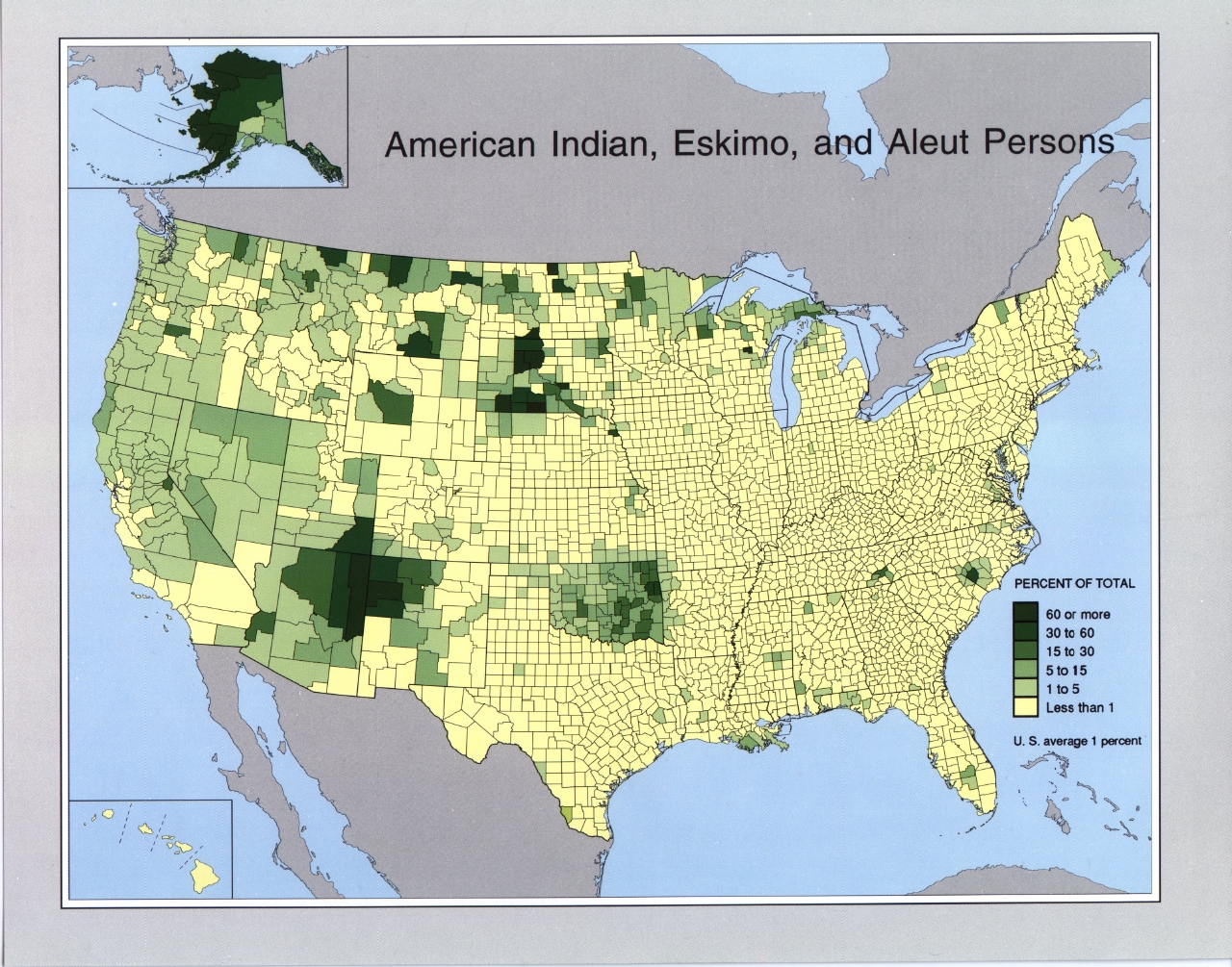
The previous answer that darkened areas are simply reservations is partially, but not wholly correct. The largest dark area in the Four Corners region is a good counterexample, because that's where the Hopi and Navajo reservations are. The Hopi and the Navajo (among other Four Corners tribes) are rather unique groups when it comes to aboriginal policy because they retained the core of their ancestral homelands through Spanish and American colonialism.
So the question becomes: Why did the Four Corners groups retain their homelands while those in other regions largely did not? There are a couple of broad reasons.
The Hopi successfully maintained independence from the Spanish and thus there was no colonialist system for the US to inherit over their area.
The Navajo had both an extremely high population and very strong resistance to settlers, leading to relative depopulation near them.
The Four Corners region is mostly very arid, high altitude plains. Farming is difficult without very specific geologic features, features that had already been exploited for thousands of years by Hopi and Puebloan peoples.