Just a note to anyone that answers this question knows, I know absolutely nothing about precolonial African kingdoms so please forgive me
So I saw the above quote from R. Guisepi's Africa and The Africans In The Age Of The Atlantic Slave Trade, (1992) & it struck me as an interesting statement for several reasons; the relationship between the mass-production of firearms & the precolonial contacts that brought African kingdoms into contact with said guns, the psychological effects that this would've had on the civilians living under this regime & how that would shift thinking within the country from order to disorder & if this would have any impact on the wider picture of slavery in the Caribbean.
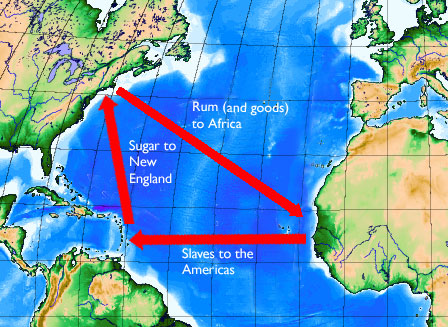
Not only that but the fact that when taught about the slave trade in schools we're mostly taught about the supposed "triangular" nature (e.g. Abduction of slaves >> transportation to West Indies >> Transportation of goods brought back from the WI to the colonial powers) of the trade as depicted here & never what was happening before, after or as a result of the trade in the African kingdoms. (even though in the UK with the new reforms we're starting to slowly broaden our horizons historically to other topics. but that's another story entirely)
Thank you for any help :)
First off the "triangle" doesn't refer to Africa-Caribbean-North America but to Europe-Africa-Americas. This was a pretty complex arrangement that is simplified to get a sense of their economic interdependence.
Guns were an important part of the trade and most cultures would willingly trade for them since they provide an obvious force advantage. Even if guns weren't prima facie desirable to one group, a competing group would be willing to trade for them which would shift a local balance of power. This is an example of how large scale slaving was undertaken. In guns-for-slaves you provide guns to the groups who are willing to give you slaves, and guns reenforce your ability to get slaves. Guns allow you to win at war, and you trade the men you capture for more guns. The trade in slaves was the cheapest and easiest way to get guns so it is self reenforcing. The arms trade, legal and illegal, still shapes Africa to this day and would be hard to overstate.
Here's one recentish paper on the economics of the trade.
Guns-for-Slaves: The 18th Century British Slave Trade in Africa