Cities in various historical time periods are often portrayed as crowded, bustling, and even chaotic. Massive throngs of people shuffle through each other and jostling seems to be the norm.
However, I've been thinking about the world's population increase over time, and it seems to me that the cities of today are just... more populated than ever before. Looking up my modest current residential area of Ann Arbor, Michigan, the city's population density is about 4,000 people per square mile according to the city's Wikipedia page.
By comparison, the estimated population of Florence during the Renaissance period was 60,000 according to this Wikipedia page. When combined with the total area of the city according to the Florence Wikipedia page, we can calculate that 60,000/39.54 = 1,518 people per square mile.
I've never felt jostled or crowded in Ann Arbor outside of specific events, despite its apparent 2.5x person density when compared to Renaissance Florence. Are these numbers misleading due to the number of individuals that traveled into Florence's streets from the surrounding land (much like modern day work commuters)? Were Florence's borders much smaller during the Renaissance? Did people more tightly concentrate in various areas during the Renaissance? Were people on the streets more instead of inside buildings like today?
I'd like information about what it was like to be on a street market in Florence during the Renaissance. Was it more crowded than my little American college town? Traveling to the street markets of Turin and Florence today, are the modern experiences more packed with people than similar events during the Renaissance in the same locations? In Renaissance Florence, could I have committed theft at a market and escaped into a crowd if someone was attempting to catch me?
The numbers at face value just seem to indicate that I'd be incredibly comfortable walking around Renaissance Florence with relatively little "hustle and bustle", if you will. I heard that the Medici family often traveled above the city instead of on its streets due to concern for safety, but it just seems to me like there just wouldn't have been enough chaos on the streets to warrant anything more than a pair of guards. This claim itself might need some clearing up, but it's nevertheless an ubiquitous trope in popular culture that "nobility" is unsafe in the chaotic streets with the "rabble". How accurate are these portrayals (say, specifically in Game of Thrones' markets in Braavos and King's Landing).
I'd start by saying that current city of Florence has city limits in no way comparable to those of the Renaissance city of Florence. Urbanization, suburbanization, and city sprawl had enlarged Florence far beyond it's old boundaries! This image traces the renaissance walls of Florence on an image of the modern city.
So how much more bustling was Renaissance Florence compared to the modern city? In his Public life in Renaissance Florence, which I am citing even if I'm not too crazy about everything about it, Richard Trexler places the tax-paying (and thus working) male Florentine population at around 5,600 people in a city of around 40,000 inhabitants in the 15th century. Add maybe a few thousand women and foreigners/commuters, and that would put the people conducting their business in the city's streets at what, 10,000 at the most? All told, that wouldn't be very crowded, right? Well, evaluating "crowding" is tougher than you think. Certainly, Florence was less crowded following the plague and construction of the new walls in the 14th century, which respectively reduced population and expanded the city's size from .28 square miles to 1.66 square miles. So according to Trexler;
The area of the city within the third and final set of walls easily accommodated the reduced population of the Renaissance. The construction of large Renaissance palaces in the center city during the fifteenth century certainly complicated the lives of displaced artisans, but it does not seem to have brought about any significant housing development in the sizable open areas within the walls. In 1530, the large garden areas in the city and the generally uninhabited hills in the southeast quadrant remained intact. Population density [...] was never a pressing problem in late medieval or Renaissance Florence.
So crowding like you see in dramatic TV/movie scenes wasn't a problem, but crunching the numbers the conclusion is that the city was still absurdly dense; even if there were some wide open spaces and large palaces, for the most part apartments were small and streets were narrow. We can calculate a specific number: 40,000 inhabitants in 1.66 square miles (430 hectares) puts density at little over 24,000 per square mile. That's almost 360 times denser than Manhattan is today.
And keep in mind, Trexler's estimate is post-Black Plague. Estimates of Florence's population just prior to the black plague in the mid-14th century like to place it at about 100,000 inhabitants. If we assume this means the city had a population of around 80,000 in the second half of the 13th century, as Franco Cardini does in his Breve Storia di Firenze, that would place population density at over eight hundred times the density of Manhattan, seeing as the pre-expansion walls of Florence enclosed an area of circa 0.28 square miles.
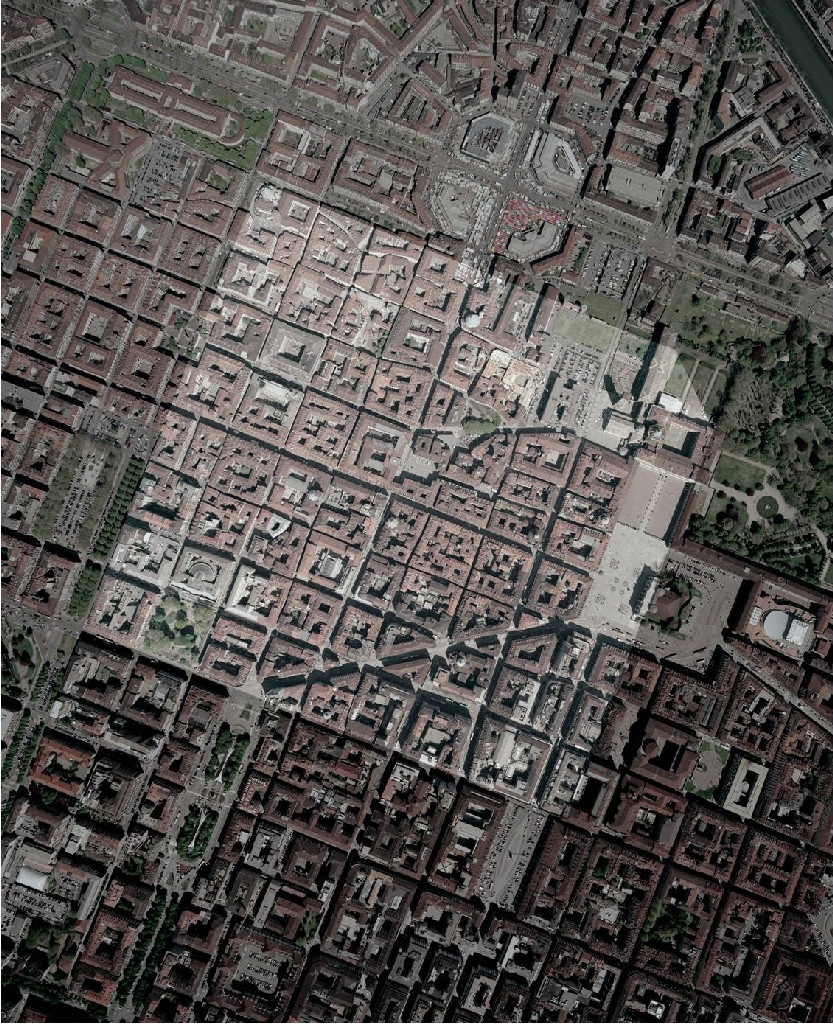
Same goes for many other renaissance cities. Since you specifically asked; Turin was dramatically remolded in the late 18th and early 19th century to have wide arcade-lined boulevards suitable for royal processions, and then exploded in growth after the Industrial Revolution. It's tough to grasp what the medieval city must have looked like, the city today is totally different: Turin had always been a relatively modest possession of the house of Savoy; the first expansion of the Roman-era grid and walls (here superimposed on the modern street grid) occurred in 1568, seven years after Duke Emanuel Filibert "Ironhead" transferred the capital there from Chambray.