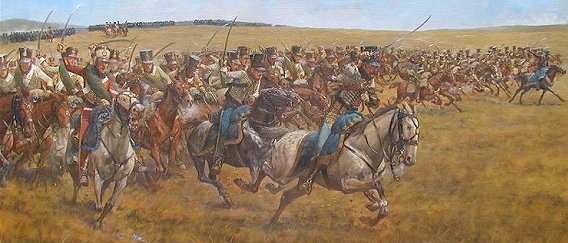
During the 16th and 17th century armored lancers were largely replaced by pistol or harquebus armed cavalry who would deliver a volley at close range while charging and then either wheel away or follow through with their swords. During the napoleonic wars and later, aside from mounted infantry like dragoons, cavalry seem to be generally depicted as charging forward with sword-point only. example
When and why did the close range volley stop being used while charging?
The battle of Blenheim in 1704 marks the decisive point in time when the pistol volley and wheel away tactic was supplemented by the straight charge with the sword. Most of this driven by the Duke of Marlborough.
The Duke wanted his cavalry to be free from distraction whilst in the saddle. He felt the demands of cumbersome and unreliable firearms at the time (100 years prior to the Napoleonic wars) detracted from a cavalry squadron's fighting effectiveness.
Marlborough believed it was important for the cavalry to "handle their swords well, which is the only weapon our British Horse makes use of when they charge the enemy; more than this is superfluous."
To underline this point, Marlborough issued the horsemen with just three rounds per trooper, PER campaign. The cavalrymen was only to use his hand-gun if surprised into defensive action - such as being ambushed during foraging. The pistol was not part of the battle drill for his armies.
Marlborough's French opponents on the other hand, preferred to use the armed horseman as a mounted bearer of carbine or pistols. French cavalry would usually be sent at a trot towards the enemy, discharge their volleys at close range, then retire to reload. This was partly out of necessity on the French part, as decades of constant warfare had drained the French of horses strong enough to maintain the physical demands of a repeated charge. With the demand for greater numbers of Cavalry regiments, the French simply stuck to the old, trusted tactics.
The combination of French conservatism in tactics and Marlborough's new innovations would prove disastrous for the French. Marlborough's cavalry went on to play a decisive part at Blenheim, while his infantry pinned down the French flanks his horsemen delivered a crushing blow with 80 cavalry squadrons against the French centre, resulting in the first major defeat of a French in 40 years, and the French army losing over 30,000 casualties and having its commander-in-chief captured.
Source: Blenheim: The Battle For Europe : Charles Spencer