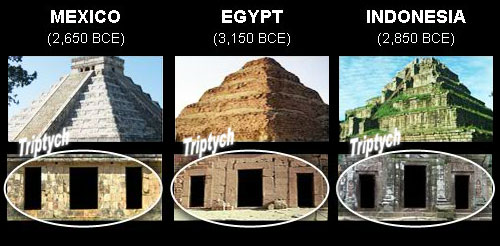
Occasionally I will see a picture floating around the internet that shows the Mayan, Egyptian, and Indonesian Pyramids, each with the same 3 doors. Are these pictures accurate, do they really each have these similarities? Or is this fake?
You've stumbled upon a classic!
This comparison, and others like it, are a mainstay of hyperdiffusionist theories that imagine some ancient globe-spanning Mother Culture. Such theories assume that either life-long archaeologists are stupider than someone who's never left their own basement, or that archaeologists have some motivation to hide exciting new discoveries- an idea proved false with one glance at an archaeologist's pocketbook. Sometimes the theorists twist facts or prey on supposed gaps in knowledge to peddle their secrets, but this is no such case. This image really is just wrong.
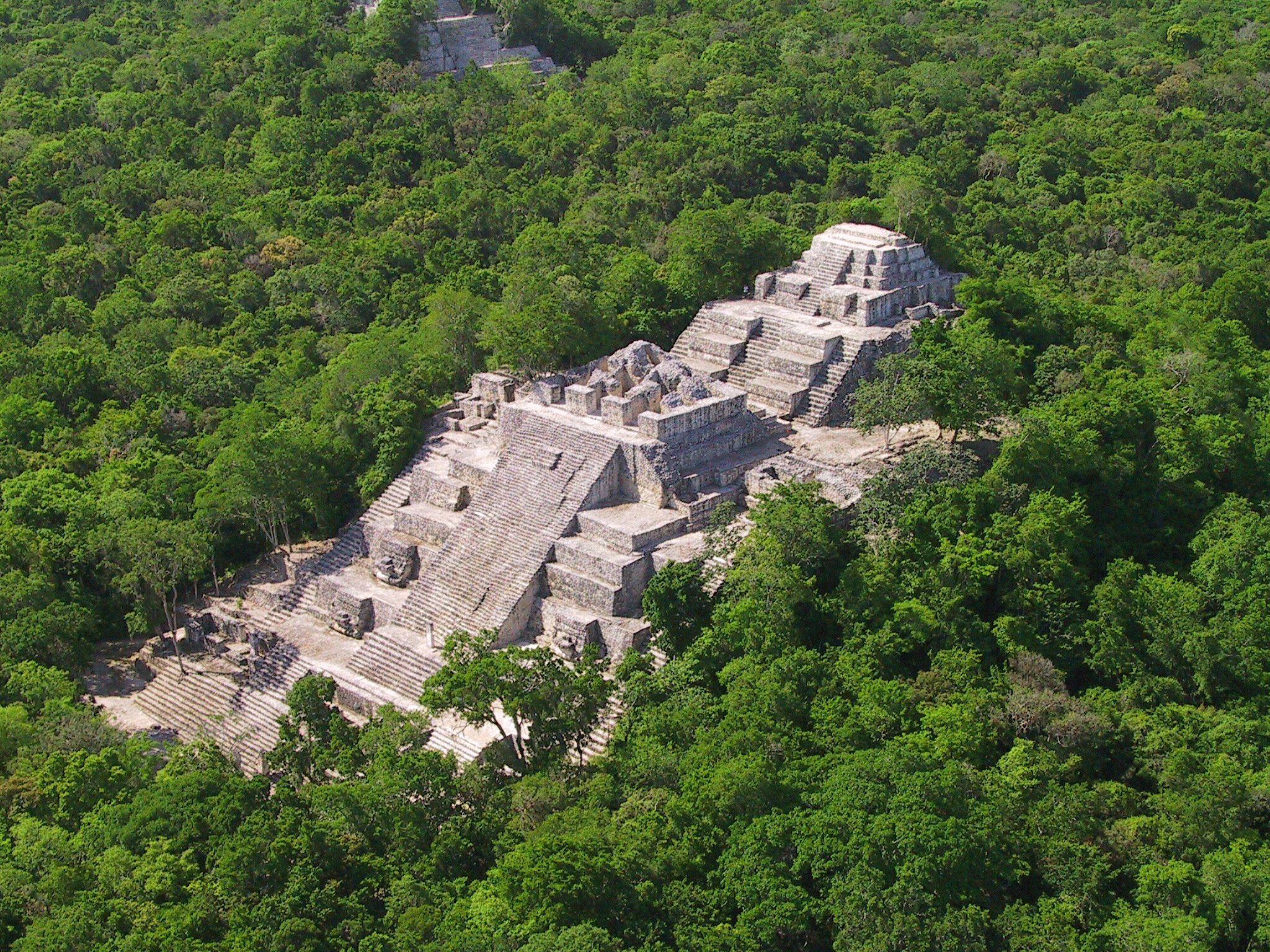
The pyramid shown for Mexico is El Castillo in the famous Terminal/Post-Classic Maya city Chichén Itzá. It was constructed no earlier than 900 AD. Let's give a little more leniency. The earliest culture to build similarly style pyramids was the Olmec, but the given data of 2650 BC predates their major cities (e.g. San Lorenzo) by at least 550 years. The doorway pictures are too small to reliably source, but the inset is definitely not the same pyramid. You can, however, see that El Castillo does have three entryways at its peak. Apparently we just have to ignore that the other side obviously only has one. There are other examples of pyramids in Mexico with three doorways (Calakmul, Xunantunich). There are plenty of temples without them, like those at Tikal. If the "triptych" is so important, why does it appear so inconsistently?
The Egyptian pyramid was built for king Djoser, a 3rd dynasty ruler, sometime in the early 27th century BC. The structure, an extrapolation of the earlier mastaba burial monuments, is the earliest of its kind- yet our image once more gives a date 500 years prior. Unlike Mesoamerican pyramids, it itself is not meant to be accessed. Instead, there was a large mortuary complex where family and others could pay their respects and perform rituals to ensure the king a quality afterlife. Notably, all the entrance to Djoser's complex are single passages. I have yet to find an example of this "triptych" in a pyramid complex. "Proper" temples like those at Abu Simbel and Luxor are not tripartite either; they have a single passage lined with pylons and colonnades, called hypostyle halls.
The "Indonesian pyramid" is actually from Cambodia. It's the central temple of a city called Koh Ker, contemporaneous with the more well known Angkor Wat (and, coincidentally, Chichen Itza). I have no authority on the region, but it's not hard to tell that Koh Ker doesn't have an entrance anymore. Similar structures still have their shrines at the peak, but these are tall, single-door structures. See this one at Angkor and this in Bakong.
The origin of this image tells us the dates, pyramids, and doorways should be connected. If it is, as the site tells us, the "chief symbol" of an ancient "Universal Religion," we should expect it to be treated as such. Yet even if we saw three doors on all of the aforementioned structures, it would mean very little. Why is that?
The operative word is "context." In archaeology, the study of the material past, context is practically everything. As specific data points, context is where and how things were found. As an applied concept, context is how things relate to each other. Archaeologists do not analyze individual artifacts, we analyze assemblages of artifacts. That doesn't mean we don't write entire articles on a single jar, but that any observations about said jar must be related to other jars, to nearby artifacts, and to the place it was found before we can begin talking about meaning or significance. We don't look for similar things, we look for similar things in similar contexts. Suppose I'm a future excavator looking at a 21st century city. I've collected a whole catalog of artifacts with crosses on them. Obviously these were all associated with earlier forms of Christianity, right? All these pendants and jewelry must be connected to the same symbols we see in churches.
Alas, by not considering context I have just added another member to the local Diocese: Hot Topic.
That is precisely why we can't take a single trait, like doorways, and make any conclusions from them, no matter how similar and ubiquitous they might be. Comparing doors from a public space for congregational religion (cathedrals) to those on a private mortuary complex is akin to comparing cruciform decor from a cathedral and a store for try-hard emos.


.jpg)