I am doing (or my girlfriend is, really) a project in The Sims modeling the middle ages. Western Europe is a cinch, but I'd also love to try to recreate the Islamic Golden Age and the most advanced medieval civilization :) However, I'm having a hard time finding any info on what would have been prominent in Arab civilization in the Middle Ages. What buildings and structures were prominent and, moreover, what played a major role in people's lives other than religion?
In a beautiful book that dispels many myths about the backwardness of Arab societies, Richard Bulliet notes:
Whoever has attempted to characterize medieval Middle Eastern and North African cities has sooner or later commented upon the narrow streets, the blind corners, the encroachment of buildings upon the public way, and in general upon the labyrinthine quality that strikes so forcibly the Western visitor. (Camel and the Wheel, 223)
Bulliet's entire book is about explaining why this type of urban layout made sense, and he argues that it arose at the same time that the camel became the preferred mode of transport (versus the wagon) across North Africa, the Middle East, and Central Asia. This isn't straight technological determinism, however, since nobody 'invented' the camel (although harnessing and saddling became better adapted), nor did Near Easterners ever forget about the wheel (which they still used for a number of other different things). Instead, camel caravans made increasing sense, as the Islamic states that succeeded the Roman Empire streamlined government, abandoning road repair but also taxing trade less and intervening less directly into the affairs of urban families. From a broad perspective, the transition from Roman boats and wagons to Arab camel caravans on the 'inland sea' of the deserts demanded the careful maintenance of bridges and the construction of caravanserais (inns built around courtyards at watering holes across the desert). But what were the advantages for urban life?
And in fact, narrow, winding streets have much to recommend them. They easily follow the lay of the land; in hot countries they provide shade; they diminish winds; they permit a higher density of habitation which in turn makes a sizable city accessible to pedestrians; they facilitate social relationships; and they are easily defensible. (Camel and the Wheel, 225)
Okay, so what kinds of buildings take over in these towns? There's a great article by Hugh Kennedy which might be worth a read. He examines some of the same discontinuities of urban design and planning that Bulliet had noted: (1) streets – broad and straight classical colonnades were abandoned for narrow winding paths and cul-de-sacs, (2) commercial areas – open centers or squares (Roman fora, Greek agora) were replaced by narrow lanes (suqs, like in the movie Alladin), (3) the open gathering spaces of mosques replaced the collective functions of Christian and classical church, agora, theater, court, and school.
Kennedy presents a somewhat more pessimistic view than Bulliet, emphasizing that these new developments were neither planned nor ordered. Islamic central government was less elaborate than the Roman, and civic patronage dwindled in the 500s—a big part of how Roman families had built their prestige was by dedicating public buildings or hosting public events, but this kind of prestige was no longer important during the Middle Ages. In Islamic areas, this was in part because whereas Roman law had focused on intersections of public and private lives, Islamic law focused on the freedom of the family unit. For what it's worth, Kennedy therefore describes the shift from the classical polis to Islamic madina as a long-term socio-economic and not a religio-cultural change.
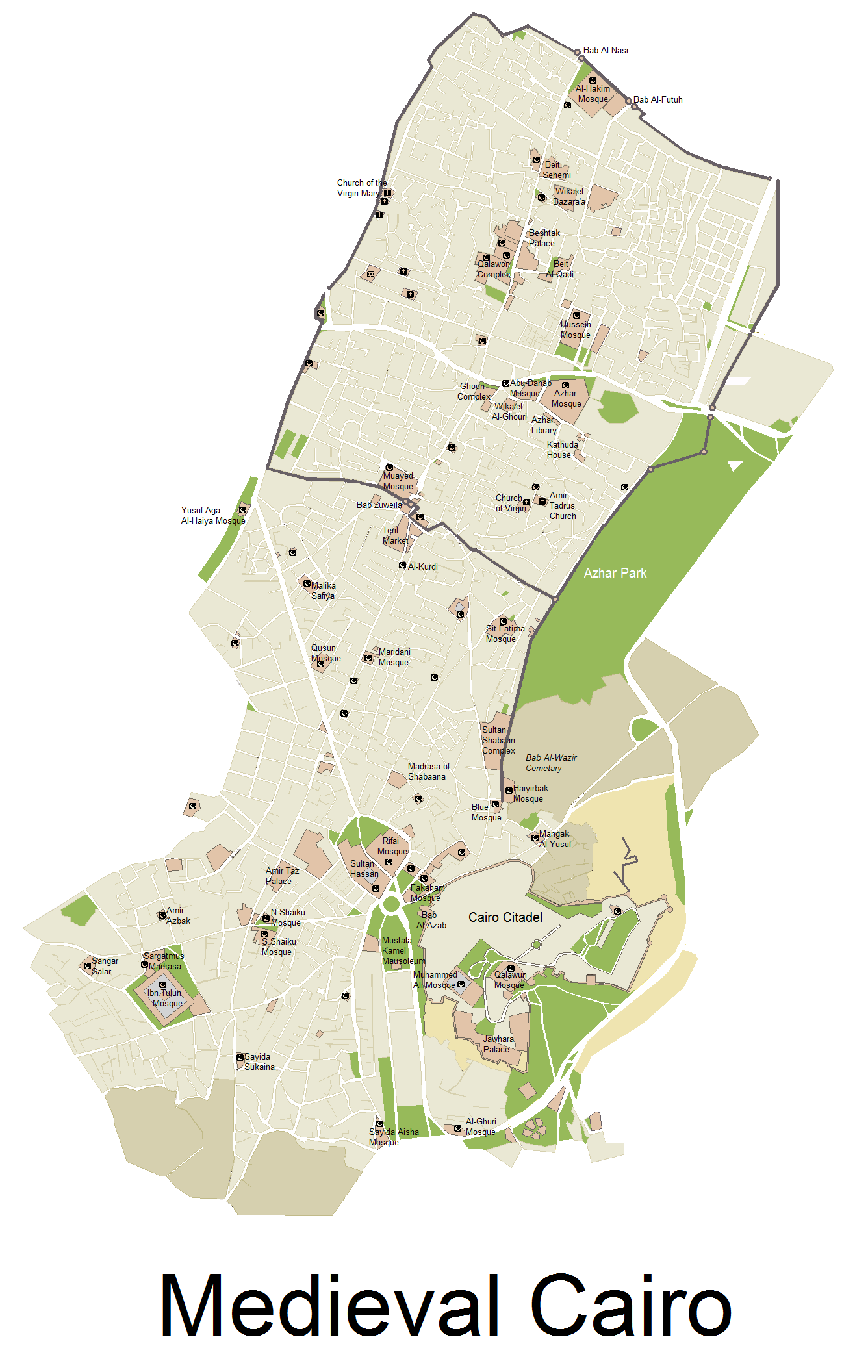
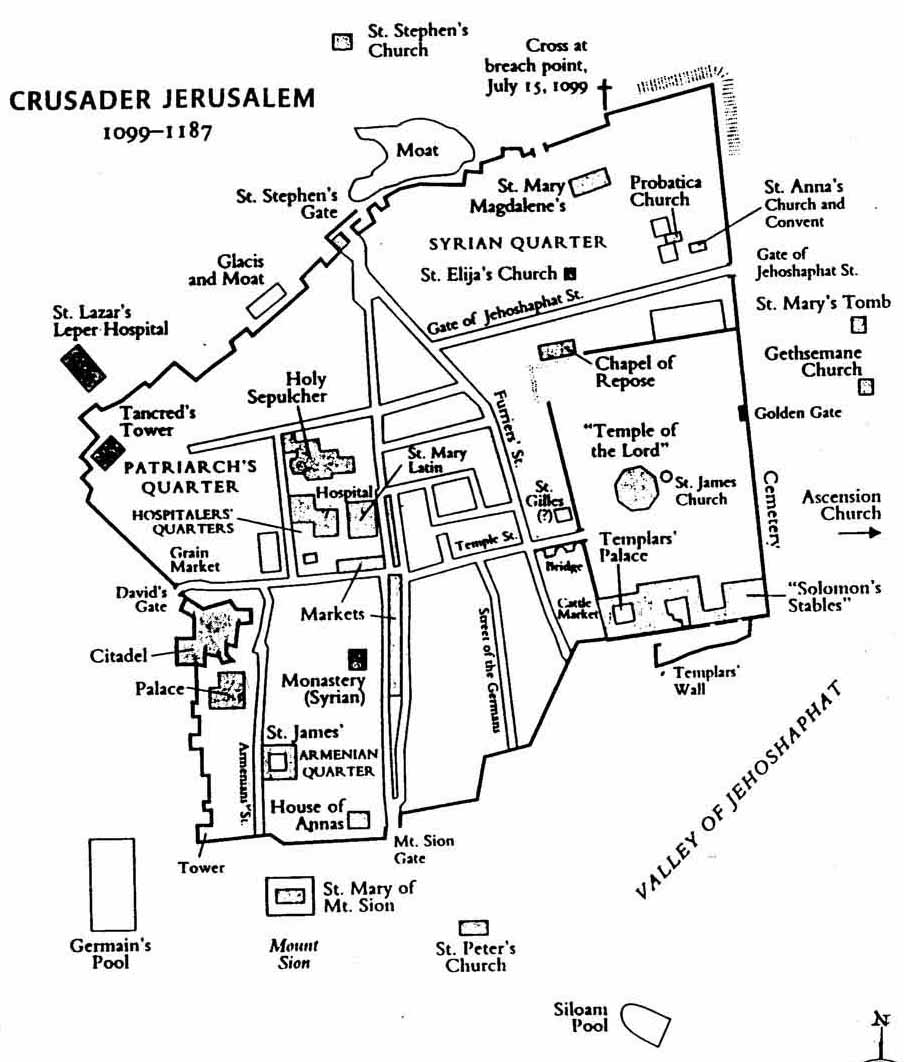
Since these cities weren't centrally planned, each city was unique—something that led to a lot of terrific literature as Arabic poets celebrated their hometowns. With a bit of fishing, you can turn up some decent maps of places like Cairo, Damascus, and Jerusalem. Hope that helps!
Richard W. Bulliet, The Camel and the Wheel (New York: Columbia University Press, 1990 [originally published 1975]).
Hugh Kennedy, “From Polis to Madina: Urban Change in Late Antique and Early Islamic Syria,” Past and Present 106 (1985), 3-27.
Not much played a major role in people's lives "other than religion" in medieval times, as religion mandated every aspect of everyday life. Still, if you mean "other than going to the mosque/church", there's a couple of buildings I can think of - hammams and suqs - public baths and marketplaces.
So, while marketplaces are marketplaces and I don't know if they were significantly different from western european markets in layout (in terms of goods being traded, they obviously did), hammans are non-existent in Western Europe. There are vestiges of hammams in Iberia, used and maintained during the islamic period, and buildings that survived to this day, but christianity, in the middle ages, didn't use them as "baths".
Arab public baths (and, just as well, we can name them turkish baths) result from the roman legacy added to an islamic precept of cleanliness. Looking for a text to source this, I found this cool page from the Metropolitan Museum, which has a much nicer look than reddit and contains a quick (enough for The Sims) rundown on what hammams are about.