Really interested in this.
Say the Mongol emperor had an urgent message to be delivered from Karakorum to Persia, how long would it take for a horseback rider to reach?
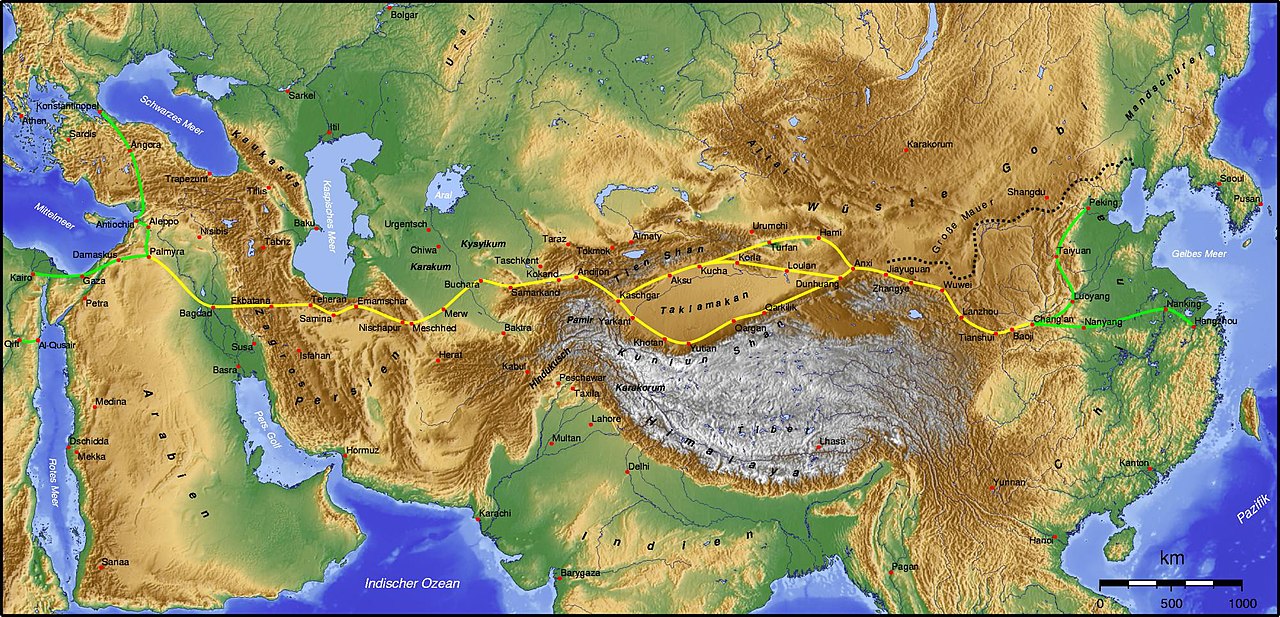
Okay, so a couple of things right off the bat. You don't seem to be talking about the Silk Road... the SR's traditionally thought of as beginning at Xi'an and it's land-based termini at and around Constantinople, Damascus, and other trading cities along the eastern coast of the Mediterranean and Black Seas.
What you seem to be curious about is instead the "Yam" or "Örtöö" system of the Mongol Empire which, rather than being a single(ish) route like we popularly concieve the Silk Road (though that's not actually the case, there were multiple routes). The Yam system was how the Mongol Khagans were able to ferry urgent messages back and forth across the vast stretches of Central Asia at a speed, for the 13th and 14th centuries, and even the way up through the early 20th, that was so blazingly fast it could hardly be believed.
That said, often no one person would make the journey, only the message would make the full transit. However, there are accounts of single riders making tremendous legs of the trip in a single go. From Genghis Khan: Conqueror of the World by Leo de Hartog, "There were some couriers who would ride for 2,000 km with only short pauses for rest. Probably many horses fell dead at this stage." We might think of it in a similar vein to the short-lived but iconic American Pony Express. Throughout the Mongol Empire, as stipulated by law in the Mongol Code, or Yassa, there would be relay stations spaced at vasious intervals, depending on the "type" of message it was.
From Marco Polo and His Travels:
Marco was equally impressed with the efficient communication system in the Mongol world. There were three main grades of dispatch, which may be rendered in modern terms as 'second class', 'first class', and 'On His Imperial Majesty's Service: Top Priority'. 'Second class' messages were carried by foot-runners, who had relay-stations three miles apart. Each messenger wore a special belt hung with small bells to announce his approach and ensure that his relief was out on the road and ready for a smooth takeover. This system enabled a message to cover the distance of a normal ten-day journey in 24 hours. At each three miles station a log was kept on the flow of messages and all the routes were patrolled by inspectors. 'First class' business was conveyed on horseback, with relay-stages of 25 miles.
The top class of mail for the most urgent of missive directly to and from the Great Khan to his generals, was in a class all its own. Again, relay stations were about 25 miles apart. A rider would be dispatched from whichever starting point and travel by horse to the next station as fast as humanly (horsely?) possible. Upon arrival, the message would be passed to the next horseman with his fresh horse and away he went. Through such a means, the message could travel faster and further than any single team of man and horse possibly could. Some estimates put the amount of ground covered in a single 24-hour period at between 200 and 300 mi... 5-10x further that even Mongolian mounted armies tended to travel under normal circumstances, even in wartime. Thus, the message would be able to outpace its intended recipient. From Vadime Elisseeff's The Silk Roads: Highways of Culture and Commerce:
A horse relay postal system was introduced by Ögedei in 1234. [...] The structure of the system was based on the building of a post station at stages equivalent to a day's journey; that is about 25-50 miles. The stations held stocks of horses and fodder for those who traveled. Normally, messenger traffic was about 25 miles a day, but express messengers could go much faster, 200-300 miles per day.
So that meant that word could - potentially, and in the case of a truly dire situation - word might be able to go from one side of the empire to the other in as little as a couple of weeks. That would have been a truly rare situation, however, and in general when people needed to move across the empire we have to expect much slower speeds...As an aside, imperial riders (as well as other protected classes like merchants and traders) were typically given a kind of "passport" or "imperial guarantee of safe passage" in the form of a paizi (牌子), a stamped and engraved golden plate conferring absolute imperial protection onto its bearer... and woe be unto the bandit stupid enough to accost an imperial messenger.
From the writings of first-hand European travellers like John of Plano Carpini and William of Rubruck, we can see at least some of the more well-travelled paths of the Yam system. One route went from Kiev into the heartland of Russia, across the Volga and Ordu Rivers. It then went on to a town called Yanikant in what is modern Kazakhstan. Further north the routes traversed the territory of Khwarism, crossed the Chu, Ili, and Emil Rivers and then into Xinjiang (called Omyl by the travellers). From there the routes crossed the Altai mountain range and into Mongolia proper, crossed the Khangai range and at least arrived a Karakhorum.
In the case of the Friar John of Plano Carpini (Giovanni da Pian del Carpine), who was one of the very few Europeans to willing enter Mongol territory, we get a good idea of the time frame one might expect for this nearly 3,000 mile journey. Since the Mongols he was presented to in Kiev understood him to be an emissary of European submission, they were trying to get him to the capital as quickly as possible, so that he could be present for the Kurultai ceremony to choose and coronate the next Great Khan. The trip took some 3 and a half months, in all, 106 days... and again, that was considered exceedingly fast. Nevertheless, he managed to endure the journey and arrive in time for the acclamation of Guyuk Khan to the position of Great Khan in mid-June 1247.
So, long story short: you might get a message across the Mongolian Empire in as little as 2 weeks if it were truly important. But if you wanted to make the trip yourself? You're talking a good third of a year at minimum, and that's only if you're going as fast as you reasonably can.
Of course, maybe you really are curious about the travel times of the Silk Road, instead... if that's the case I'll be happy to go into more detail about that.
And I'd be remiss if I didn't at least take a moment to plug The History of China Podcast! We're almost to episode #100, and the Tang Empire is about to explode into a civil war that rank at about #3 of the deadliest conflicts in human history...
Hi! The Mongol yam postal system had staging posts every 40km between major cities, where government-sanctioned riders, issued with passports (Paiza) could rest and change horses. A man, it is said, could get from Beijing to Baghdad in two weeks, while a letter, handed off from rider to rider, could make the journey in one.